
Logitech Q1 2027: Strong Liquidity and Profitability Supported by Tariff Refunds and Premium Product Demand
Logitech International’s Q1 2027 results reveal solid net income and liquidity, bolstered by tariff refunds and premium product sales, while advancing AI and B2B growth strategies.
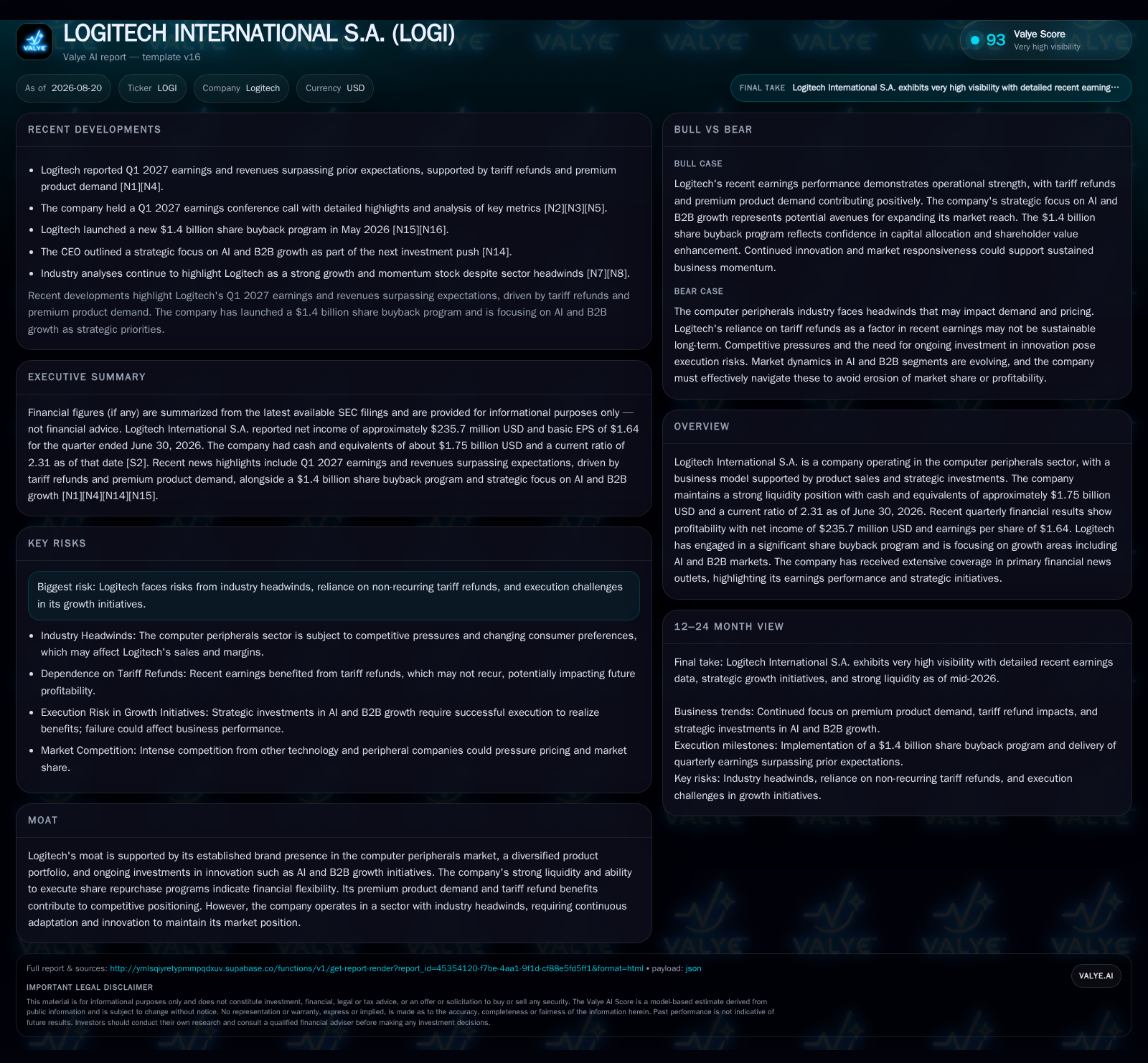
In Q1 2027 ended June 30, 2026, Logitech International reported net income of $235.7 million and earnings per share of $1.64, driven in part by non-recurring tariff refunds and strong demand for premium hardware products. The company held $1.75 billion in cash and equivalents with a current ratio of 2.31, supporting ongoing share repurchases and strategic investments. Logitech’s focus on AI and B2B markets offers potential growth avenues, though reliance on tariff refunds and execution risks in new initiatives present key considerations for sustainability.
Logitech International S.A. reported net income of $235.7 million and earnings per share of $1.64 for the first quarter of fiscal 2027, ended June 30, 2026, supported by tariff refunds and strong demand for premium hardware products [S2]. The company held $1.75 billion in cash and maintained a current ratio of 2.31 as of June 30, 2026 [F1]. These financial results demonstrate Logitech's reported profitability and liquidity levels for the quarter, which relate to its capital allocation and growth initiatives amid ongoing sector challenges [S2][F1].
Q1 2027 Financial Performance and Profitability
The Q1 2027 earnings beat was materially influenced by tariff refunds, which alleviated cost pressures associated with import duties. These refunds effectively reduced Logitech's cost of goods sold, thereby enhancing gross margins and contributing significantly to the quarter's profitability [S2][N1]. This non-recurring benefit played a pivotal role in the margin expansion observed during the period. Alongside tariff refunds, Logitech benefited from strong consumer and business demand for premium peripherals, including gaming accessories and software-enabled hardware solutions. The product mix skewed toward higher-margin premium items, which aligns with Logitech's strategic emphasis on innovation and diversification of its product portfolio [S2].
However, this reliance on tariff refunds introduces an element of uncertainty regarding the sustainability of current profitability levels. Should these refunds diminish or cease, Logitech could face margin compression unless it offsets the impact through growth in other segments or operational efficiencies. Maintaining strong demand for premium products may be important to sustaining profitability in the absence of tariff benefits. The company held cash and cash equivalents of approximately $1.75 billion, with current assets totaling $3.12 billion against current liabilities of $1.35 billion, resulting in a current ratio of 2.31 as of June 30, 2026 [F1]. This liquidity position may provide financial flexibility to fund growth initiatives, manage working capital needs, and pursue capital return programs without immediate refinancing concerns.
This capital allocation strategy demonstrates Logitech's commitment to enhancing shareholder value while balancing investments in strategic growth areas. These initiatives represent potential avenues for sustainable revenue growth and enhanced competitive positioning. The integration of AI technologies into peripherals and enterprise solutions could differentiate Logitech’s offerings in a competitive landscape increasingly driven by software-enabled hardware innovation.
Logitech's diversified product portfolio encompasses input devices, gaming accessories, and software-enabled hardware designed for both consumer and business customers [S1]. This breadth supports resilience amid sector challenges such as component shortages and fluctuating demand. The company’s established brand and innovation focus provide competitive advantages, although execution risks remain as growth initiatives require successful market acceptance and operational scaling.
Risks and Sustainability Considerations
A key risk factor for Logitech is its dependence on non-recurring tariff refunds that materially supported Q1 2027 earnings [S2][N1]. The temporary nature of these refunds means that a reduction or elimination could exert downward pressure on margins and net income if not offset by growth in AI, B2B, or premium product segments. Investors should be cautious in interpreting the current profitability as fully sustainable without these benefits.
Additionally, the broader industry context presents ongoing challenges. Logitech continues to face component shortages and extended supply chain lead times, particularly for semiconductors and base metals critical to its products [S1]. These constraints can impact product availability and cost structures, potentially affecting margins. Execution risks in scaling AI and B2B initiatives further add uncertainty to the company’s growth trajectory, as these areas require effective innovation, marketing, and operational capabilities to realize their potential.
Outlook and Watchpoints
Looking ahead, investors should closely monitor upcoming quarterly earnings releases for changes in tariff refund impacts and margin trends. The trajectory of revenue growth and margin contribution from AI and B2B segments will be critical indicators of Logitech’s ability to sustain and grow profitability beyond temporary tariff benefits. Additionally, cash flow generation and capital allocation decisions, including the pace and scale of share repurchases, will provide insights into the company’s financial discipline and strategic priorities.
The earnings beat and margin strength were materially supported by non-recurring tariff refunds and robust demand for premium hardware products, reflecting effective cost management and favorable product mix [S2]. Strategic focus on AI and B2B markets offers potential for future revenue growth and competitive differentiation, though execution risks and sector headwinds remain. The reliance on tariff refunds introduces uncertainty about the sustainability of current profitability levels, emphasizing the need for successful growth in new areas and continued premium product demand.
However, investors should remain aware of the temporary nature of tariff benefits and the operational risks inherent in growth initiatives. Future performance may depend on the company’s ability to translate its innovation and market positioning into sustainable earnings growth beyond the current quarter's favorable conditions.

Comments