
Pathfinder Bancorp Q2 2026: Strong Local Deposit Base Supports Funding Stability and Balance Sheet Strategy
Pathfinder Bancorp’s leading deposit market share in Oswego County underpins funding stability amid a strategic asset mix shift in mid-2026.
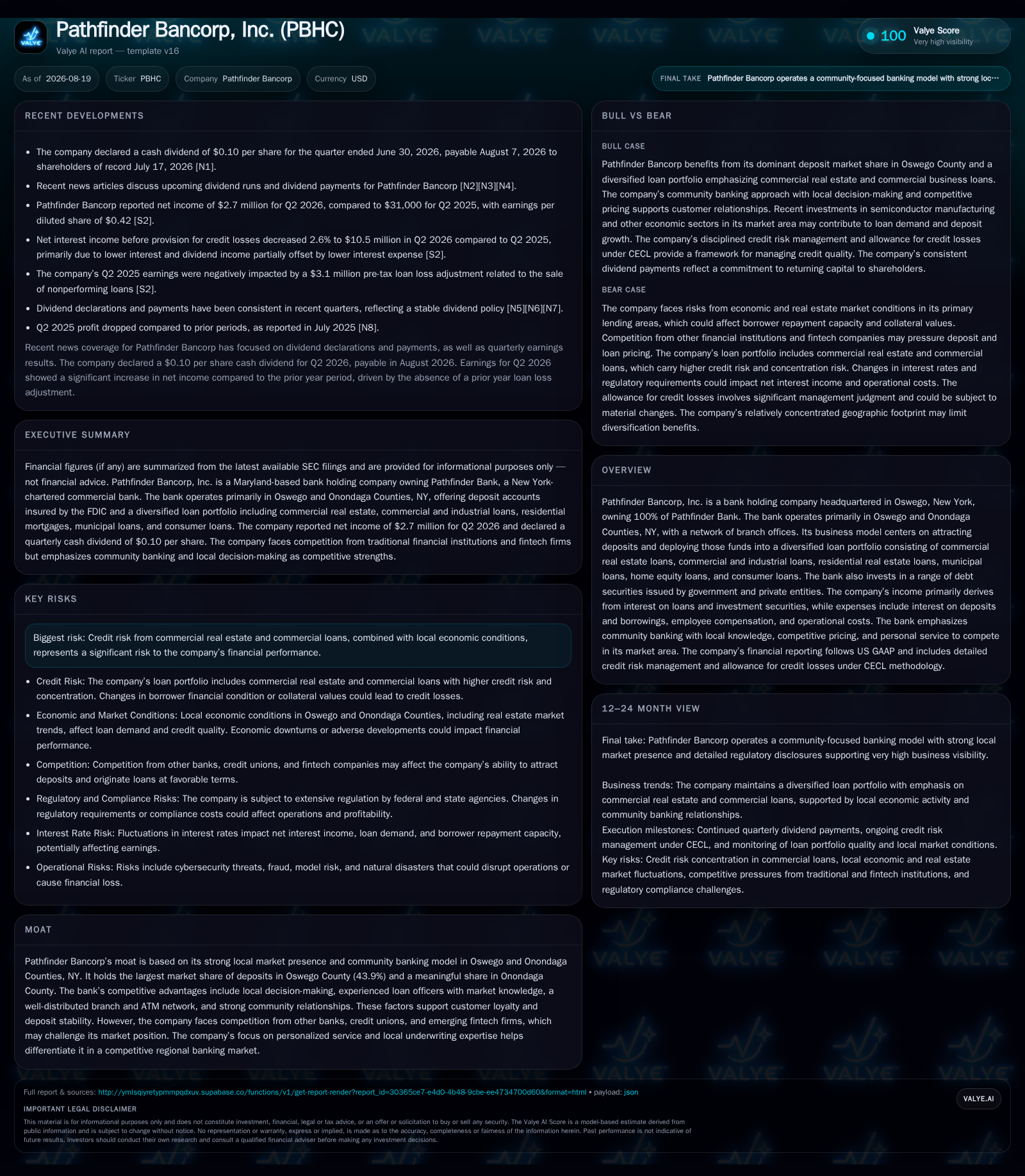
At June 30, 2026, Pathfinder Bancorp reported a 4.6% increase in total assets to $1.49 billion, driven by an 18% rise in investment securities to $490.7 million, alongside reductions in loans and cash balances. The bank maintains the largest deposit share in Oswego County and a meaningful share in Onondaga County, supporting a stable funding base. Substantial unused credit lines totaling $151 million further enhance liquidity flexibility. These factors collectively support Pathfinder’s competitive positioning and prudent balance-sheet management amid evolving local economic and credit conditions.
Local Market Deposit Dominance
Pathfinder Bancorp’s strong local market presence remains a cornerstone of its funding stability and competitive positioning. As of the latest annual context, the bank commands the largest deposit market share in Oswego County at 43.9%, complemented by a meaningful share in neighboring Onondaga County [S1]. This dominant deposit franchise supports a stable and low-cost funding base, which is critical for a regional community bank operating in a competitive environment with other banks, credit unions, and fintech lenders. The stability of this deposit base reduces Pathfinder’s reliance on more volatile wholesale funding sources and underpins its liquidity management strategies.
Q2 2026 Asset Composition Shift
At June 30, 2026, Pathfinder Bancorp reported total consolidated assets of $1.49 billion, a 4.6% increase from $1.43 billion at December 31, 2025 [S2]. This growth was primarily driven by an 18% increase in investment securities, which rose by $74.9 million to $490.7 million. Investment securities include holdings such as Federal Home Loan Bank of New York (FHLB-NY) stock and other debt securities issued by government agencies and municipalities [S2].
Concurrently, the bank’s loan portfolio and cash balances decreased, partially offsetting the securities growth [S2]. This shift in asset composition suggests a deliberate rebalancing toward more liquid and lower-risk assets. One possible economic interpretation is that management is responding to evolving credit risk concerns or softness in local loan demand by increasing holdings in investment securities, which typically offer more predictable income streams and lower credit risk compared to loans.
This asset mix adjustment impacts the bank’s interest income composition and credit risk profile. Investment securities generally yield less than loans but provide liquidity and reduce exposure to potential loan losses. For a community bank, balancing loan growth with prudent credit risk management is essential, especially in markets sensitive to economic fluctuations.
Liquidity and Funding Position
Supporting this asset strategy, Pathfinder Bancorp maintains substantial unused credit lines totaling approximately $151.0 million out of $284.4 million available under agreements with the FHLB-NY, Federal Reserve Bank of New York, and correspondent banks [S2]. The combination of a strong local deposit base and available credit lines provides Pathfinder with funding flexibility to manage deposit fluctuations and meet loan demand. This liquidity cushion is particularly important in a regional banking context where deposit beta and loan demand can vary with local economic conditions.
Credit Risk and Economic Environment
Pathfinder’s loan portfolio includes commercial real estate, commercial and industrial loans, residential real estate, municipal loans, home equity, consumer, and unsecured small business loans [S1]. Credit risk concentration in commercial real estate and commercial loans is a known sector risk, particularly sensitive to local economic conditions.
The shift toward investment securities and the reduction in loans may reflect cautious credit risk management amid evolving local economic factors. Maintaining a strong deposit franchise in Oswego and Onondaga Counties supports funding stability, which in turn allows the bank to manage credit risk prudently without excessive reliance on wholesale funding.
Business Economics and Competitive Positioning
Pathfinder Bancorp’s business model centers on attracting retail and commercial deposits primarily in Oswego and Onondaga Counties and deploying these funds into diversified loan products and investment securities [S1]. The bank earns net interest income from the spread between yields on loans and securities and the cost of deposits and borrowings, supplemented by fees from banking services.
The largest deposit share in Oswego County provides a competitive advantage by enabling stable, low-cost funding. This stability supports liquidity management and allows the bank to adjust its asset mix strategically in response to credit risk and market conditions. The increase in investment securities, while potentially lowering net interest margin due to their generally lower yields compared to loans, enhances liquidity and reduces credit risk exposure.
Watchpoints
Investors and analysts should monitor several key indicators in upcoming filings to assess the sustainability of Pathfinder Bancorp’s strategy:
- Loan portfolio credit quality metrics: Trends in non-performing assets, allowance for credit losses, and charge-offs will reveal whether credit risk concerns are materializing.
- Deposit growth or outflows: Changes in deposit levels and composition in Oswego and Onondaga Counties will affect funding stability.
- Investment securities portfolio composition and yields: Shifts in the securities mix and their interest income contribution will impact net interest margin.
- Utilization of credit lines: Increasing reliance on wholesale funding could signal deposit pressure or loan demand changes.
Conclusion
Pathfinder Bancorp’s strong local deposit franchise in Oswego and Onondaga Counties supports a funding base that contributes to liquidity and competitive positioning. The 4.6% growth in total assets to $1.49 billion as of June 30, 2026, driven by an 18% increase in investment securities alongside a reduction in loans and cash, reflects a tactical balance-sheet adjustment that could be related to managing credit risk and liquidity amid evolving local economic conditions [S2]. Substantial unused credit lines further enhance liquidity flexibility. This asset mix shift and funding stability may enable Pathfinder Bancorp to navigate local market dynamics, with key watchpoints focused on credit quality, deposit trends, and funding utilization to confirm or challenge this outlook.

Comments