
Movado Group Q2 2026: Portfolio Diversification and Licensing Strategy Sustain Brand Strength
Movado Group extends its revolving credit facility maturity to 2031 while maintaining a strong liquidity position and a diversified brand portfolio.
In Q2 2026, Movado Group amended its revolving credit facility, extending the maturity date to July 16, 2031, enhancing its medium-term financial flexibility and reducing refinancing risk. The company reported a robust liquidity position with a current ratio of 4.26 as of July 31, 2026, supported by $211.6 million in cash and equivalents. Additionally, Movado recorded no severance or employee-related charge accruals in the quarter, contrasting with accruals in the prior year, which may indicate operational steadiness. The company continues to operate a diversified portfolio of owned and licensed watch brands across luxury and fashion segments, supporting resilience amid industry challenges.
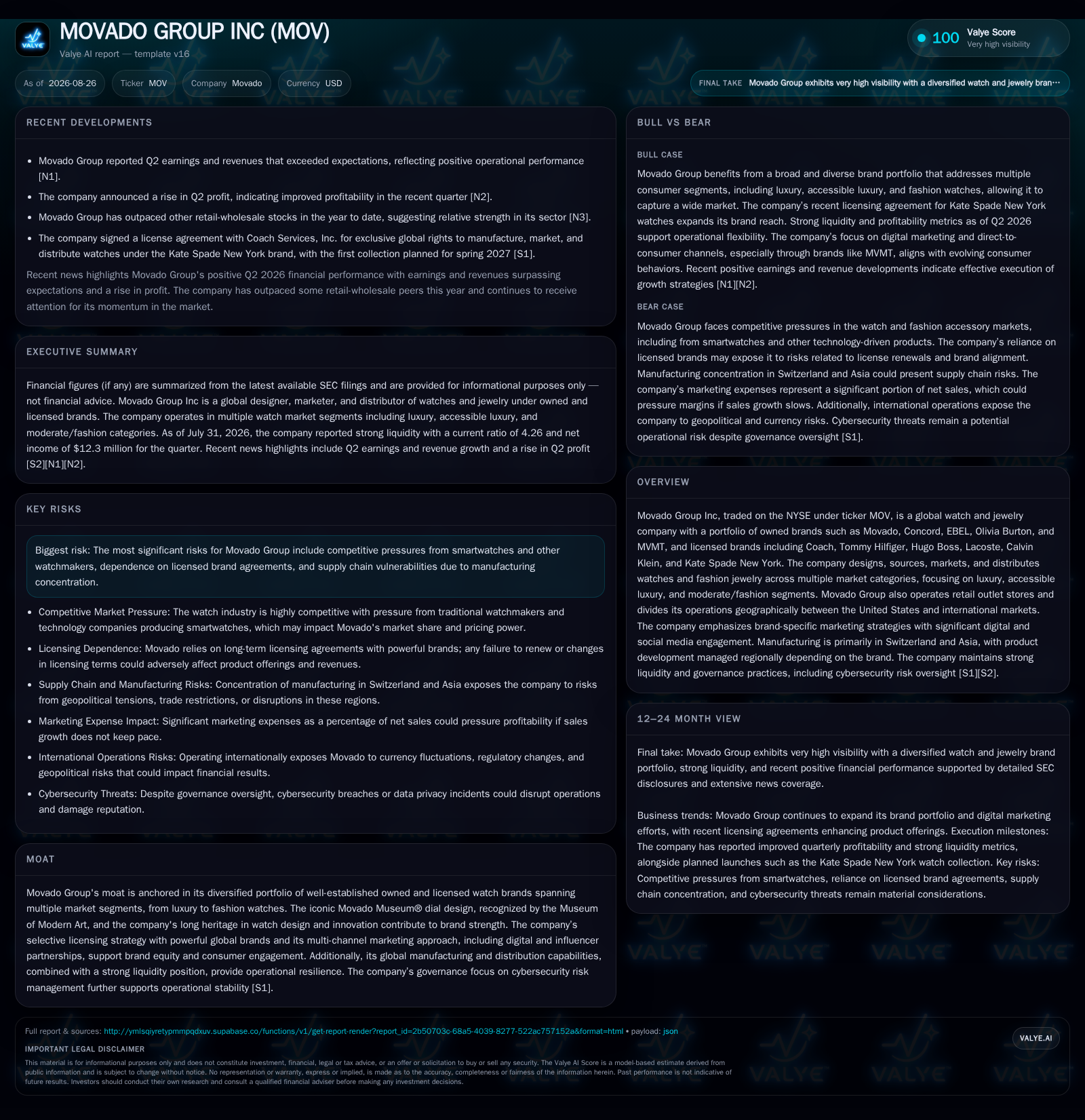
Movado Group, Inc. operates a diversified portfolio of owned and licensed watch brands spanning luxury, accessible luxury, and fashion segments. Owned brands include Movado, Concord, EBEL, Olivia Burton, and MVMT, while licensed brands feature Coach, Tommy Hilfiger, Hugo Boss, Lacoste, Calvin Klein, and Kate Spade New York. This stable portfolio enables Movado to target a broad global consumer base, leveraging brand equity across price tiers and fashion categories, which supports resilience against market volatility and competitive pressures such as the rise of smartwatches [S1]. Revenue is generated through design, sourcing, marketing, and distribution of watches, jewelry, and accessories via retail outlets, e-commerce, and wholesale channels. The company’s selective licensing strategy focuses on long-term agreements with strong global brands, enhancing competitive positioning and managing risk through diversification across segments and geographies [S1].
On July 16, 2026, Movado amended its revolving credit facility, extending the maturity date to July 16, 2031, with a $75 million senior secured revolving credit facility [S2]. This extension materially reduces refinancing risk by postponing the need to access credit markets under potentially adverse conditions, thereby enhancing financial flexibility over the medium term. The longer maturity horizon supports stable capital allocation and operational funding, lowering exposure to interest rate volatility and credit market disruptions, which is valuable in an industry subject to cyclical demand and economic fluctuations [S2].
The company held $211.6 million in cash and cash equivalents as of July 31, 2026, with current assets totaling $527.2 million and current liabilities of $123.7 million, resulting in a current ratio of 4.26 [S2][F1]. Operationally, Movado did not record any accruals for severance or employee-related charges during Q2 2026, compared to $0.9 million accrued in Q2 2025 [S2]. The absence of these accruals may indicate operational steadiness or reduced restructuring activities, positively impacting selling, general, and administrative expenses by reducing non-recurring charges. This suggests a period of organizational stability, which can translate into more predictable cost structures and better resource allocation for growth initiatives.
The watch and jewelry industry faces structural challenges, including competition from smartwatches and evolving consumer preferences that can impact traditional watch demand. Movado’s diversified brand portfolio spanning multiple market segments provides some resilience against these cyclical risks. However, the company remains exposed to supply chain concentration risks and the need to continuously innovate and market effectively to sustain brand relevance [S1]. Cybersecurity and data privacy risks are also important considerations, as significant breaches could materially affect operations and reputation. The company’s governance includes oversight by the Audit Committee and senior management with extensive IT security experience, helping mitigate these risks [S1].
Analytically, the extension of Movado’s revolving credit facility maturity to 2031 materially reduces refinancing risk and enhances financial flexibility over the medium term. By postponing refinancing obligations, Movado lowers exposure to adverse credit market conditions and supports stable capital allocation, which is particularly valuable given the cyclical nature of the watch industry and potential economic volatility [S2]. The company’s strong liquidity position, evidenced by a current ratio of 4.26 and substantial cash reserves, further supports operational stability and the capacity to meet short-term obligations without liquidity stress [F1].
Movado’s business economics are driven by leveraging brand equity across owned and licensed brands, generating revenue through multiple global distribution channels. The selective licensing strategy allows the company to benefit from established brand recognition while limiting capital investment and operational risk associated with brand development. Margins and cash conversion may be influenced by brand strength, operational efficiency in manufacturing and distribution, and marketing strategies including digital and social media engagement. The company’s liquidity position and extended credit facility maturity could provide a financial foundation to support these economic drivers.
A bull scenario involves Movado Group leveraging its diversified brand portfolio and strong financial flexibility to invest in digital marketing and expand direct-to-consumer channels, potentially accelerating growth in accessible luxury and fashion segments. Confirmation would be increased revenue growth and higher marketing spend with improved customer acquisition metrics, while refutation would be declining sales or margin pressure and increased severance or restructuring charges indicating operational issues [S1][S2][F1]. A bear scenario involves intensified competitive pressures from smartwatches and other watchmakers, potentially causing margin compression and slower revenue growth despite Movado’s diversified portfolio and financial strength [S1]. Confirmation would be declining sales volumes and increased discounting, while refutation would be stable or growing market share and successful new product launches.
Investors should monitor subsequent quarterly revenue and margin trends to assess whether Movado’s growth trajectory aligns with its financial flexibility and brand diversification. Changes in severance or restructuring accruals could signal operational shifts, while updates on licensing agreements, particularly new launches under the Kate Spade brand, may impact future revenue streams. Additionally, any amendments or drawdowns on the revolving credit facility should be watched closely as indicators of liquidity management and capital structure adjustments.
Operational cost trends appear steady, though ongoing risks from competition and supply chain dynamics warrant continued monitoring.

Comments