
CFN Enterprises Q2 2026: Strategic Expansion into Wine and Beverage Distribution via J Street Acquisition
CFN Enterprises discontinues hemp-derived consumable operations amid federal ban while expanding wine and beverage distribution through J Street acquisition.
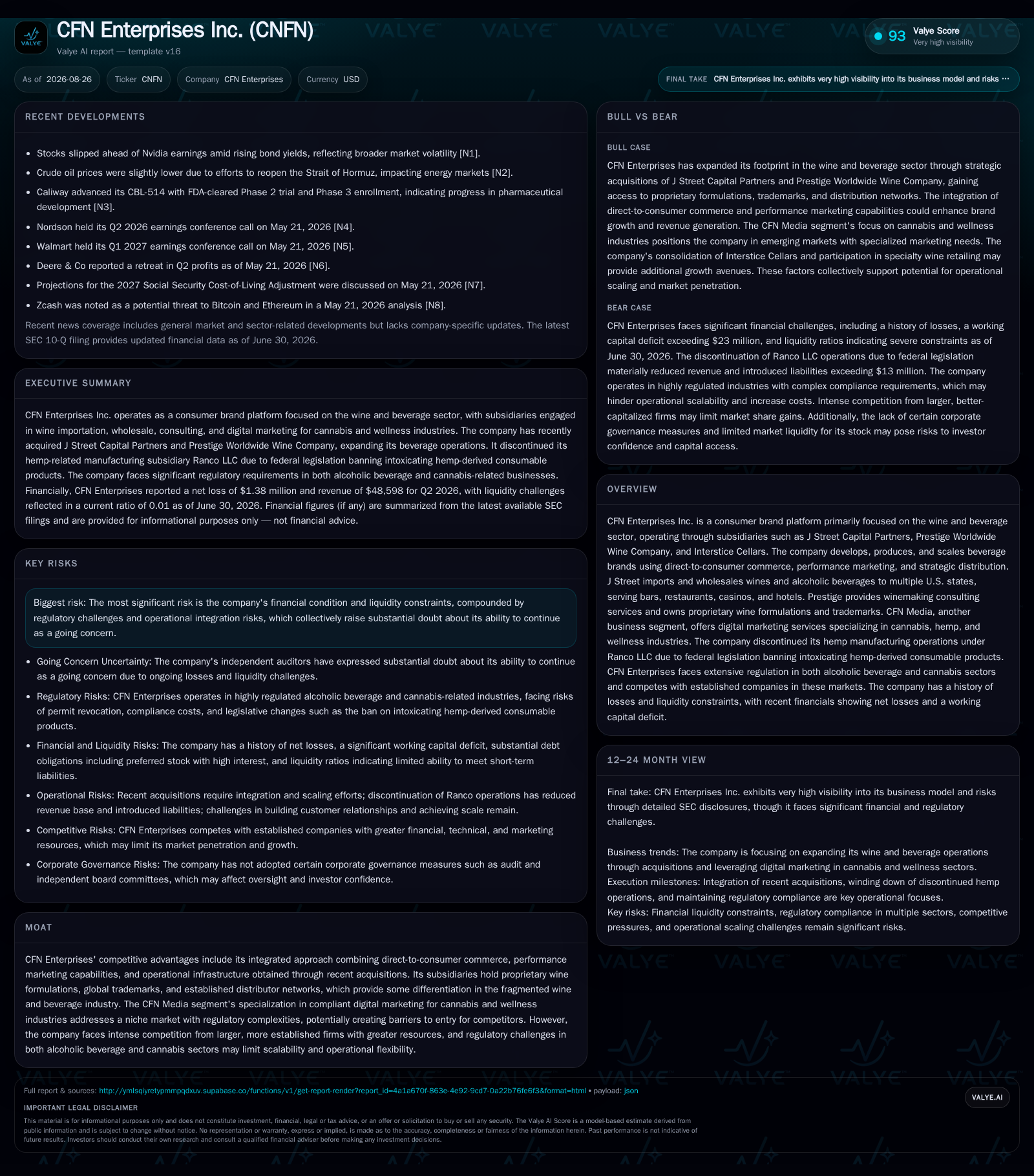
In Q2 2026, CFN Enterprises confirmed the discontinuation of its Ranco LLC hemp-derived consumable products operations following federal legislation banning such products. This cessation materially reduced its revenue base and contributed to a severe working capital deficit, with current liabilities exceeding current assets by over $24 million as of June 30, 2026. Concurrently, CFN continues to integrate its July 2025 acquisition of J Street Capital Partners LLC, aiming to expand its footprint in the wine and alcoholic beverage distribution sector. The company’s liquidity constraints raise substantial doubt about its ability to meet short-term obligations, underscoring the importance of successful operational scaling and financing to support its strategic shift.
Q2 2026 Operating and Financial Update
CFN Enterprises Inc. reported in its August 26, 2026 10-Q filing that it has discontinued the operations of its wholly owned subsidiary Ranco LLC following the passage of federal legislation banning intoxicating hemp-derived consumable products [S1][S2]. This legislation, enacted November 12, 2025, mandated cessation of such products nationally effective November 12, 2026, prompting CFN’s Board of Directors to approve a wind-down plan for Ranco in late 2025. As a result, Ranco’s operations ceased in Q4 2025 and were classified as discontinued operations in the company’s financial statements.
The discontinuation of Ranco materially reduced CFN’s revenue base, as Ranco had been a significant contributor to consolidated revenues [S1]. Moreover, the discontinued operations carry substantial liabilities that continue to impact the company’s financial position in 2026.
The company reported current assets totaling $345,365 against current liabilities of $25,134,214, resulting in a current ratio of 0.01 [F1][S2]. This extreme imbalance indicates that CFN’s current liabilities vastly exceed its short-term assets, raising substantial doubt about its ability to meet immediate financial obligations and sustain ongoing operations without external financing or restructuring [F1][S2].
Business Model and Strategic Focus
CFN Enterprises operates as a consumer brand platform primarily focused on the wine and beverage sector through its subsidiaries, including Prestige Worldwide Wine Company and J Street Capital Partners. The acquisition of J Street, completed on July 1, 2025, expanded CFN’s footprint in the import and wholesale distribution of wines and alcoholic beverages across key states such as Nevada, New York, New Jersey, Florida, and California [S1]. J Street’s customer base includes bars, restaurants, casinos, and hotels, representing on-premise accounts critical to wholesale distribution.
Prestige Worldwide Wine Company provides winemaking consulting services and holds proprietary wine formulations, trademarks, and a distributor network, complementing CFN’s direct-to-consumer commerce and performance marketing capabilities. Additionally, CFN Media delivers digital marketing services specializing in compliant advertising for cannabis, hemp, and wellness industries, although the hemp-related manufacturing operations have been wound down [S1].
This integrated business model combines wholesale distribution, direct-to-consumer sales, and specialized marketing services, aiming to leverage operational infrastructure and acquisitions to drive revenue growth [S1]. This financial condition underscores the challenges CFN faces in funding its ongoing activities and integrating recent acquisitions. The company’s history of losses and negative cash flows, combined with substantial indebtedness and obligations related to preferred stock interest payments, further complicate its financial sustainability [S1]. Without meaningful improvements in cash flow generation from core wine and beverage operations or access to additional financing, CFN’s ability to meet short-term liabilities faces significant challenges, which could raise concerns about its financial sustainability [F1][S2].
Risks and Regulatory Environment
CFN’s operations in both the alcoholic beverage and hemp-derived product sectors are subject to extensive regulatory oversight. The federal ban on intoxicating hemp-derived consumable products directly led to the discontinuation of Ranco’s operations, illustrating the regulatory risks inherent in this segment [S1].
The wine and beverage business also faces complex federal and state licensing requirements. Loss or non-renewal of permits could materially affect operations, while the early-stage status of wine and beverage acquisitions introduces integration and scaling risks [S1]. These regulatory and operational challenges, coupled with financial constraints, present significant hurdles for CFN as it seeks to reposition its business focus and restore financial stability.
Scenario Analysis and Investment Implications
One plausible positive scenario is that CFN successfully integrates its wine and beverage acquisitions, leveraging direct-to-consumer commerce and performance marketing to grow revenue and margins. Access to external capital or debt restructuring could alleviate liquidity pressures, enabling operational scaling and financial stabilization [S1][S2]. Confirmation of this scenario would include quarterly revenue growth in wine and beverage segments, improved liquidity ratios, and positive cash flow from operations.
Conversely, a downside scenario involves CFN failing to offset the revenue loss from discontinued hemp operations [S1][F1][S2]. Continued liquidity deterioration, regulatory setbacks, or integration challenges could lead to insolvency or restructuring.
In summary, CFN Enterprises is navigating a transformational period marked by the cessation of hemp-derived consumable operations and a strategic pivot toward expanding its wine and beverage distribution platform. The company’s ability to leverage its acquisitions and secure financial stability will be critical to its future performance and risk profile.

Comments