
Elmet Group Faces Investor Uncertainty Amid Limited Business Model Disclosure
Elmet Group's consistent lack of detailed business model disclosure constrains investor insight despite recent financial updates.
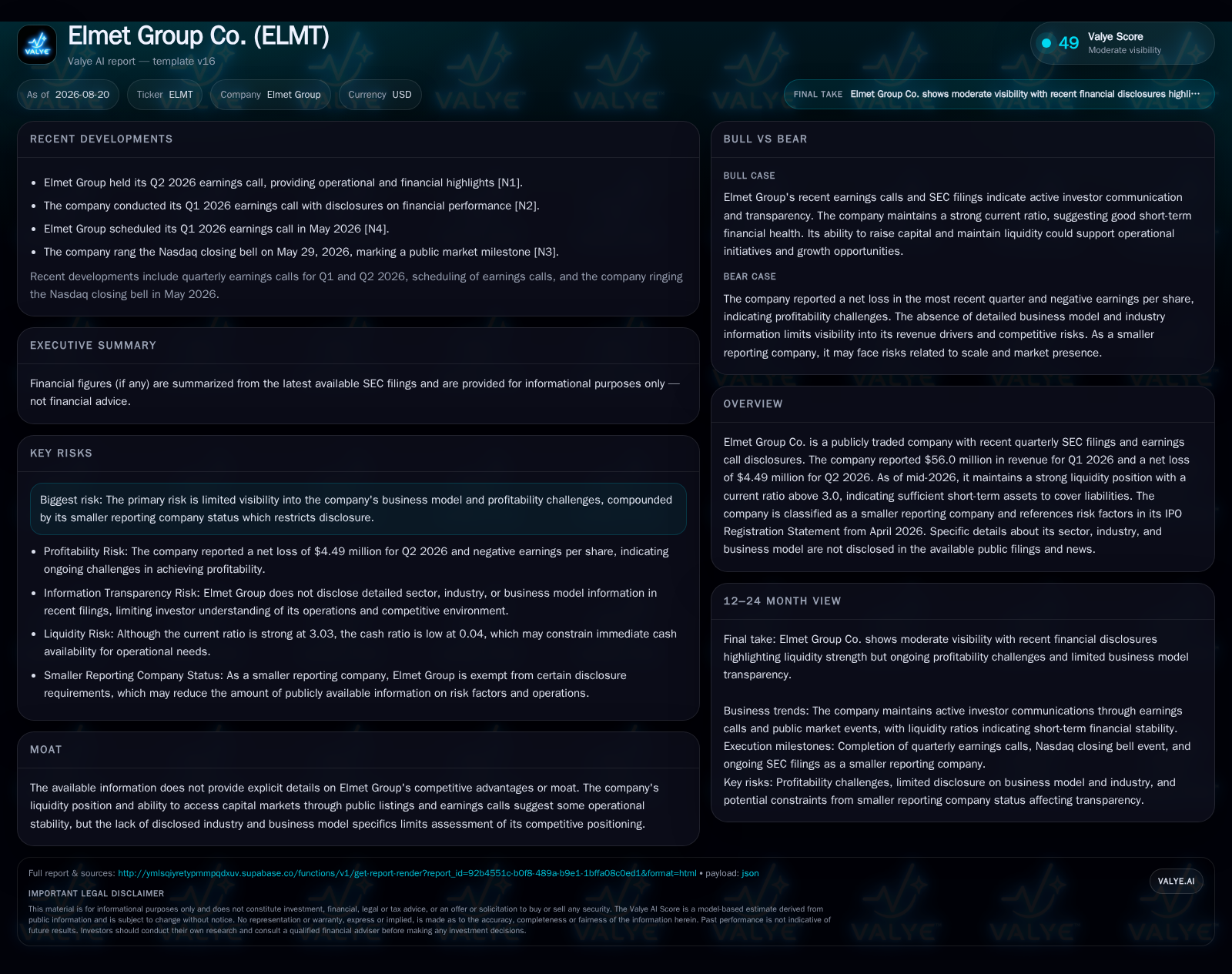
Elmet Group's Q2 2026 filings reveal ongoing net losses alongside strong liquidity, but limited disclosure on its business model and sector classification hampers investor understanding of its revenue drivers and competitive positioning. The company reported a net loss of $4.49 million for Q2 2026 and maintained a current ratio of 3.03 as of July 3, 2026, highlighting sufficient short-term assets to cover liabilities. Revenue of $56.0 million in Q1 2026 provides a recent scale reference, but the absence of clear business model details complicates valuation and assessment of profitability prospects.
Business Model and Disclosure Limitations
Elmet Group Co. maintains a consistent pattern of limited disclosure regarding its business model and sector classification, as reaffirmed in its Q2 2026 filings dated August 13, 2026 [S2]. This opacity aligns with the company's prior IPO registration and related filings but continues to constrain investor understanding of how the company generates revenue and competes within its industry. Without detailed insights into its operational mechanics or sector positioning, investors face challenges in assessing the sustainability and growth potential of Elmet’s business. This lack of clarity complicates valuation efforts and obscures the drivers behind reported financial outcomes.
The company’s limited disclosure extends to its risk factors, where it primarily references the risk section of its April 2026 IPO Registration Statement rather than providing updated or expanded risk information in its quarterly filings [S2]. This approach, while permissible under its status as a smaller reporting company, further restricts investor access to current and comprehensive risk assessments. Consequently, the absence of detailed business model and sector information, combined with reliance on prior risk disclosures, leaves investors with an incomplete picture of Elmet Group’s competitive positioning and operational strategy.
Latest Quarterly Financial Performance
For the quarter ended July 3, 2026, Elmet Group reported a net loss of $4.49 million [S2]. This result highlights ongoing challenges in achieving profitability despite the company’s ability to generate revenue. Notably, the company reported revenue of $56.0 million in the prior quarter, Q1 2026, which provides a recent benchmark for its top-line scale but does not reflect Q2 performance as that figure has not been disclosed [S2].
The persistence of net losses despite this revenue level indicates that Elmet Group has not yet reached operational profitability. This situation suggests that the company’s costs and expenses remain high relative to its revenue, potentially due to factors such as commodity price volatility, operational inefficiencies, or investment in growth initiatives. The continued net losses reduce retained earnings and may place pressure on future cash flows, necessitating either external capital support or operational adjustments to achieve break-even and sustainable profitability.
Without current quarter revenue data, investors must rely on the prior quarter’s revenue of $56.0 million [S2] and the net loss figure to infer the company’s operational dynamics, which introduces uncertainty into valuation and forecasting efforts.
Balance Sheet and Liquidity Analysis
Elmet Group’s balance sheet as of July 3, 2026, shows current assets totaling $218.1 million against current liabilities of $72.1 million, resulting in a current ratio of 3.03 [F1]. The composition of current assets, totaling $218.1 million as of July 3, 2026 [F1], likely includes cash, accounts receivable, and other liquid assets that can be readily converted to cash to meet liabilities as they come due.
However, while the current ratio of 3.03 as of July 3, 2026 [F1] suggests a healthy short-term financial position, it does not address the underlying profitability challenges.
Moreover, the company’s total debt stood at $10.538 million as of July 3, 2026 [F1], which is modest relative to its current assets but still represents a fixed financial obligation. The strong current ratio of 3.03 provides a buffer against short-term liquidity risks, allowing the company to meet its obligations and fund operations in the near term [F1]. Improvement in business model transparency and a clear path to profitability would be positive developments confirming this scenario. Persistent opacity in disclosure combined with increasing losses could deplete cash reserves and necessitate capital raises or cost restructuring. This scenario requires reductions in net losses turning into net income, stable or increasing revenue, effective cost management, and clearer communication of the company’s business model and strategy.
Investors should closely monitor upcoming quarterly revenue and profitability figures, liquidity ratios, and management commentary for signs of progress or deterioration. However, the persistence of losses and the absence of detailed business model disclosure constrain investor understanding and complicate valuation efforts.
The company’s reliance on prior IPO risk disclosures and limited sector classification information further restricts insight into its competitive positioning and revenue mechanics.
Additionally, announcements regarding capital raising or cost restructuring would be critical indicators of the company’s financial health and strategic direction.
In summary, while Elmet Group’s liquidity provides near-term financial stability, the company’s ongoing net losses and limited disclosure present significant challenges for investors seeking to evaluate its long-term prospects [S2][F1]. Enhanced transparency and operational improvements will be essential to support investor confidence and valuation going forward.

Comments