
Lithia Motors Q2 2026: Integrated Business Model Supports Resilience Amid Vehicle Margin Pressure
Lithia Motors' diversified automotive retail and finance operations underpin profitability despite continued margin normalization in vehicle sales.
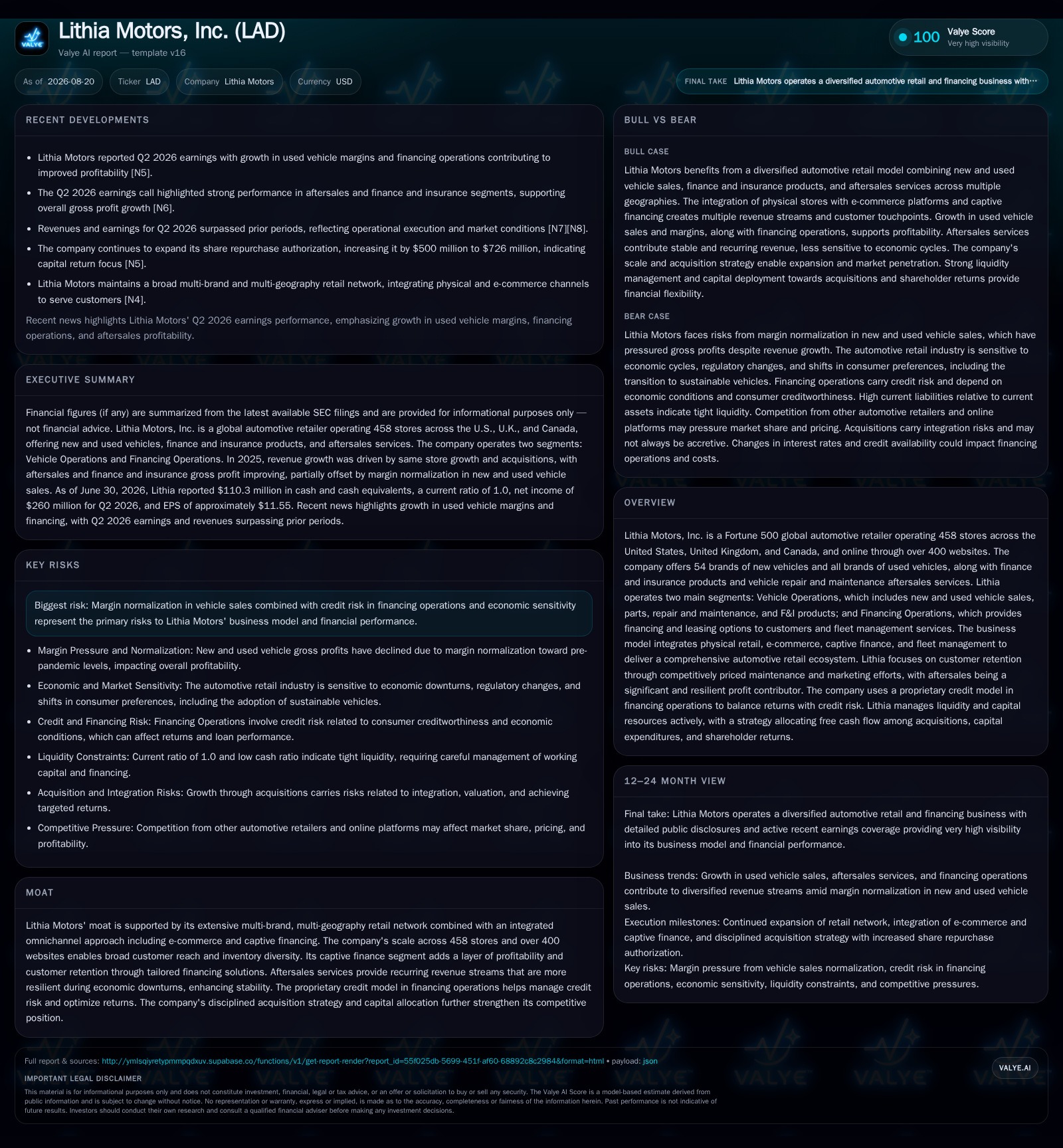
In Q2 2026, Lithia Motors reported ongoing margin pressure in new and used vehicle sales, consistent with a structural trend toward pre-pandemic levels. However, growth in financing and aftersales gross profit segments helped offset this pressure, supporting overall profitability. The company’s integrated business model spans 458 stores and over 400 websites across multiple countries, combining multi-brand retail, e-commerce, captive finance, and fleet management. A declared cash dividend and a balanced liquidity position as of June 30, 2026, reflect financial discipline amid these operational dynamics.
Business Model and Competitive Positioning
Lithia Motors operates a large-scale, integrated automotive retail and finance platform encompassing 458 stores across the United States, the United Kingdom, and Canada, complemented by more than 400 e-commerce websites [S1]. The company offers 54 new vehicle brands alongside all used vehicle brands, serving retail customers through a multi-brand dealership network. Its revenue streams are diversified across new and used vehicle sales, finance and insurance (F&I) products, aftersales services including vehicle repair and maintenance, captive finance operations, and fleet management leasing services.
This integrated business model combines physical retail presence with an omnichannel e-commerce platform and captive financing capabilities, which collectively support customer retention and provide multiple avenues for revenue generation. The scale and geographic breadth of Lithia’s operations enable it to leverage economies of scale and cross-channel synergies, enhancing its competitive positioning in a fragmented automotive retail market.
The company’s Vehicle Operations segment encompasses new and used vehicle sales, finance and insurance, and aftersales services. Finance and insurance revenues were $1.47 billion, and aftersales services generated $4.1 billion [S1]. Despite growth in total revenues, gross profit margins in new and used vehicle sales have been declining, reflecting a structural normalization of margins toward pre-pandemic levels. Specifically, new vehicle gross profit margins declined 70 basis points to 6.3%, and used vehicle margins declined 20 basis points to 5.5% in 2025 [S1].
This margin normalization is a continuing structural trend, driven by market pricing dynamics as supply chain disruptions ease and competitive pressures intensify [S2]. Although unit volumes remain stable or growing, the average gross profit per unit has decreased, exerting pressure on overall profitability. For example, new vehicle average gross profit per unit fell 8.2% year-over-year in 2025, from $3,164 to $2,904 [S1].
However, Lithia’s financing and aftersales segments demonstrated growth in gross profit during the quarter. Finance and insurance gross profit increased by 3.9% in 2025, reaching $1.47 billion, while aftersales gross profit grew 10.4% to $2.36 billion [S1]. Aftersales services benefit from recurring demand for vehicle maintenance and repair, which tend to have more stable and higher-margin characteristics compared to vehicle sales. The captive finance operations provide additional revenue through interest income and fees, further diversifying income streams.
This growth in financing and aftersales gross profit partially offsets the margin pressure in vehicle sales, supporting earnings and cash flow stability. The diversification inherent in Lithia’s business model thus provides a buffer against cyclical fluctuations in vehicle sales margins and contributes to more predictable profitability.
Additionally, Lithia declared a cash dividend of $0.70 per share payable on August 21, 2026 [S3]. Conversely, the financing and aftersales segments continued to show growth in gross profit, reinforcing their role as key profit centers. This segment-level performance highlights the importance of Lithia’s integrated business model in mitigating the impact of vehicle sales margin compression.
The declaration of a $0.70 per share cash dividend in Q2 2026 further underscores the company’s financial discipline and shareholder return focus amid these operating conditions [S3]. This dividend is payable to shareholders of record as of August 7, 2026, with payment scheduled for August 21, 2026.
Balance Sheet and Liquidity Position
As of June 30, 2026, Lithia Motors reported a current ratio of 1.0, with current assets totaling approximately $8.27 billion and current liabilities close to $8.25 billion, including cash and cash equivalents of $110.3 million [F1]. This current ratio of 1.0 as of June 30, 2026, indicates that Lithia’s current assets of $8.27 billion roughly cover its current liabilities of $8.25 billion, consistent with typical automotive retail industry norms where significant inventory and receivables are balanced against payables and short-term obligations [F1]. Automotive retail operations inherently involve substantial working capital tied up in vehicle inventory and receivables from customers and captive finance operations.
The cash and equivalents balance of $110.3 million as of June 30, 2026, provides a liquidity buffer to support ongoing operations and capital allocation activities, including dividend payments [F1].
Analytical Conclusions and Scenario Analysis.
The evidence supports two primary analytical conclusions. First, margin normalization in new and used vehicle sales is a continuing structural trend reflecting market pricing returning to pre-pandemic levels. This trend represents a fundamental shift in the automotive retail environment, requiring adaptation in business strategy and cost management.
Second, growth in financing and aftersales segments partially offsets margin pressure in vehicle sales, supporting overall profitability and cash flow stability. This diversification reduces reliance on vehicle sales margins and enhances resilience.
Looking ahead, two plausible scenarios emerge:
Bull Scenario: If Lithia successfully leverages its integrated multi-channel business model to grow financing and aftersales segments, it can offset vehicle sales margin pressure and stabilize or grow earnings despite cyclical headwinds. This scenario is plausible given the diversified revenue streams and customer retention mechanisms inherent in Lithia’s business model.
Bear Scenario: If vehicle sales margin normalization accelerates and financing or aftersales segments fail to grow sufficiently, Lithia's earnings could decline materially despite its integrated business model. Vehicle sales remain the largest revenue component and are sensitive to economic cycles and competitive pricing pressure. Further declines in vehicle gross profit margins, credit losses or margin compression in financing operations, or weakening aftersales demand would confirm this scenario. Conversely, stabilization or growth in financing and aftersales segments or improved vehicle sales pricing or volume would refute it.
In summary, Lithia Motors’ integrated multi-channel business model combining retail, e-commerce, captive finance, and fleet management across a broad geographic footprint may contribute to competitive differentiation and resilience amid ongoing margin normalization in vehicle sales. Growth in financing and aftersales segments may support profitability and cash flow stability. The company’s liquidity position and recent dividend declaration provide context on capital allocation. However, margin pressures in vehicle sales remain a material risk, necessitating vigilant monitoring of segment performance and market dynamics.

Comments