
NAPCO Security Technologies Q3 2026: Recurring Cellular Service Growth Drives Revenue Expansion
NAPCO reported 13.0% growth in recurring cellular service revenues and 10.0% growth in equipment sales for fiscal 2026, enhancing revenue stability and margin profile.
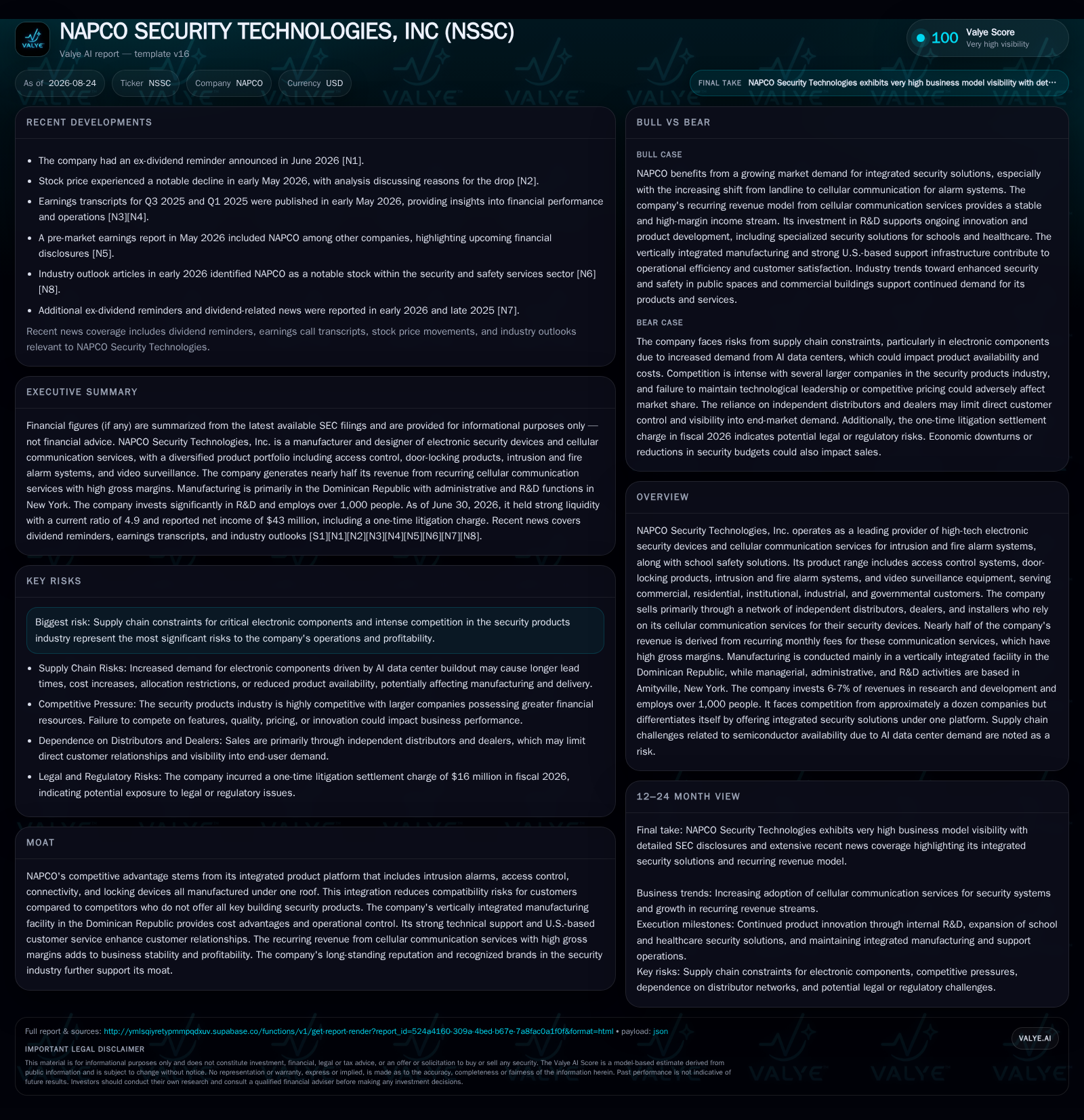
NAPCO Security Technologies, Inc. posted solid fiscal 2026 revenue growth driven by a 13.0% increase in recurring cellular communication service revenues and a 10.0% rise in equipment product sales. The recurring revenue stream, characterized by high gross margins, supports improved revenue stability and profitability. The company’s vertically integrated manufacturing facility in the Dominican Republic underpins operational control and cost efficiency. Strong liquidity with $126.9 million in cash and cash equivalents and a current ratio of 4.9 as of June 30, 2026, provides financial flexibility amid ongoing supply chain and competitive pressures.
Recent Operating Performance and Revenue Growth
NAPCO Security Technologies, Inc. reported notable revenue growth for the fiscal year ended June 30, 2026, driven by strong performance in both recurring cellular communication services and equipment product sales [S1]. Equipment product revenues rose year-over-year, contributing to net revenues [S1]. This increase was primarily due to higher sales of door-locking products and intrusion and access products, which are core components of NAPCO’s integrated security platform, serving commercial, residential, institutional, industrial, and governmental customers through a national network of trusted independent dealers and integrators.
The combination of recurring service revenue growth and equipment sales expansion reflects both successful product adoption and service activation, enhancing revenue stability and profitability [S1]. Recurring cellular services, in particular, are characterized by high gross margins, which contribute positively to the company’s overall margin profile.
Liquidity and Balance Sheet Strength
As of June 30, 2026, NAPCO held cash and cash equivalents totaling $126.9 million, a significant increase compared to prior periods [F1]. The strong cash balance includes highly liquid investments such as short-term time deposits and money market funds, which provide operational flexibility and a buffer against supply chain disruptions or competitive risks [S2][F1]. This financial strength supports the company’s ability to fund ongoing operations, invest in growth initiatives, and manage working capital efficiently.
Business Model and Competitive Positioning
NAPCO’s business model centers on manufacturing and selling high-tech electronic security devices alongside providing cellular communication services for intrusion and fire alarm systems. The company’s product portfolio includes access control systems, door-locking devices, intrusion and fire alarm equipment, video surveillance products, and integrated cellular communication services that generate recurring monthly fees from its dealer network [S1].
A key feature of NAPCO’s strategy is its vertically integrated manufacturing facility located in the Dominican Republic. This integration enables the company to produce critical security products in-house, reducing compatibility risks and providing cost advantages through operational control and manufacturing efficiency [S1].
NAPCO competes in a market with approximately 12 larger competitors, facing intense competition on product features, quality, pricing, and technical support [S1]. The company’s integrated product platform and cellular communication services, combined with a national network of independent dealers, offer competitive strength. However, supply chain constraints for critical electronic components remain a challenge that could pressure future revenue and profitability.
Risks and Industry Context
The electronic security hardware industry is subject to economic cycles that influence demand for new installations and renovations. While recurring cellular service revenues provide some mitigation against cyclical fluctuations, ongoing supply chain constraints and competitive pressures pose risks to NAPCO’s growth trajectory [S1].
The company’s reliance on independent distributors and dealers means that any downturn in construction or renovation activity could reduce the available pool of customers, impacting sales volumes [S1]. Additionally, competition from larger firms with greater resources may intensify pricing and innovation pressures.
Analytical Conclusions and Scenarios
NAPCO’s 13.0% year-over-year growth in recurring cellular communication service revenues is a critical driver of both revenue stability and margin expansion [S1]. These high-margin, recurring monthly fees complement equipment sales and contribute positively to profitability, underscoring the importance of continued growth in cellular service activations.
The vertically integrated manufacturing approach and integrated product platform reduce compatibility risks and manufacturing costs, supporting competitive differentiation and operational efficiency. Producing key products in a single facility in the Dominican Republic allows for tighter control over quality and costs, which is a meaningful advantage in a competitive and supply-constrained environment [S1].
Looking ahead, one possible scenario is that NAPCO leverages its integrated platform and recurring cellular services to accelerate revenue growth and margin expansion, gaining market share from competitors [S1][F1]. This would be supported by continued increases in recurring revenue, improved gross margins, and strong customer retention metrics.
Conversely, prolonged supply chain disruptions or intensified competition could erode revenue growth and margin profiles, pressuring profitability and cash flow [S1]. Signs of this scenario would include revenue declines, margin contraction, and negative cash flow trends.
Watchpoints
Investors and analysts should monitor quarterly recurring cellular communication service revenue growth and activation rates, as these are key indicators of the company’s recurring revenue health. Equipment product sales trends, especially in door-locking and intrusion/access products, will provide insight into demand strength. Gross margin trends on both recurring services and equipment, supply chain developments, and cash flow from operations are also critical metrics to watch for assessing ongoing operational and financial performance.

Comments