
1RT Acquisition Corp. Q2 2026: SPAC Status Unchanged with $172.5M Trust Account and No Business Combination Yet
1RT Acquisition Corp. remains a blank check company with no selected business combination target and an intact Trust Account as of mid-2026.
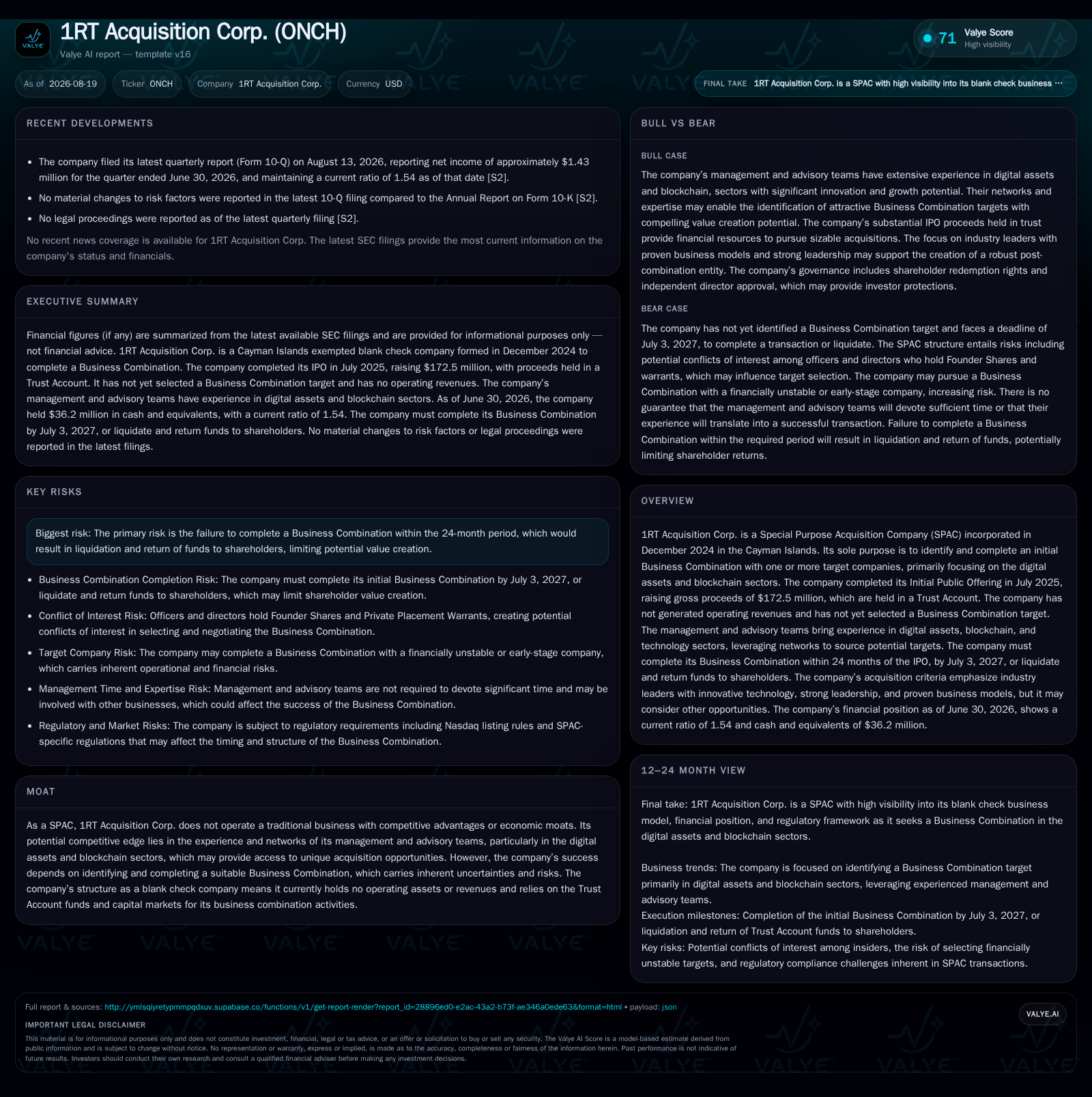
As of the quarter ended June 30, 2026, 1RT Acquisition Corp. has not identified a business combination target, maintaining its $172.5 million Trust Account intact since its July 2025 IPO. The company continues to operate as a blank check SPAC focused on digital assets and blockchain sectors, generating no operating revenues to date. Risk factors remain materially unchanged, emphasizing the critical deadline of July 3, 2027, by which the company must complete a business combination or face liquidation.
Latest Quarterly Operating Status
1RT Acquisition Corp.'s latest quarterly filing for the period ended June 30, 2026, confirms that the company has not selected any specific business combination target to date [S2]. The Trust Account, funded with $172.5 million from the company's Initial Public Offering (IPO) in July 2025, remains intact without any material changes or capital deployment [S2][S1]. No operating revenues have been generated thus far, consistent with the company's status as a blank check Special Purpose Acquisition Company (SPAC) focused on acquiring a business in the digital assets and blockchain sectors [S2]. Risk factors disclosed in the filing remain materially unchanged from the prior annual report, including the explicit risk of liquidation if a qualifying business combination is not consummated by the July 3, 2027 deadline [S2][S1].
Business Model and SPAC Structure
1RT Acquisition Corp. operates as a blank check company formed to raise capital through an IPO by selling units consisting of Class A Ordinary Shares and Public Warrants to public investors [S1]. The gross proceeds of $172.5 million from the IPO, along with $4.5 million from private placement warrants sold to the Sponsor and underwriter representative, are held in a Trust Account until the company completes its initial Business Combination [S1]. The SPAC's goal is to merge with or acquire a private company, thereby taking it public without a traditional IPO process. Until such a transaction occurs, the company does not generate operating revenues and its value depends entirely on the successful execution of a business combination [S1].
The company’s management and advisory teams bring experience in digital assets and blockchain, and the stated acquisition focus targets companies with enterprise values generally above $1 billion, though deals outside this range may be considered [S1]. Public shareholders have the right to redeem their shares for cash upon completion of the business combination or liquidation, which introduces a risk of dilution and capital structure complexity [S1]. The SPAC must complete its business combination within 24 months of the IPO, by July 3, 2027, or it will be required to liquidate and return the Trust Account funds to shareholders [S1].
Risk Profile and Deadline Implications
The risk factors disclosed in the latest quarterly filing remain materially consistent with those outlined in the prior annual report, underscoring the ongoing risks inherent in the SPAC structure [S2][S1]. A key risk is the possibility that 1RT Acquisition Corp. may fail to complete a business combination by the July 3, 2027 deadline, which would trigger liquidation and the return of funds held in the Trust Account to shareholders [S2][S1]. This liquidation scenario limits upside potential for investors, as the return would generally be limited to the amount held in trust, minus any expenses.
Additional risks include potential challenges in sourcing a suitable target within the combination period, shareholder redemption rights that may reduce available capital, and the influence of Sponsor and founder shares in the approval process [S1]. The 24-month timeframe imposes a structural constraint that may pressure deal negotiations and due diligence, particularly as the deadline approaches [S1].
Scenario Analysis and Investor Considerations
One plausible outcome is that 1RT Acquisition Corp. successfully identifies and completes a business combination within the remaining approximately 11 months, leveraging the management team's expertise in digital assets and blockchain to source a suitable target [S1][S2][F1]. Confirmation of this base case scenario would include the announcement of a definitive agreement, shareholder vote outcomes, and subsequent filings evidencing transaction progress.
Conversely, the company may fail to consummate a business combination by the deadline due to market conditions, deal sourcing difficulties, or shareholder opposition, resulting in liquidation and return of Trust Account funds to investors [S2][S1][F1]. Indicators confirming this bear case would be announcements of termination, liquidation plans, or the distribution of Trust Account funds.
A third, less likely but possible, bull case is that the company obtains shareholder approval to extend the combination period, providing additional time to identify and complete a business combination. Confirmation of this scenario would include announcements of charter amendments approved by shareholders and continued maintenance of the Trust Account balance.
Investors should monitor for any announcements of definitive business combination agreements, shareholder votes or tender offer results, amendments to the company’s charter extending the combination period, changes in the Trust Account balance, and updates to risk factors or litigation disclosures. These developments will materially influence the company's trajectory and shareholder value prospects.
In summary, 1RT Acquisition Corp. remains in the early to mid-stage of its SPAC lifecycle with significant execution risk ahead. The intact Trust Account preserves capital for a potential acquisition, but the absence of a selected target more than halfway through the 24-month combination period highlights the critical importance of timely deal execution to avoid liquidation and deliver value to shareholders.

Comments