
nCino Q2 2026: Continued AI-Driven Platform Expansion Amid Liquidity Pressure
nCino advances its AI-embedded cloud banking platform with broad adoption and value-based pricing while facing liquidity constraints as of July 31, 2026.
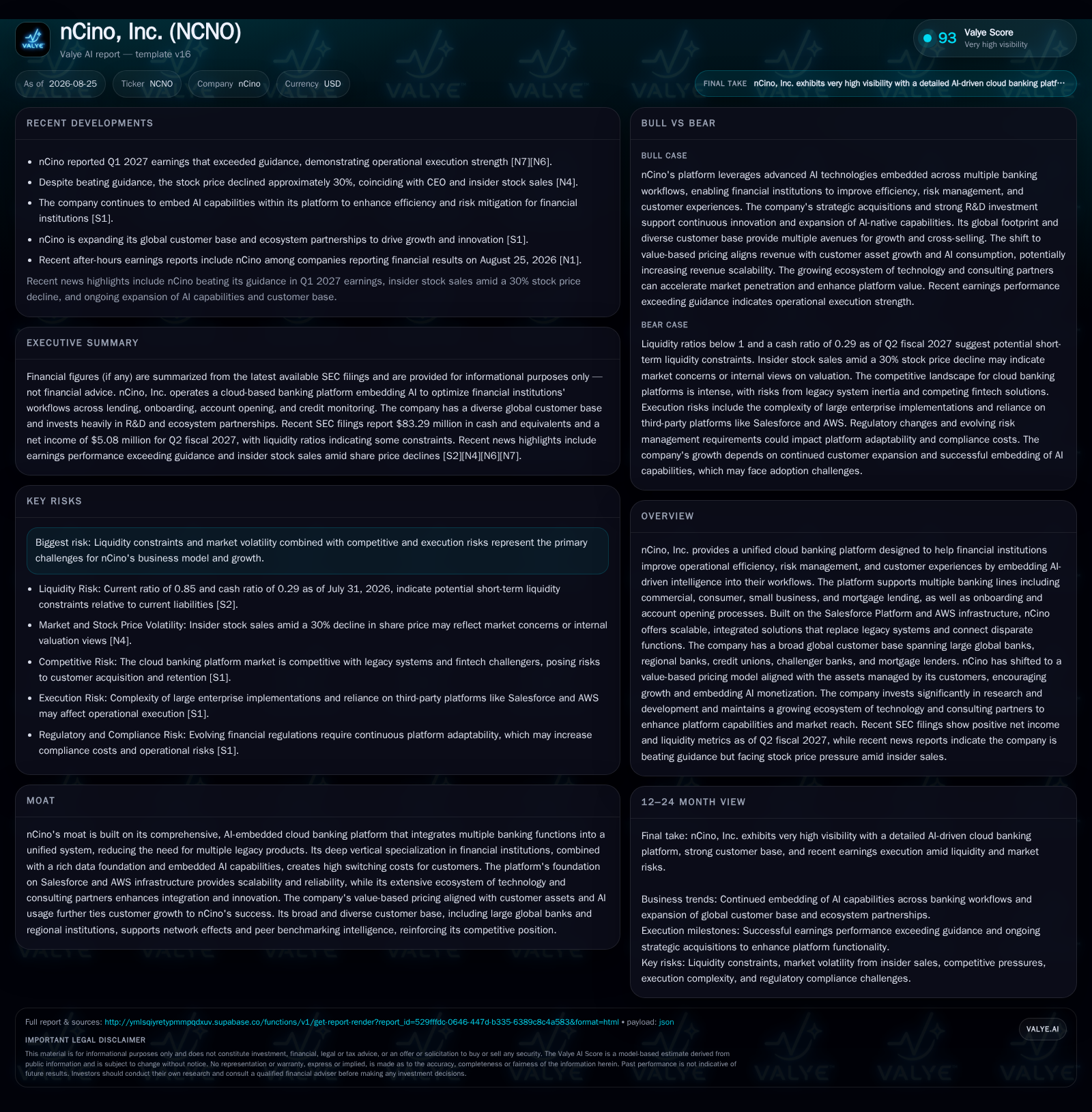
In Q2 2026, nCino demonstrated ongoing expansion and monetization of its AI-driven cloud banking platform, embedding intelligence across multiple lending lines and shifting to value-based pricing aligned with customer asset growth. However, the company reported a current ratio below 1.0 and net debt of approximately $193 million, signaling liquidity pressures that may constrain near-term financial flexibility. Balancing accelerated AI-driven revenue growth with working capital management will be critical to sustaining competitive positioning and operational agility.
nCino, Inc. reported financial results for the second quarter of fiscal 2026 ended July 31, 2026, highlighting a current ratio of 0.85, where current liabilities of approximately $286.8 million exceed current assets of about $242.9 million, resulting in a working capital deficit [S2]. The company also holds net debt of roughly $192.7 million, calculated as total debt of $276 million less cash and equivalents of $83.3 million as of the same date [S2]. These liquidity metrics underscore constrained near-term financial flexibility, which is significant as nCino pursues expansion and AI-driven monetization of its cloud banking platform, balancing growth ambitions with liquidity pressures that will shape its near-term financial health and competitive positioning [S1][S2].
Despite these balance sheet pressures, nCino’s platform revenue growth is supported by broad adoption of AI-driven solutions and a shift to value-based pricing aligned with customers’ assets under management [S2]. Margins currently reflect ongoing investments in AI and platform development, with no clear evidence of margin expansion or contraction in the quarter [S2].
Business Model and AI-Driven Platform Expansion
nCino serves financial institutions ranging from community and regional banks to enterprise banks and credit unions, providing a cloud-based banking platform that integrates AI-driven automation and workflow digitization. The platform spans multiple lending lines—including commercial, consumer, small business, and mortgage lending—embedding AI intelligence to improve operational efficiency, risk management, and customer experience [S1][S2].
The company’s AI capabilities include its Digital Partners intelligent agent framework and Operations Analytics platform, which automate workflows and provide actionable insights across banking functions [S1]. This AI integration supports a "Dual Workforce" model, where technology handles routine tasks and amplifies human decision-making, enhancing employee and client experiences.
A key business development is nCino’s transition to a value-based pricing model that ties subscription revenue to the assets managed by customers [S2]. This alignment incentivizes platform usage growth and AI monetization, creating a recurring revenue stream linked to customer asset expansion [S2]. The platform’s foundation on Salesforce and AWS infrastructure enables scalability and reliability critical for serving global financial institutions.
With current liabilities exceeding current assets, nCino’s current ratio of 0.85 signals working capital deficits that could limit operational agility and the ability to fund growth initiatives [F1]. The net debt position of approximately $192.7 million further underscores leverage risks that may pressure capital allocation decisions, especially in a competitive and rapidly evolving market [F1].
While the company prioritizes investments in AI and platform innovation, these liquidity pressures could necessitate careful management of expenditures and financing strategies to sustain growth momentum and risk management capabilities.
Risks and Competitive Landscape
nCino operates in a highly competitive cloud-based financial services software market characterized by rapid technological change and intense pricing pressure [S1]. The company’s growth strategy increasingly depends on customer adoption and effective use of its AI capabilities. Failure to achieve expected adoption rates or competitive pricing pressures could adversely affect revenue growth and market position.
Additionally, the financial services sector’s technology spending is subject to macroeconomic and cyclical risks, which may impact demand for nCino’s solutions. The company must also navigate regulatory compliance requirements, data security risks, and execution challenges inherent in continuous AI innovation.
Scenario Analysis and Investor Considerations
One possible bull scenario is that nCino successfully leverages its AI-driven platform to accelerate customer asset growth and AI monetization, resulting in revenue growth that outpaces liquidity pressures. This could enable margin expansion and improved cash flow, supported by sustained AI adoption, effective working capital management, and stable financial services technology spending [S2]. Confirmation would come from accelerating quarterly revenue growth, improvements in liquidity ratios, and positive operating cash flow.
One possible bear scenario is that liquidity constraints worsen due to slower-than-expected AI adoption or competitive pressures, forcing the company to curtail investments or raise capital under unfavorable terms, impairing growth trajectory. Indicators would include declining revenue growth, deteriorating liquidity metrics, and the need for dilutive capital raises.
These factors support recurring revenue growth potential and customer retention through integrated workflows and AI intelligence. However, liquidity constraints evidenced by a current ratio of 0.85 and significant net debt of approximately $192.7 million present challenges to near-term financial flexibility and capital allocation [F1]. Balancing accelerated AI-driven monetization with prudent working capital management will be critical for sustaining growth and competitive positioning in the evolving cloud banking software market.

Comments