
Edesa Biotech Advances Clinical Pipeline Amid $25 Million Public Offering
Edesa Biotech’s August 2026 capital raise strengthens liquidity to support ongoing clinical development of its immuno-inflammatory drug candidates.
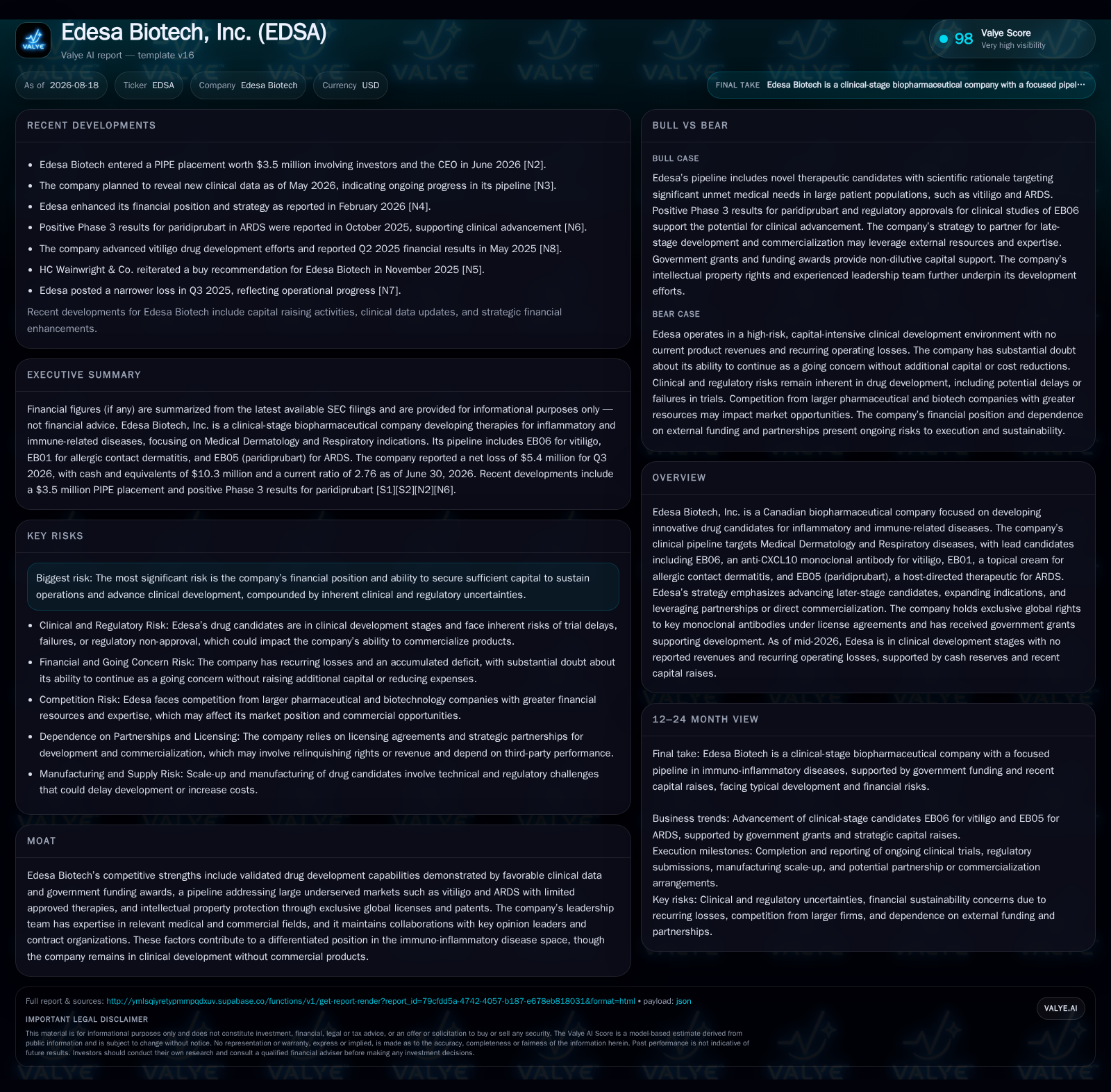
Edesa Biotech completed a $25 million public offering in August 2026, significantly enhancing its cash position beyond the $10.3 million reported at June 30, 2026. This capital infusion supports continued clinical advancement of its lead candidates EB06 and EB05, including planned Phase 2 enrollment for vitiligo and ongoing studies in ARDS. The improved liquidity profile reduces near-term financing risk and underpins the company’s ability to progress toward regulatory milestones and potential commercialization.
Edesa Biotech, Inc. reported a significant update in its August 13, 2026 quarterly filing, followed by a material capital raise disclosed on August 19, 2026 [S2][S3]. The company completed a public offering of shares and warrants, bolstering its liquidity to fund ongoing clinical development programs focused on immuno-inflammatory diseases.
As of June 30, 2026, Edesa held $10.3 million in cash and equivalents and maintained a current ratio of 2.76, indicating that its current assets exceeded current liabilities by nearly threefold and providing a liquidity buffer for near-term obligations [F1]. The recent offering substantially increases this cash base, improving the company’s financial runway beyond the prior quarter’s position. This infusion of capital materially extends Edesa’s cash runway, reducing near-term financing risk and enabling sustained investment in its late-stage clinical programs [S3][N1][F1]. This financial strengthening addresses a critical risk for clinical-stage biopharmaceutical companies, where capital availability directly impacts the ability to meet trial milestones and regulatory timelines.
Edesa’s clinical pipeline centers on two lead candidates: EB06, an anti-CXCL10 monoclonal antibody targeting moderate-to-severe nonsegmental vitiligo, and EB05 (paridiprubart), a host-directed therapeutic for Acute Respiratory Distress Syndrome (ARDS). EB06 is planned to initiate Phase 2 enrollment by mid-2026, subject to regulatory approval, confirming prior regulatory discussions and timelines [S2][S1]. This progression advances the company’s pipeline toward potential regulatory milestones that could serve as value inflection points.
EB05 demonstrated positive Phase 3 results in October 2025, meeting primary and secondary endpoints with statistical significance in a truncated study of hospitalized ARDS patients. The candidate is also under evaluation in an ongoing U.S. government-funded platform study, and certain development expenses are eligible for reimbursement under a Canadian government grant [S1]. These data provide clinical validation of EB05’s therapeutic potential and support continued development.
Edesa’s business model relies on in-licensing drug candidates with demonstrated proof-of-concept, focusing on indications with unmet medical needs and large addressable markets. The company outsources manufacturing to third-party contract manufacturing organizations (CMOs) to concentrate resources on research and development activities rather than capital-intensive infrastructure [S1]. Government grants and equity financing are primary funding sources, with no current revenue from product sales as the company remains in clinical stages.
The company’s strategy to in-license promising product candidates allows it to maintain a well-balanced portfolio across various stages of development without significant investment in basic research, which can be costly and time-consuming. This approach enables Edesa to focus its operational and financial resources on advancing clinical programs and preparing for potential commercialization [S1]. The reliance on third-party CMOs for manufacturing and packaging further supports this capital-efficient model, although it introduces dependencies on external partners for production scale-up and quality control.
The $25 million capital raise materially extends Edesa’s cash runway, reducing near-term financing risk and enabling sustained investment in its late-stage clinical programs [S3][N1][F1]. This financial strengthening addresses a critical risk for clinical-stage biopharmaceutical companies, where capital availability directly impacts the ability to meet trial milestones and regulatory timelines. The current ratio of 2.76 as of June 30, 2026, indicates a liquidity buffer sufficient to cover current liabilities more than two times over, providing operational liquidity to support ongoing activities [F1].
Despite these advances, risks remain inherent in Edesa’s development path. The success of EB06 and EB05 depends on clinical trial outcomes, regulatory approvals, and the company’s ability to secure additional funding if needed [S1][S2]. Clinical-stage biopharmaceutical companies face substantial uncertainties, including the possibility of trial failures, regulatory setbacks, and challenges in manufacturing scale-up. Moreover, the company’s reliance on external financing and government grants underscores the importance of maintaining investor confidence and managing cash burn effectively.
The planned Phase 2 initiation of EB06 and the positive Phase 3 data for EB05 underpin the company’s clinical validation and potential for future regulatory milestones. These developments collectively influence the company’s near-term financial and execution outlook as it advances toward commercialization pending successful trial outcomes and regulatory approvals [S2][S1]. Regulatory approvals and statistically significant clinical endpoints demonstrate progress toward commercialization, which is critical for value creation in a clinical-stage biotech.
These elements will be pivotal in confirming or refuting the company’s trajectory toward successful commercialization.
Scenario analysis highlights three potential paths for Edesa. In a bull case, successful completion of Phase 2 trials for EB06 and advancement of EB05 through ongoing studies could lead to regulatory approvals and commercialization, supported by favorable clinical data and the recent capital raise [S2][S1][S3]. The base case envisions maintenance of current clinical development pace with typical biotech risks, supported by improved liquidity but dependent on financing [S2][S3][F1]. The bear case considers clinical setbacks or inability to secure further financing, potentially forcing delays or discontinuation of programs and materially harming the investment case [S1][S2][S3].
In summary, Edesa Biotech’s recent public offering improves its financial position by extending its cash runway and reducing near-term financing risk. Combined with ongoing clinical progress in its lead candidates EB06 and EB05, the company may be able to advance its late-stage pipeline toward potential regulatory milestones if clinical and regulatory outcomes are favorable. However, inherent risks related to clinical outcomes, regulatory approvals, and capital needs remain critical watchpoints for investors assessing the company’s future prospects.

Comments