
VirTra Advances AI and Volumetric Video Integration to Enhance Training Simulators
VirTra's ongoing product innovation in AI and volumetric video supports competitive differentiation amid government contract risks.
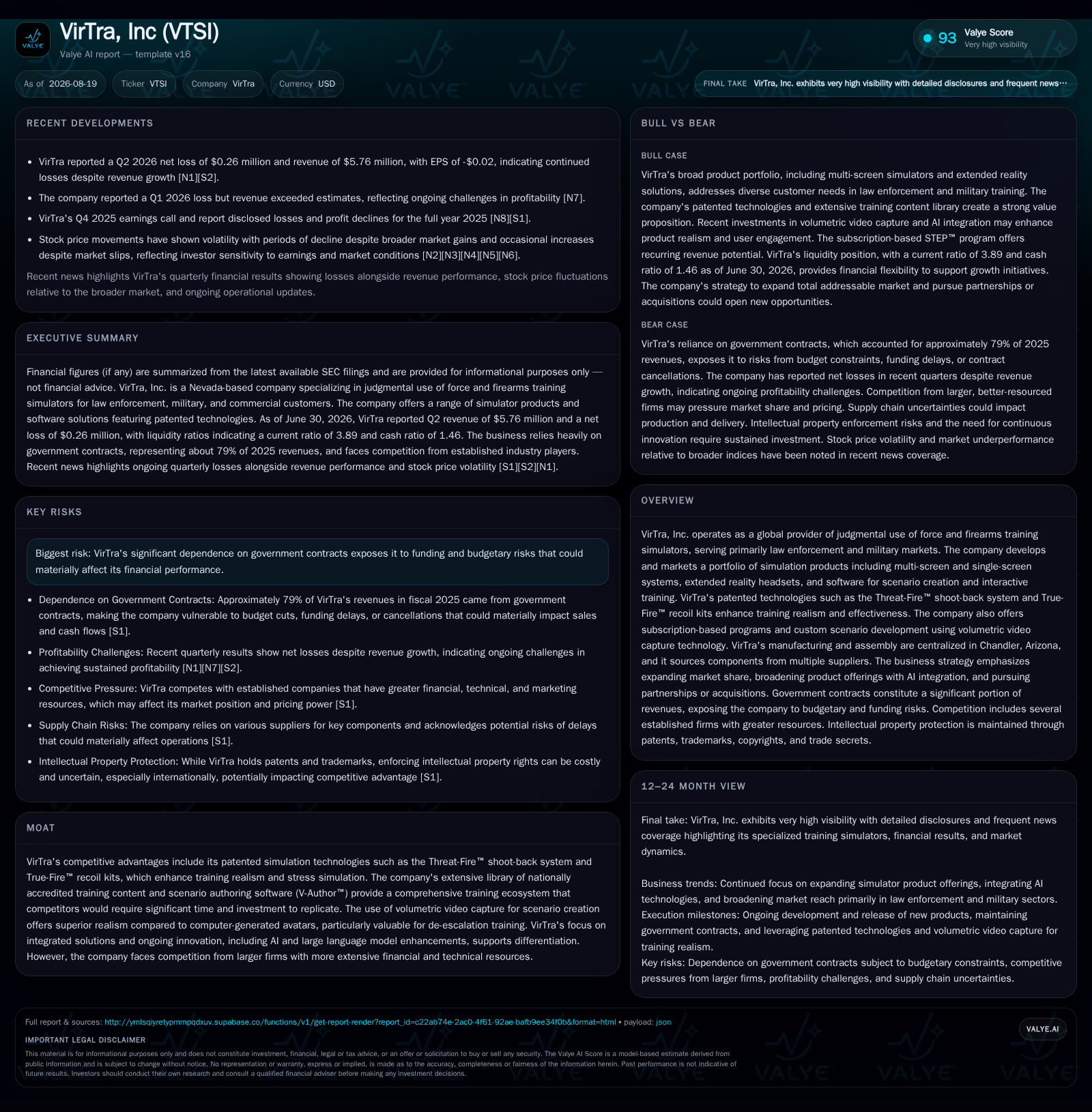
VirTra, Inc. reported Q2 2026 revenue exceeding analyst estimates, reflecting sustained demand for its patented firearms and use-of-force training simulators primarily sold to government agencies. The company continues to integrate AI and volumetric video capture technologies into its scenario development software, enhancing training realism and scenario authoring capabilities. Despite a strong liquidity position with a current ratio of 3.89 as of June 30, 2026, VirTra remains exposed to government budgetary and contracting risks that could impact future backlog and cash flow.
Product Innovation and Strategic Technology Integration
VirTra, Inc. continues to advance its product portfolio by integrating artificial intelligence (AI) and volumetric video capture technology into its scenario authoring software. These enhancements aim to improve the realism and effectiveness of judgmental use-of-force and firearms training simulators, which are central to the company's offerings. VirTra's patented technologies, including the Threat-Fire™ shoot-back system and True-Fire™ recoil kits, further augment training realism by simulating recoil and interactive target responses. The integration of AI and volumetric video supports more immersive and customizable training scenarios, potentially increasing the company's competitive differentiation in a market where realistic, scenario-based training is critical for law enforcement and military customers [S1].
The use of volumetric video capture allows VirTra to create three-dimensional, lifelike training scenarios that can be manipulated and adapted to various training needs. This technology, combined with AI-driven scenario development, enables the company to offer dynamic and evolving training environments that better prepare trainees for real-world situations. Such innovation not only enhances the effectiveness of training but also positions VirTra to capture additional market share by meeting the increasing demand for sophisticated simulation solutions.
Latest Quarterly Operating Performance
In the second quarter ended June 30, 2026, VirTra reported revenue that exceeded analyst estimates, indicating sustained demand for its specialized training simulators and software solutions [S2][N1]. This revenue performance reflects ongoing government procurement activity and the company's ability to meet customer needs with its patented and technologically advanced products. The positive revenue surprise suggests that despite broader uncertainties in government budgets, VirTra's offerings remain relevant and in demand.
As of June 30, 2026, VirTra held cash and cash equivalents of $14.3 million and a current ratio of 3.89 [F1]. This level of liquidity may provide the company with some operational flexibility to manage the timing of government payments and invest in ongoing product development. This concentration exposes the company to risks related to government budget constraints, funding delays, and changes in procurement policies. Such risks could materially affect VirTra's backlog, revenue streams, and cash flow.
The company faces several specific risk factors including potential budget cuts affecting defense and transit agencies, reallocation of government resources due to geopolitical events, and increased demands for indemnification provisions in contracts. Additionally, government procurement practices such as the use of lowest-priced technically acceptable criteria and shorter contract durations increase competitive pressures and the frequency of recompeting for contracts [S1].
These factors underscore the cyclical and politically sensitive nature of VirTra's business. While the company benefits from a diversified customer base across various government levels, the overall dependence on government spending makes its revenue and backlog vulnerable to shifts in fiscal policy and appropriations.
Financial Position and Liquidity Analysis
VirTra's liquidity metrics as of June 30, 2026, demonstrate a balance sheet capable of supporting ongoing operations and strategic investments [F1][S2]. Working capital, defined as current assets minus current liabilities, stands at approximately $28.0 million, reflecting a strong operational liquidity position [F1]. This financial strength is critical given the timing uncertainties inherent in government contract payments and the need to fund research and development initiatives, particularly in AI and volumetric video technologies.
Margins and cash flow are influenced by the product mix, contract terms, and component sourcing costs. VirTra sources key components from various suppliers on a purchase order basis, which allows some flexibility but also exposes the company to supply chain risks and cost fluctuations [S1]. Operational efficiency in manufacturing and software development remains essential to maintaining healthy margins.
Scenario Analysis and Investment Implications
Bull Case: If government funding remains stable or grows and VirTra successfully expands its AI-enhanced product offerings, the company could increase market share and improve margins [S1][S2]. Sustained government demand combined with differentiated patented technology and innovation supports revenue growth and competitive positioning. Confirmation would come from increased backlog or contract awards, rising subscription revenue or software adoption, and improved margin trends. This scenario assumes stable or increased government budgets for training simulators, successful AI integration and customer adoption, and no significant competitive displacement.
Base Case: VirTra maintains steady revenue and liquidity with moderate growth driven by ongoing government contracts and incremental product enhancements [S1][S2][F1]. The company’s entrenched position and patented technology provide a stable base, but government funding volatility limits rapid expansion. Stable revenue and backlog levels, consistent liquidity ratios, and incremental product updates would confirm this scenario. Conditions include flat government budgets, uninterrupted product innovation, and manageable competitive pressures.
Bear Case: Government budget cuts or procurement delays materially reduce VirTra’s backlog and revenue, straining liquidity and limiting investment in innovation [S1]. High government contract concentration exposes the company to funding risks, and competition from larger firms could erode market share. Signs would include declining backlog and revenue, liquidity ratio deterioration, and reduced R&D spending. This scenario depends on significant government budget reductions, loss or delay of key contracts, and increased competitive pressure.
Business Economics and Watchpoints
VirTra's business model centers on selling integrated hardware-software training simulators primarily to government agencies, including law enforcement and military customers. Customers purchase integrated judgmental use-of-force and firearms training simulators that include hardware components such as multi-screen video-based scenarios, patented Threat-Fire™ shoot-back systems, gas-powered simulated recoil weapons, scenario authoring software, and training scenarios [S1][S2]. Revenue is generated from sales of simulator systems, software licenses, subscription-based training content, and custom scenario development services, often through government contracts and subcontracts.
Margins and cash flow depend on the product mix, terms of government contracts, component sourcing costs from various suppliers, and operational efficiency in manufacturing and software development [S1][S2]. VirTra's patented technologies, unique scenario authoring capabilities, and extensive accredited training content differentiate it in the market; however, dependence on government contracts, budgetary constraints, competitive pressures, and government procurement risks constrain growth.
These watchpoints will provide insight into the company's ability to sustain growth and manage risks associated with its government contract dependence.
In summary, VirTra's strategic emphasis on AI and volumetric video integration may enhance its product differentiation and could support potential growth in a government-dependent market. While Q2 2026 results demonstrate operational momentum, the company's exposure to government budgetary risks remains a critical factor shaping its near-term outlook. The reported liquidity position may provide a basis for continued innovation and operational resilience, but vigilance is warranted given the cyclical nature of government funding and competitive dynamics.

Comments