
Box Inc 2026: Leveraging a Dual Go-to-Market Strategy for Growth
Box Inc's combined enterprise sales and viral adoption approach underpins its customer acquisition and retention, supported by targeted investments and stable liquidity.
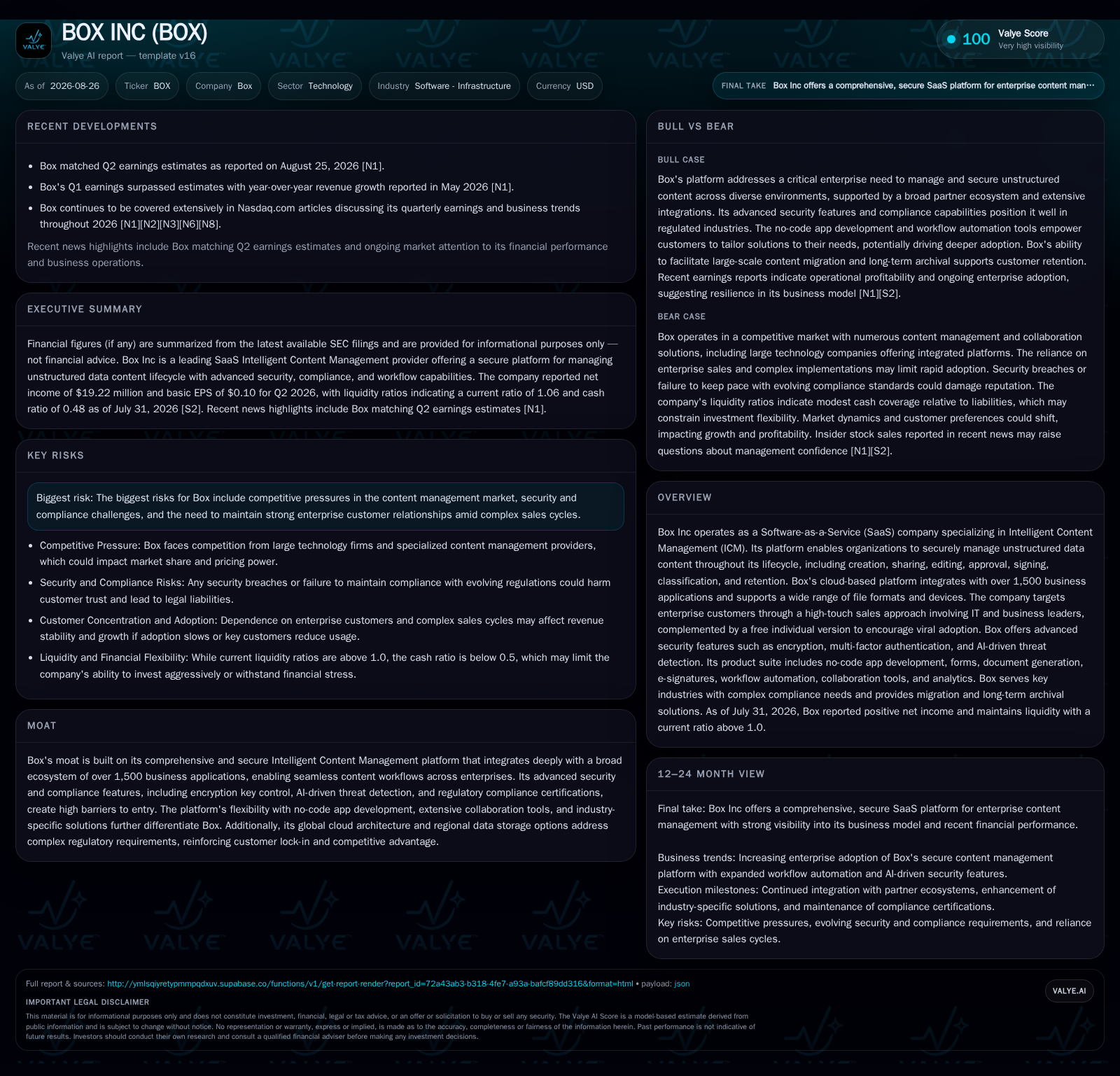
Box Inc’s 2026 filings reveal a go-to-market strategy that blends high-touch enterprise sales with viral adoption via a free individual version, driving customer growth and retention. The company continues to invest in research and development, sales and marketing, cloud hosting, and professional services to enhance its Intelligent Content Management platform. As of July 31, 2026, Box maintains a current ratio of 1.06, reflecting sufficient liquidity to support ongoing investments. This dual approach and financial foundation position Box to sustain growth in a competitive SaaS content management market.
Go-to-Market Strategy Overview
Box Inc’s 2026 annual filing details a dual go-to-market approach that integrates high-touch enterprise sales with viral adoption via a free individual version of its platform [S1]. This strategy enables Box to engage IT decision makers and line of business leaders directly during enterprise sales cycles while simultaneously allowing individual users to experience the Intelligent Content Management (ICM) platform without upfront commitment. Viral adoption often leads to organic expansion within and across organizations, complementing the enterprise sales efforts. This combined approach supports customer acquisition and retention by addressing both top-down and bottom-up demand dynamics.
The Box ICM platform is designed to manage unstructured content securely throughout its lifecycle, supporting collaboration, workflow automation, compliance, and integration with over 1,500 business applications [S1]. Its extensive security and compliance features cater to enterprise requirements, while the platform’s flexibility—including no-code app development and a broad partner ecosystem—enhances its appeal and stickiness. This ecosystem of partners, including software vendors and consulting services, broadens Box’s market reach and use cases.
Supporting Investment and Financial Context
Box’s Q2 2026 10-Q filing discloses ongoing investments in research and development, sales and marketing, public cloud hosting, and professional services [S2]. These investments may support product innovation, customer acquisition, and scalable infrastructure, which could contribute to sustaining competitive positioning in the SaaS Intelligent Content Management market.
The company also reports non-cancellable operating lease agreements for office spaces with terms primarily expiring between fiscal years 2028 and 2037 [S2]. These leases include variable payments based on actual consumption, such as common area maintenance and utilities, which influence Box’s fixed cost structure and capital allocation decisions.
As of July 31, 2026, Box’s balance sheet shows current assets of $757.9 million against current liabilities of $715.8 million, resulting in a current ratio of 1.06 [F1]. This ratio indicates that Box maintains modest positive working capital, with sufficient near-term liquidity to meet its obligations and fund ongoing investments. Cash and equivalents stand at $342.9 million, providing a financial foundation to support operational needs and growth initiatives [F1].
Business Model and Competitive Positioning
Box operates a subscription-based SaaS business model focused on enterprise customers who pay recurring fees for access to the Intelligent Content Management platform [S1]. The platform’s integration with a broad ecosystem of over 1,500 business applications, combined with advanced security and compliance features, creates a structural advantage by addressing diverse enterprise content management needs.
Revenue is primarily derived from annual and multi-year subscription contracts with negotiated invoice frequencies. Sales channels include high-touch enterprise engagements, self-service online platforms, and channel partners such as value-added resellers and systems integrators [S1]. This diversified sales approach complements the viral adoption strategy, facilitating both large contract wins and organic user growth.
The scalable cloud infrastructure and customer retention underpin margins and cash flow generation, while the partner ecosystem expands use cases and market reach. These factors collectively support Box’s competitive positioning in a growing SaaS Intelligent Content Management market.
Analytical Conclusions and Scenario Analysis
Box’s disclosed investment strategy in Q2 2026 signals a focused growth approach aimed at enhancing platform capabilities and expanding market penetration [S2]. Continued spending on R&D, sales and marketing, and cloud hosting is essential to maintain innovation, attract new customers, and support scalable operations. The company’s current ratio of 1.06 as of July 31, 2026, confirms a stable liquidity position sufficient to support these investments without immediate financial constraints [F1].
One plausible scenario is that Box successfully leverages its dual go-to-market strategy, sustaining steady customer growth and retention supported by ongoing investments and a stable liquidity position with cash and equivalents of $342.9 million as of July 31, 2026 [F1]. Confirmation of this scenario would come from consistent or improving net retention rates and annual recurring revenue growth, alongside stable or expanding margins reflecting operating leverage.
Conversely, competitive pressures or macroeconomic factors could dampen enterprise IT spending and reduce the effectiveness of viral adoption, forcing Box to scale back investments and impair growth momentum [S2][F1]. Evidence supporting this downside would include reduced R&D and sales expenses, signs of customer churn, or contract non-renewals.
Investors should monitor future quarterly disclosures for metrics such as ARR growth, net retention rates, changes in investment levels, and indicators of viral adoption conversion and enterprise sales pipeline health. These data points will clarify the trajectory of Box’s growth strategy execution and financial resilience.
In summary, Box’s combined enterprise and viral go-to-market strategy, alongside ongoing investments and its current financial position, could influence the company’s ability to navigate the competitive SaaS Intelligent Content Management landscape. The interplay of these factors may affect its capacity to sustain growth and respond to enterprise demand for secure, integrated content management solutions.

Comments