
Cabaletta Bio Q2 2026: Advancing Registrational Trials and Manufacturing Scale-Up with Strong Liquidity
Cabaletta Bio progresses its lead CAR T therapy rese-cel into registrational trials for autoimmune diseases while scaling manufacturing and maintaining robust liquidity.
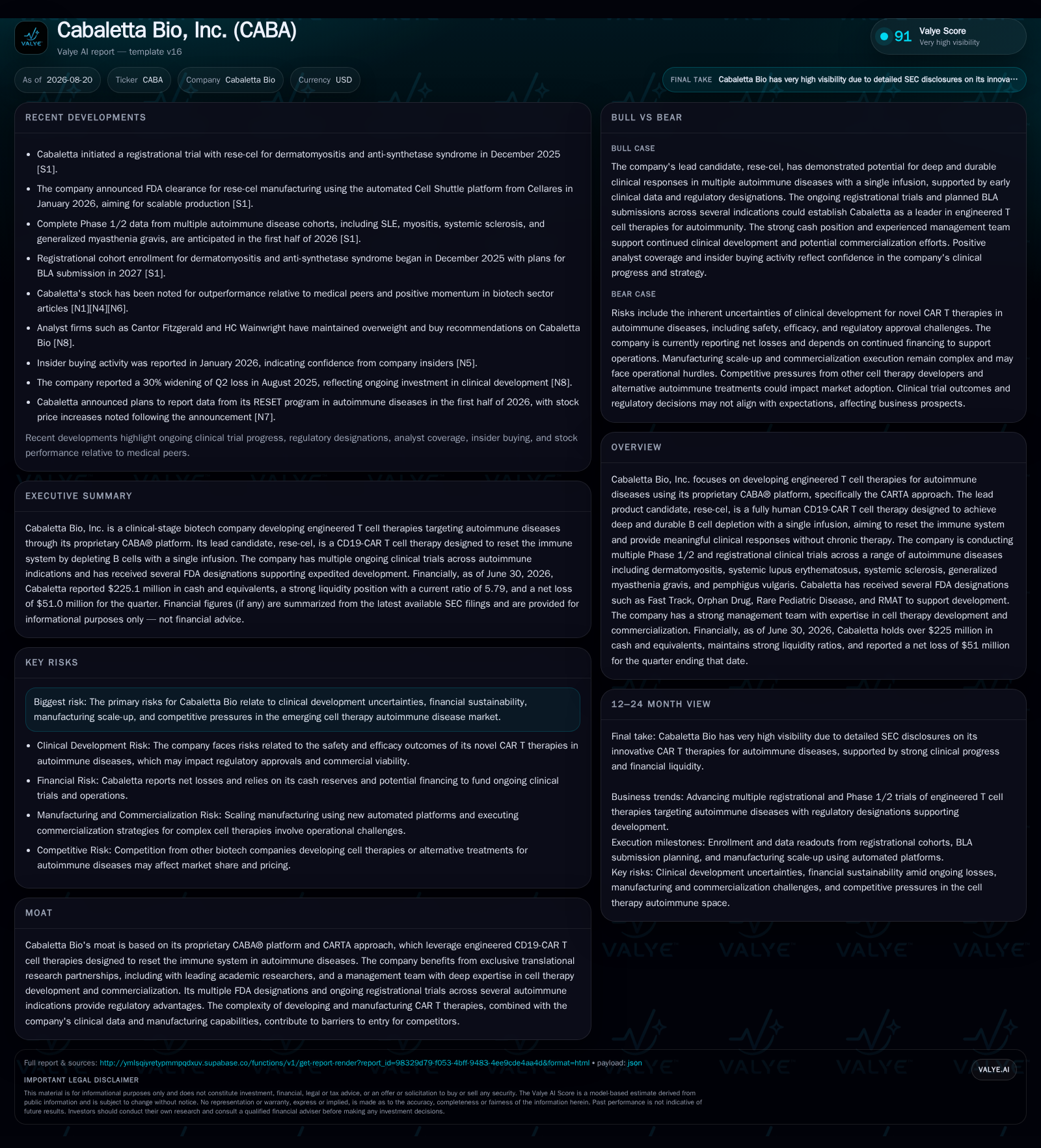
In Q2 2026, Cabaletta Bio initiated a registrational clinical trial for rese-cel targeting dermatomyositis and anti-synthetase syndrome, marking a pivotal step toward potential regulatory approval. The company is also scaling manufacturing using the automated Cell Shuttle platform to support future commercial supply. Despite no product revenues and early-stage clinical status, Cabaletta holds $225.1 million in cash and equivalents as of June 30, 2026, supporting ongoing development. Key risks remain around clinical outcomes and manufacturing scale-up success, which will determine the therapy’s commercial viability.
Clinical Development Progress
Cabaletta Bio advanced its lead CAR T therapy candidate, rese-cel, by initiating a registrational clinical trial in December 2025 targeting dermatomyositis and anti-synthetase syndrome, two autoimmune diseases with significant unmet medical needs [S1][S2]. Registrational trials are intended to generate data that may be used by regulatory authorities to evaluate potential approval, representing a development stage beyond early-phase trials. Alongside this, the company continues multiple Phase 1/2 trials evaluating rese-cel in systemic lupus erythematosus (SLE), systemic sclerosis (SSc), generalized myasthenia gravis (gMG), and pemphigus vulgaris (PV), including studies with and without preconditioning regimens [S1][S2]. These ongoing trials reflect a broad clinical development strategy aiming to assess safety and efficacy across diverse autoimmune indications.
Despite these advances, Cabaletta remains early-stage with no completed clinical trials or product revenues as of Q2 2026, underscoring the substantial clinical and regulatory risks inherent in its pipeline [S2]. Successful clinical outcomes and regulatory approvals remain uncertain, and timelines to potential commercialization extend several years into the future.
Manufacturing Scale-Up and Technology
A key development supporting Cabaletta's path to commercialization is the scale-up of rese-cel manufacturing using the automated Cell Shuttle platform from Cellares [S1]. This platform enables automated production processes designed to improve scalability and reduce capital intensity compared to traditional manual manufacturing methods. The company aims to produce rese-cel for thousands of patients annually with minimal capital investment, which could materially enhance its ability to supply commercial volumes efficiently.
Automated manufacturing is critical in the cell therapy sector, where production complexity and costs often limit commercial viability. By leveraging the Cell Shuttle platform, Cabaletta could achieve improved cost structures and throughput, positioning itself competitively in the autoimmune CAR T therapy market. The company reported $225.1 million in cash and equivalents and a current ratio of 5.79, with current assets of $231.0 million against current liabilities of $39.9 million [F1]. This liquidity buffer provides a runway to fund operations without immediate financing concerns, which is important given the extended timelines and high costs typical of clinical-stage biotechnology firms.
Risks and Uncertainties
Cabaletta faces significant risks typical of early-stage biotech companies developing novel cell therapies. The clinical development of rese-cel involves uncertainty around safety, efficacy, patient enrollment, and regulatory approval [S2]. Failure to demonstrate positive clinical outcomes in registrational or Phase 1/2 trials could delay or prevent commercialization.
Manufacturing scale-up also presents operational risks. The transition to automated production must meet stringent quality and regulatory requirements. Manufacturing failures or cost overruns could impair supply capabilities and increase capital needs.
Future revenues depend on successful regulatory approvals and commercialization, with healthcare providers and payers expected to purchase therapies post-approval.
Margins and cash flow in this sector hinge on manufacturing efficiency, pricing, reimbursement, and market uptake. The automated Cell Shuttle platform could reduce manufacturing costs and support supply for thousands of patients annually, which is critical for achieving sustainable margins in cell therapy.
The initiation of registrational trials represents a key milestone toward regulatory approval and potential commercialization. Positive clinical data and successful manufacturing scale-up would be necessary to validate the therapy’s commercial prospects. Conversely, clinical failures, manufacturing challenges, or regulatory delays would materially impair value creation.
Watchpoints
Investors should closely monitor interim and final data readouts from the registrational trial in dermatomyositis and anti-synthetase syndrome, as well as ongoing Phase 1/2 trials in other autoimmune indications. These data will provide critical evidence on safety and efficacy to support regulatory submissions.
Updates on manufacturing scale-up progress and capacity utilization of the Cell Shuttle platform will be important to assess the company’s ability to meet future commercial demand cost-effectively. Any delays or quality issues could signal operational risks.
Cash burn rate and announcements of financing or capital raises will indicate financial sustainability and the need for additional capital to fund development.
Finally, regulatory interactions and FDA feedback on ongoing trials will provide insight into approval likelihood and potential timing.
Conclusion
Cabaletta Bio’s Q2 2026 developments reflect progress in advancing its lead CAR T therapy rese-cel toward regulatory approval and commercialization. The initiation of registrational trials and manufacturing scale-up using an automated platform are important operational milestones. The company remains early-stage with no product revenues and faces substantial clinical, manufacturing, and financial risks. The coming quarters will be important to assess the clinical and operational progress and the potential of rese-cel in autoimmune disease treatment.

Comments