
BK Technologies Q2 2026: Revenue Growth and Strong Liquidity Amid Competitive Pressures
BK Technologies reported Q2 2026 revenue growth driven by P25 radios and SaaS solutions alongside increased contract manufacturing utilization and a solid liquidity position.
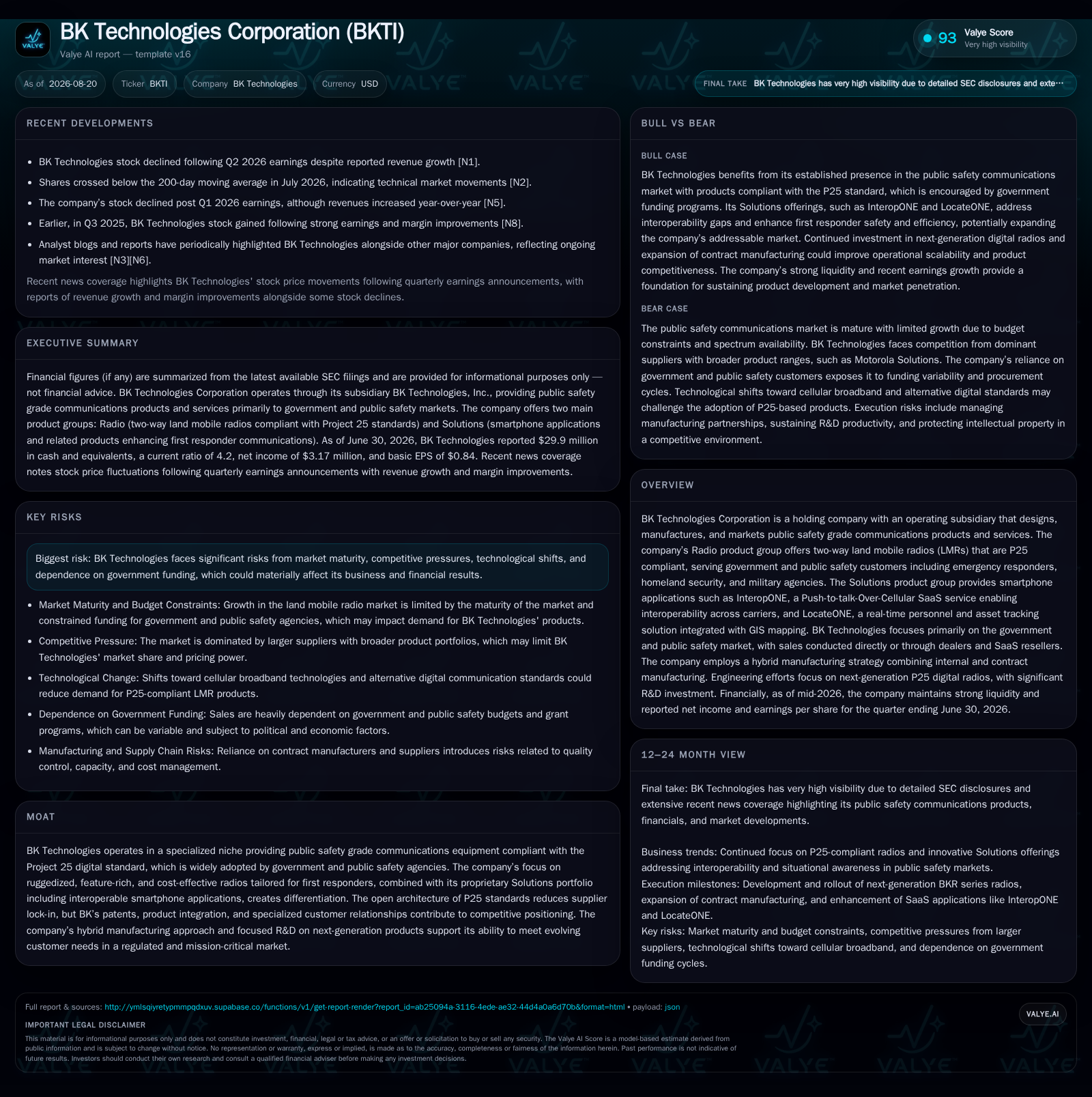
In Q2 2026, BK Technologies demonstrated revenue growth fueled by higher sales of Project 25 (P25)-compliant radios and SaaS offerings, reflecting sustained demand in a mature public safety communications market. The company is strategically increasing its use of contract manufacturing to enhance production flexibility and manage costs amid competitive bidding pressures. BK Technologies also maintains a strong liquidity profile with $29.9 million in cash and a current ratio of 4.2 as of June 30, 2026, supporting operational needs and share repurchase capacity. However, structural challenges including market maturity, dominant competitors, and government budget constraints continue to limit margin expansion and growth sustainability.
BK Technologies Corp reported increased revenue and a higher share of contract manufacturing utilization for the second quarter ended June 30, 2026, compared to prior periods [S2],[S3]. This growth reflects sustained demand for the company's interoperable, ruggedized P25 radios and complementary SaaS solutions, which serve government and public safety customers. The operational shift toward greater contract manufacturing enhances production flexibility and cost efficiency, positioning BK Technologies to better meet market demand in a mature and competitive industry [S1].
The public safety Land Mobile Radio (LMR) market in which BK operates is structurally mature. Growth is constrained by limited radio frequency spectrum availability and government budget restrictions that cap procurement spending. This approach reduces fixed manufacturing overhead by outsourcing portions of production to third-party manufacturers, allowing BK to better scale capacity in response to fluctuating demand. Current assets totaled $60.5 million against current liabilities of $14.4 million. This liquidity profile supports the company's operational needs and provides flexibility for capital allocation, including its ongoing share repurchase program authorized for up to $5 million, funded by cash on hand and operations [F1],[S1].
These products align closely with government interoperability requirements and benefit from ongoing equipment upgrades funded by federal grants and state and local agency budgets [S2],[S3]. The P25 standard, designed to maximize spectrum efficiency and interoperability among public safety agencies, continues to be a key purchasing criterion, which could support demand despite the overall market maturity [S1].
The company’s Solutions segment, including smartphone applications operating over public cellular networks, complements its radio hardware by enhancing situational awareness and interagency coordination for first responders. This integrated offering helps BK differentiate its products and expand sales reach, contributing to revenue growth alongside traditional radio sales [S2],[S3].
Manufacturing Strategy and Cost Management
BK Technologies has increased its utilization of contract manufacturing resources, a strategic shift aimed at improving production flexibility and managing costs more effectively [S1]. By outsourcing a greater portion of manufacturing to third-party providers, BK reduces fixed overhead and gains the ability to scale production capacity in response to fluctuating demand. This hybrid manufacturing model balances internal control with operational agility.
This shift is particularly relevant in a market characterized by competitive bidding and pricing pressures, especially from dominant competitors with broader product portfolios [S1]. Contract manufacturing can help BK manage labor and material costs, potentially supporting margin improvement, although explicit margin data for Q2 2026 has not been disclosed.
Liquidity and Financial Position
As of June 30, 2026, BK Technologies held cash and cash equivalents of $29.9 million, with current assets of $60.5 million against current liabilities of $14.4 million, resulting in a strong current ratio of 4.2 [F1]. This liquidity position provides a solid buffer against the uncertainties inherent in government procurement cycles and budget constraints.
The company’s authorized share repurchase program, allowing up to $5 million in repurchases funded by cash on hand and operations, indicates availability of financial resources consistent with its recent cash balances [S1]. The open architecture of the P25 standard fosters interoperability and competition, limiting supplier lock-in but also intensifying competitive pressures. This environment constrains BK’s pricing power and market share expansion.
Government procurement processes, typically conducted through competitive bidding, impose pricing discipline and require significant resources to secure contracts [S1]. The bidding process involves costs and managerial time, and even successful bids may be subject to inaccurate cost estimation risks, potentially impacting profitability.
The mature nature of the public safety LMR market, combined with government budget constraints and spectrum limitations, restricts growth potential. These structural factors pose ongoing challenges for BK Technologies in sustaining revenue growth and expanding margins.
Investment Scenarios and Outlook
A bull scenario is that BK Technologies successfully leverages its hybrid manufacturing model and proprietary SaaS solutions to expand market share and improve margins. This would require sustained government funding for public safety communications, successful execution of the contract manufacturing strategy, and continued adoption of BK's SaaS offerings. Confirmation would come from accelerating quarterly revenue growth, margin improvements, and increased SaaS subscription metrics [S2],[S3],[S1].
The base case envisions stable revenue with modest growth and steady margins, reflecting the market's maturity and budget constraints. BK's niche focus and operational adjustments, including contract manufacturing, could sustain performance in this scenario. Confirmation would include flat to modest revenue growth, stable margins, and consistent liquidity levels [S2],[S1].
A bear scenario involves revenue declines and margin pressure due to intensified competition and reduced government funding. If contract manufacturing fails to offset cost pressures or BK loses key contracts, financial performance could deteriorate. Indicators would be quarterly revenue declines, margin compression, and worsening liquidity ratios [S1],[S2].
Conclusion and Watchpoints
BK Technologies' Q2 2026 results demonstrate ongoing demand for P25-compliant radios and SaaS solutions amid a mature and competitive market. The strategic increase in contract manufacturing utilization aims to improve cost efficiency and production flexibility, which may support margin expansion if effectively managed.
Key watchpoints for investors include quarterly revenue growth trends in P25 radios and SaaS solutions as supported by recent filings [S2],[S3], gross and operating margin progression, disclosures on contract manufacturing utilization and cost impact, government budget and grant funding announcements affecting public safety communications, and liquidity and cash flow statements in upcoming filings. These factors will be critical in assessing BK Technologies' ability to sustain growth and profitability in a challenging market environment.

Comments