
BJ's Wholesale Club Q2 2026: Membership Growth and Share Repurchases Drive Operating Momentum
BJ's Wholesale Club reported sustained membership expansion and significant share repurchases in Q2 2026, alongside liquidity constraints that may affect its operational flexibility.
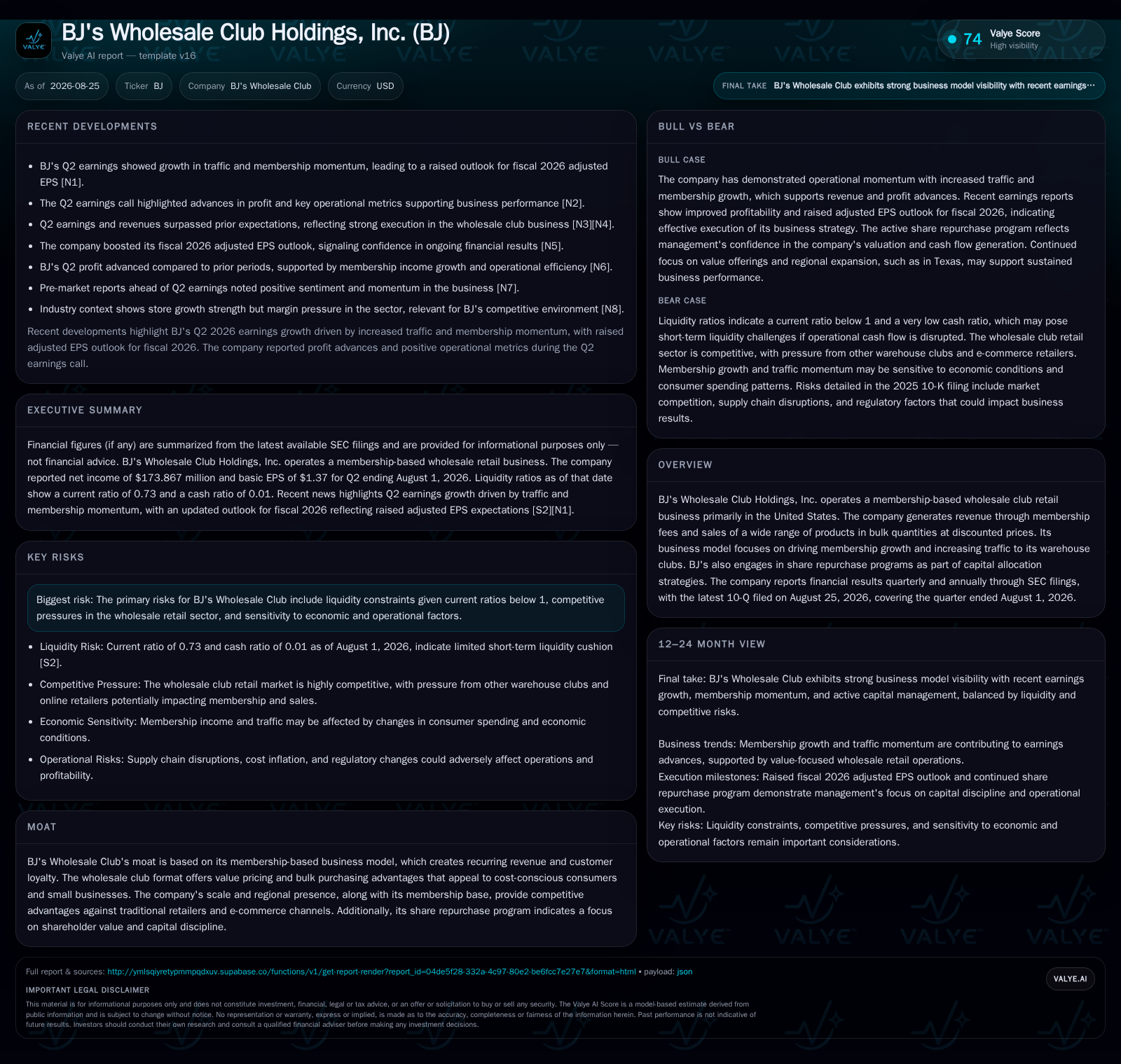
In the second quarter of fiscal 2026, BJ's Wholesale Club demonstrated continued membership growth and increased customer traffic, supporting its revenue momentum. The company repurchased approximately 1.38 million shares under its 2024 Share Repurchase Program, reflecting active capital return efforts. However, a current ratio of 0.73 as of August 1, 2026, indicates liquidity constraints that could impact near-term financial flexibility. BJ's is also investing in supply chain capacity with a new distribution center in Ohio, expected to open in 2027, to support future growth.
Q2 2026 Operating Performance and Membership Trends
BJ's Wholesale Club reported sustained growth in its membership base and increased customer traffic during the second quarter of fiscal 2026, which ended August 1, 2026 [S2]. In the membership-based wholesale club retail sector, membership fees represent a critical source of recurring revenue, while traffic and sales volume drive net sales and profitability. BJ's model relies on members paying annual fees—typically $60 for Club membership and $120 for Club+ membership—to access bulk quantities of groceries, fresh foods, general merchandise, gasoline, and ancillary services [S1]. The continued expansion in membership and traffic in Q2 2026 supports revenue momentum by increasing both the stable membership fee income and the volume of sales within warehouse clubs.
Capital Allocation and Share Repurchase Activity
During Q2 2026, BJ's repurchased approximately 1.38 million shares of its common stock under its 2024 Share Repurchase Program, which authorizes up to $1 billion in buybacks and expires in January 2029 [S2]. The repurchases occurred at an average price ranging from $85.26 to $90.42 per share over the quarter. Share repurchases reduce the outstanding share count, potentially enhancing earnings per share and other per-share financial metrics. This activity signals a prioritization of capital return to shareholders within the company's capital allocation framework.
However, the share repurchase program must be considered alongside BJ's liquidity position. While repurchases can support shareholder value, they also consume cash resources that might otherwise be used for operational needs or growth investments. The balance between returning capital and maintaining sufficient liquidity is a critical consideration for BJ's near-term financial strategy.
Liquidity and Balance Sheet Position
As of August 1, 2026, BJ's Wholesale Club reported current assets of approximately $2.17 billion against current liabilities of about $2.97 billion, resulting in a current ratio of 0.73 [F1]. This working capital deficit could limit the company's operational flexibility, including funding for inventory purchases, day-to-day expenses, or capital projects.
BJ's total debt stood at $630 million with net debt of roughly $600 million as of the same date, reflecting leverage that requires ongoing management to avoid covenant breaches or refinancing risks [F1]. The liquidity position, combined with active share repurchases, presents a scenario where BJ's must carefully balance capital returns with maintaining sufficient liquidity to support operations and growth.
Business Model and Supply Chain Expansion
BJ's business model centers on generating recurring revenue from membership fees and driving sales volume through bulk purchases in warehouse clubs. The membership model fosters customer loyalty and stable cash flow, while value pricing and private label penetration support margins [S1]. The company emphasizes offering significant savings—up to 25% compared to traditional supermarkets—on a representative basket of manufacturer-branded groceries, enhancing its value proposition to members.
To support ongoing growth, BJ's is constructing a fourth non-perishable distribution center in Ohio, expected to open in 2027 [S1]. This new facility will expand the company's supply chain capacity and operational scalability, enabling it to serve a growing membership base and geographic footprint. Membership fees provide a stable recurring revenue base, while increased traffic supports higher sales volume, directly impacting profitability [S2]. This operating performance underpins the company's ability to generate cash flow and invest in growth.
Conversely, the active share repurchase program, while potentially enhancing shareholder value by reducing share count, must be weighed against BJ's liquidity constraints. The current ratio of 0.73 indicates working capital deficits that could restrict operational flexibility and capital allocation [F1]. This tension suggests that BJ's near-term financial strategy will require balancing capital returns with maintaining sufficient liquidity.
Investors and observers should monitor several key indicators in upcoming quarters: membership growth and retention rates, traffic and same-store sales trends, liquidity ratios and working capital changes, share repurchase volumes and authorizations, and progress on the new distribution center's opening. Improvement in liquidity metrics or sustained membership expansion would support a positive outlook, while deterioration in these areas could signal operational or financial challenges.
Scenarios
One possible positive scenario is that BJ's continues to grow its membership base and traffic, accelerating revenue and profitability. This would support further share repurchases and potential margin expansion, especially if the supply chain expansion is executed effectively and liquidity is managed prudently. Confirmation would come from future filings showing sustained membership growth, improved liquidity ratios, and higher operating margins.
This might slow growth initiatives and force a reduction in share repurchases to preserve cash. Confirmation of this scenario would include worsening liquidity ratios, reduced or suspended share repurchase activity, and negative operating cash flow trends.
How the company manages this balance will be critical to its near-term performance and financial health.

Comments