
Electromed Q4 2026: Sustained Growth in Homecare HFCWO Sales and Strong Liquidity Position
Electromed’s fiscal 2026 results highlight continued revenue growth in its core homecare airway clearance market supported by a direct-to-patient sales model and a solid balance sheet.
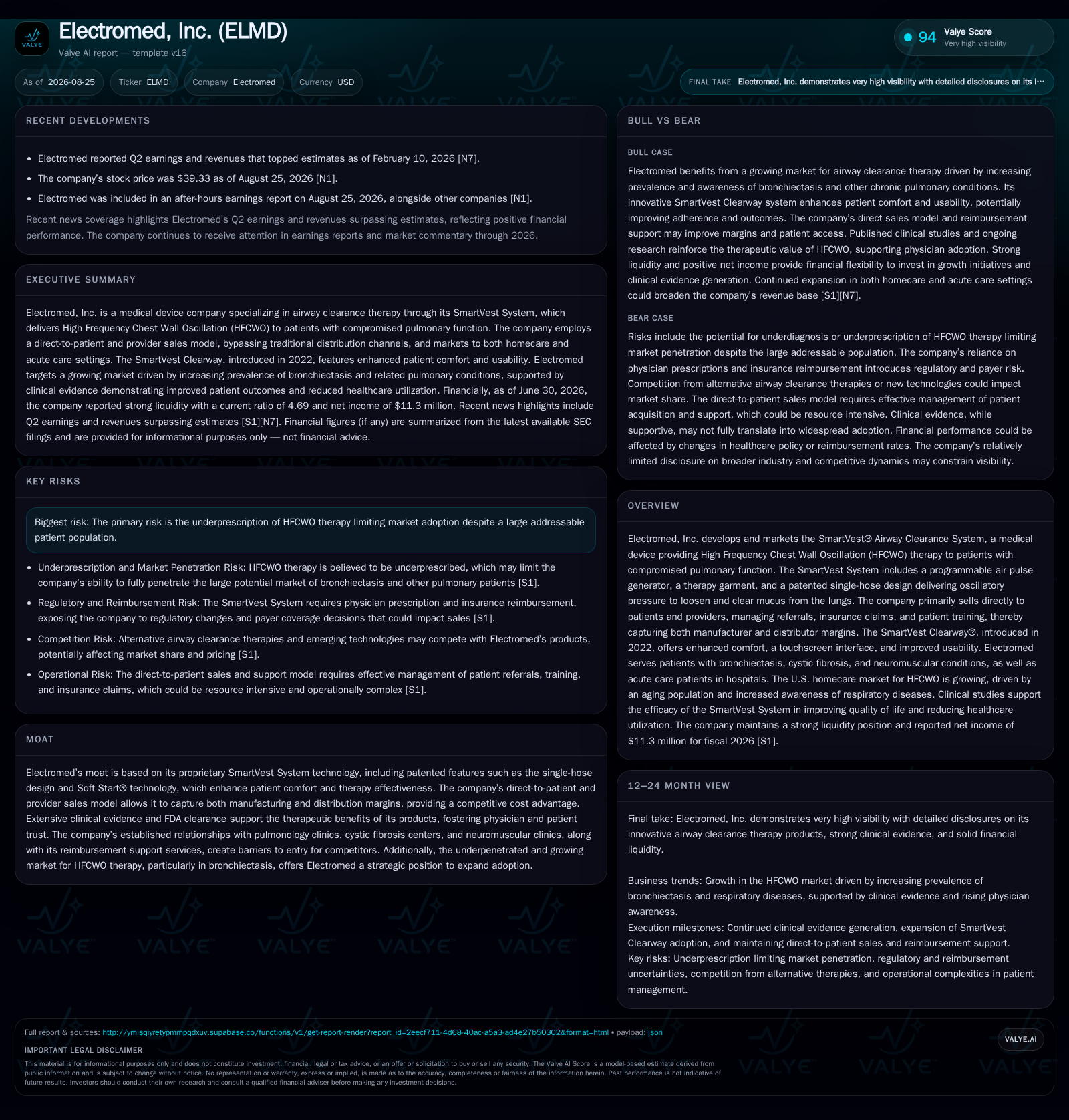
Electromed, Inc. reported sustained revenue growth in its homecare High Frequency Chest Wall Oscillation (HFCWO) segment for fiscal 2026, driven by its direct-to-patient and provider sales approach. Approximately 95.3% of its $73.4 million revenue originated from the U.S. homecare market, reflecting strong market penetration. The company maintains a robust liquidity position with a current ratio of 4.69 as of June 30, 2026, supporting ongoing investments in sales expansion and product innovation. A recent executive retirement announcement introduces potential leadership transition risks amid efforts to accelerate adoption in an underpenetrated therapy area.
Electromed, Inc. reported sustained revenue growth in its homecare High Frequency Chest Wall Oscillation (HFCWO) sales for the fiscal year ended June 30, 2026, driven by its direct-to-patient and provider sales model [S2]. Electromed’s focus on direct patient referrals, insurance claim management, and home delivery of its SmartVest System could enable it to capture both manufacturer and distributor margins, which may contribute to competitive differentiation in airway clearance therapy.
The company’s direct-to-patient and provider sales model plays a pivotal role in driving this revenue growth [S1]. By managing patient referrals from clinicians, insurance claim processing, device delivery, and patient training internally, Electromed disintermediates traditional home medical equipment distributors. This approach allows the company to capture both manufacturer and distributor margins, enhancing revenue capture and supporting sustainable growth.
Business Model and Market Position
Electromed’s SmartVest System is designed to provide effective and comfortable airway clearance therapy through patented features such as a single-hose design and Soft Start® technology. These innovations improve patient comfort and adherence to prescribed therapy regimens, which are critical factors in clinical outcomes and healthcare cost reduction [S1]. The system includes a programmable air pulse generator and therapy garments tailored for both adults and children, facilitating ease of use and personalized treatment.
The company’s direct sales model not only improves margin capture but also enables better control over patient adherence and reimbursement processes [S1]. By handling insurance claims and patient training internally, Electromed mitigates risks associated with underprescription and reimbursement delays, which are common challenges in the HFCWO homecare market. This integrated approach creates competitive differentiation and supports the company’s efforts to expand market penetration in a therapy area that remains underutilized despite clinical evidence supporting its efficacy.
Financial Condition and Liquidity
As of June 30, 2026, Electromed reported a current ratio of 4.69, supported by $20.45 million in cash and equivalents and $57.37 million in current assets against $12.22 million in current liabilities [F1]. This liquidity position may provide the company with resources to invest in growth initiatives, including sales force expansion and ongoing product innovation.
The strong working capital position reduces short-term refinancing risk and supports operational stability. Such financial health is particularly important given the company’s focus on increasing adoption of HFCWO therapy in an underpenetrated market where sales growth depends on sustained investment in education, reimbursement support, and product enhancements [F1].
Management and Governance Update.
In August 2026, Electromed announced the planned retirement of a key executive, Mr. Cunniff [S3]. While the company has not disclosed further details regarding succession plans, this leadership transition introduces potential risks related to strategic execution and investor confidence. Maintaining continuity in management will be important as Electromed seeks to capitalize on market opportunities and navigate challenges inherent in expanding therapy adoption.
Investment Risks and Market Adoption Challenges
A primary risk facing Electromed is the underprescription of HFCWO therapy by physicians, which could limit patient adoption despite the company’s product innovation and direct sales efforts [S1]. The homecare airway clearance market remains structurally underpenetrated, and growth depends heavily on increasing physician and patient awareness, favorable reimbursement policies, and patient adherence.
Changes in reimbursement environments or competitive dynamics could adversely affect revenue growth and margins. Continued success will require the company to sustain investment in sales and education initiatives, monitor referral and patient start volumes closely, and adapt to evolving payer policies.
Business Economics and Outlook
Electromed’s integrated direct-to-patient/provider sales model enhances its economic position by capturing higher margins and improving control over the revenue cycle. This model supports sustainable revenue growth by aligning incentives across manufacturing, distribution, and patient education.
The company’s reported liquidity position may facilitate investment in product development and sales expansion, which could be important for addressing structural barriers such as underprescription and limited market penetration. The patented SmartVest technology and patient-centric design contribute to competitive differentiation, which may support incremental market share gains if adoption accelerates.
Watchpoints
Investors should monitor quarterly referral and patient start volumes reported in future filings to assess adoption trends. Updates on insurance reimbursement policies and any changes in competitive landscape will also be critical. Additionally, the impact of management succession on strategic execution warrants attention. New product launches or enhancements and shifts in gross or operating margin trends could provide further insights into the company’s growth trajectory and operational efficiency.

Comments