
GENELUX Q2 2026: Progress in Olvi-Vec Clinical Trials Amid Rising Trade-Related Costs
GENELUX reports advancement in its oncolytic viral immunotherapy program alongside increased R&D expenses driven by new international tariffs.
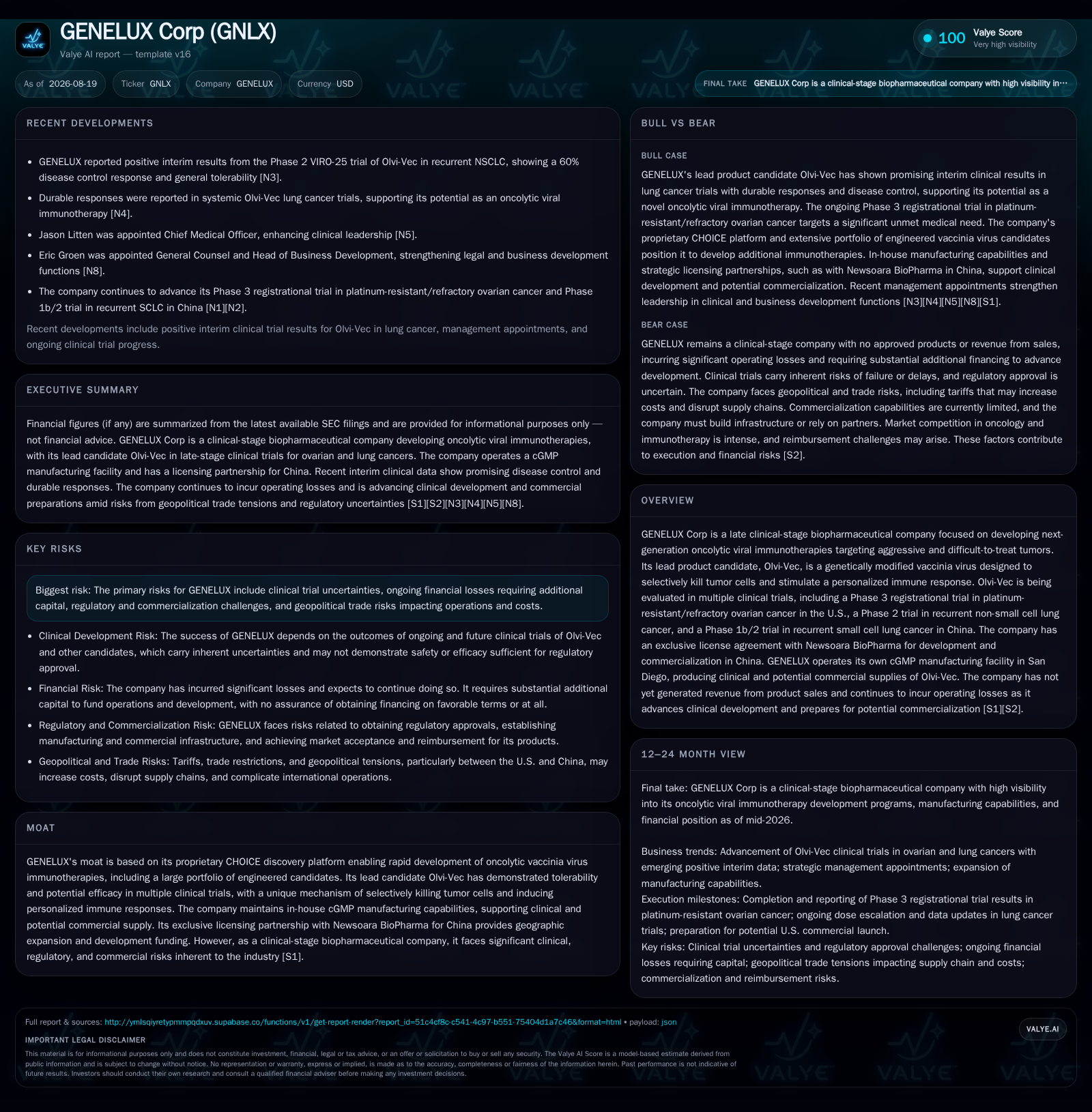
GENELUX Corp continues to advance its lead oncolytic viral immunotherapy candidate Olvi-Vec across three clinical trials targeting ovarian, non-small cell lung, and small cell lung cancers. However, the company faces rising research and development costs and growing supply chain complexity due to recently imposed U.S. tariffs and retaliatory trade measures affecting imported laboratory equipment and materials. These trade-related challenges could delay clinical development timelines and increase cash burn, though GENELUX’s proprietary CHOICE platform and exclusive China licensing partnership provide strategic support for its clinical and geographic expansion. The company maintains a moderate liquidity buffer with a current ratio of 2.39 as of June 30, 2026.
Latest Clinical Development Progress
GENELUX Corp is actively advancing its lead oncolytic viral immunotherapy candidate, Olvi-Vec, through multiple clinical trials as of Q2 2026 [S1][S2]. The company is conducting a Phase 3 registrational trial in the U.S. targeting patients with platinum-resistant or refractory ovarian cancer (PRROC), administering Olvi-Vec intraperitoneally. Concurrently, a Phase 2 trial in the U.S. is evaluating Olvi-Vec for recurrent non-small cell lung cancer (NSCLC), and a Phase 1b/2 trial in China is assessing the therapy for recurrent small cell lung cancer (SCLC) with systemic (intravenous) delivery. These trials represent critical value inflection points for GENELUX, as successful clinical milestones could advance regulatory approval prospects and eventual commercialization.
Impact of International Trade Policies on R&D Costs
The company’s Q2 2026 filing highlights emerging challenges from evolving international trade policies [S2]. Newly imposed U.S. tariffs and retaliatory measures by foreign governments have increased costs for specialized laboratory equipment and materials essential to Olvi-Vec’s research and development. These inputs, often sourced internationally, are now subject to 100% tariffs under recent proclamations, significantly raising GENELUX’s R&D expenses. Additionally, the tariffs have increased supply chain complexity, complicating logistics and potentially causing delays in clinical trial timelines. Pharmaceutical supply chains face unique regulatory constraints that limit the company’s ability to rapidly adjust sourcing or manufacturing, exacerbating the risk of disruption.
These tariff-driven cost pressures represent a material near-term operational headwind. Increased expenses and supply chain disruptions could extend development timelines and elevate cash burn, potentially impacting GENELUX’s competitive positioning relative to peers operating in more favorable trade environments [S2]. As of June 30, 2026, GENELUX reported cash and cash equivalents of $9.18 million and current assets totaling $19.14 million, against current liabilities of $7.99 million [F1]. While the company does not currently generate revenue due to its late-stage clinical development status, its capital allocation remains focused on advancing clinical trials and maintaining in-house manufacturing capacity [S2][F1]. The increased R&D expenses driven by tariffs may accelerate cash burn, underscoring the importance of monitoring liquidity trends and potential financing needs in future periods.
Business Model and Competitive Positioning
GENELUX’s business model centers on developing oncolytic viral immunotherapies using its proprietary CHOICE platform, which facilitates rapid engineering of vaccinia virus candidates like Olvi-Vec. This platform supports the company’s ability to target difficult-to-treat tumors with personalized immune responses, a strategic advantage in the immuno-oncology sector [S1].
The company also operates its own cGMP manufacturing facility in San Diego, providing control over clinical and potential commercial supply chains, which can be critical for ensuring product quality and supply reliability [S1].
Further supporting its geographic expansion and funding strategy, GENELUX has an exclusive licensing agreement with Newsoara BioPharma for the development and commercialization of Olvi-Vec in China. This partnership broadens the company’s market reach and shares development risk, partially mitigating the impact of trade-related cost pressures [S1].
Scenario Analysis and Investor Implications
The evolving trade environment introduces uncertainty around GENELUX’s clinical development timelines and cost structure. A base case scenario envisions the company absorbing tariff-related cost increases through operational efficiencies and leveraging its in-house manufacturing and licensing partnerships to maintain clinical trial progress with only moderate delays [S1][S2]. Confirmation of this scenario would come from stable clinical enrollment, timely milestone announcements, and consistent cash balance trends.
Conversely, a bear case considers the possibility of escalating tariffs and prolonged supply chain disruptions significantly delaying trials and increasing cash burn [S2][F1]. This could necessitate dilutive financing or program scaling back. Indicators supporting this downside include disclosures of trial delays, cost overruns, financing announcements, and deteriorating liquidity metrics.
Investors should closely monitor upcoming clinical trial enrollment updates, milestone achievements, future quarterly disclosures on R&D expenses and supply chain impacts, and liquidity trends. Regulatory developments affecting pharmaceutical tariffs and progress from the Newsoara BioPharma partnership in China also represent important watchpoints.
Conclusion
GENELUX’s Q2 2026 update reflects meaningful clinical progress for Olvi-Vec across multiple indications supported by its proprietary CHOICE platform and strategic China licensing partnership. However, the company faces significant near-term operational challenges from increased R&D expenses and supply chain complexity driven by new international tariffs. These factors could delay clinical development and increase cash burn, affecting GENELUX’s competitive positioning and capital requirements. The company’s moderate liquidity position provides some cushion, but the evolving trade landscape warrants ongoing investor attention to clinical and financial developments.

Comments