
Bit Digital Q2 2026: Cloud and HPC Growth Amid Ongoing Operating Losses
Bit Digital advances its shift from bitcoin mining to cloud and HPC services with revenue growth in Q2 2026, while operating losses persist.
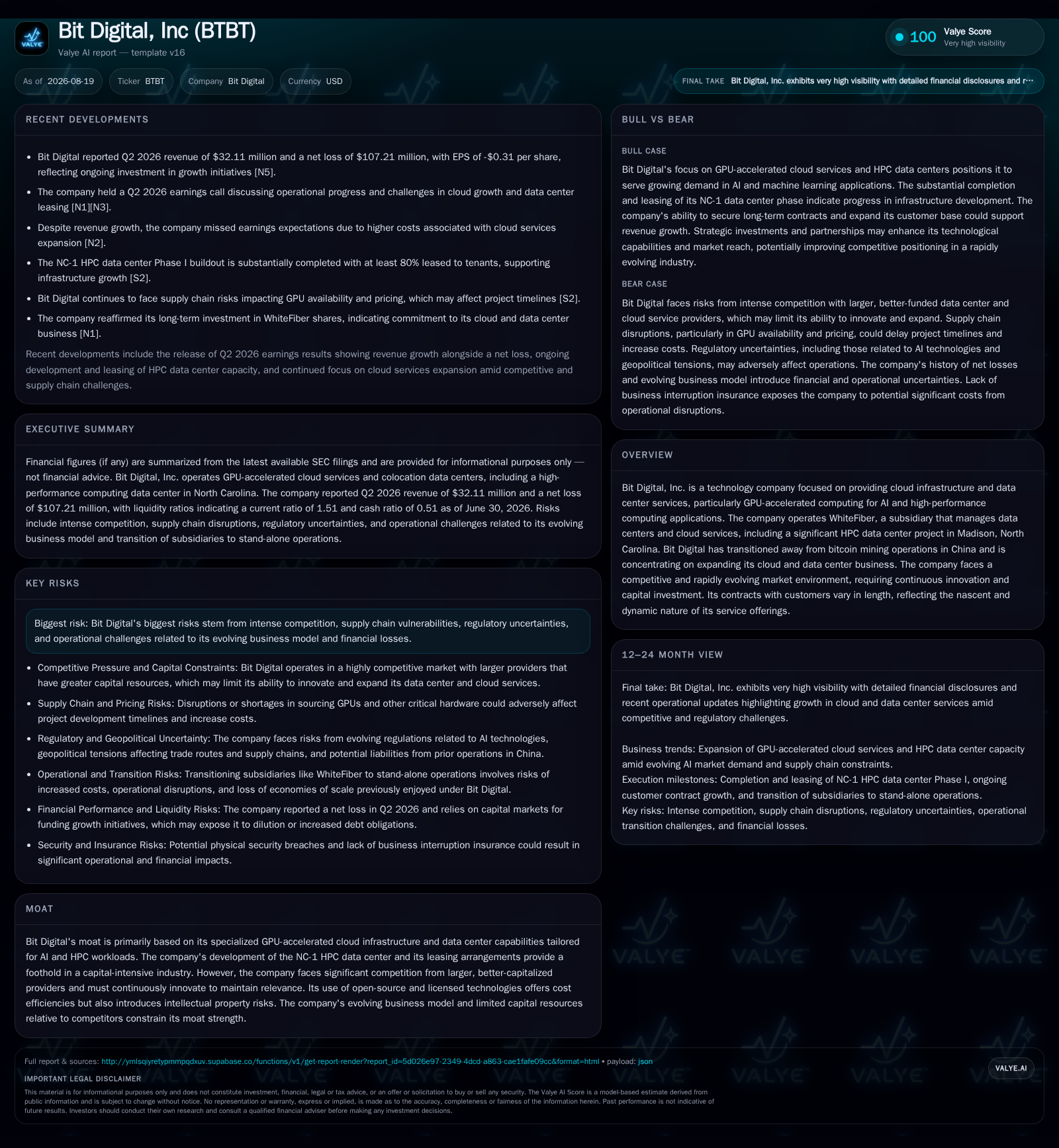
In the second quarter of 2026, Bit Digital continued its strategic transition away from legacy bitcoin mining toward cloud infrastructure and high-performance computing (HPC) services through its majority ownership of WhiteFiber. The company reported revenue growth driven by cloud and HPC operations but sustained operating losses reflecting capital-intensive expansion and competitive pressures. Bit Digital’s balance sheet shows moderate liquidity with $83.6 million in cash and a net cash position, providing a buffer for ongoing investments amid legal and geopolitical risks.
Q2 2026 Operating and Financial Update
Bit Digital’s second quarter 2026 operating results reflect its ongoing strategic pivot from bitcoin mining toward cloud infrastructure and high-performance computing (HPC) services. The company reported revenue growth primarily driven by WhiteFiber, its majority-owned subsidiary specializing in cloud and HPC data center operations, including AI-optimized GPU-accelerated infrastructure [S2][S3]. Despite this top-line growth, Bit Digital continues to report operating losses, underscoring the capital-intensive nature of scaling cloud and HPC data centers and the competitive pressures in these markets [S2][S3].
The company’s current assets of $245.5 million versus current liabilities of $162.5 million yield a current ratio of 1.51, indicating moderate short-term liquidity to support ongoing operations and capital expenditures [F1].
Business Model and Strategic Transition.
Bit Digital’s transformation centers on its approximately 70.5% ownership of WhiteFiber, which operates cloud services and HPC data centers including the NC-1 HPC project. WhiteFiber’s infrastructure supports AI and machine learning workloads through GPU-accelerated computing, positioning Bit Digital within the fast-growing cloud AI infrastructure market [S1]. This market is forecasted to expand significantly, driven by increasing digital transformation, large data set usage, and demand for scalable, accessible cloud resources.
Since ceasing bitcoin mining operations in China as of September 30, 2021, Bit Digital has focused on cloud infrastructure and Ethereum staking strategies. This shift reduces exposure to legacy digital asset mining risks and aligns the company with higher-growth, infrastructure-as-a-service (IaaS) business models [S1][S2]. Revenue generation now primarily derives from WhiteFiber’s cloud and HPC services sold to enterprises and institutions requiring high-performance compute capacity.
Margins and cash conversion in this business depend on data center operational efficiency, capacity utilization, energy costs, and capital expenditure intensity [S2][S1]. The company’s ongoing operating losses reflect the high upfront investment required to build and expand HPC data centers and the competitive environment dominated by larger cloud providers and specialized HPC operators.
Risk Factors and Legal Proceedings
Bit Digital faces several risks that could affect its financial condition and operational continuity. The company is engaged in ongoing litigation against Blockfusion related to prior business dealings, seeking damages exceeding $5 million [S1]. This legal proceeding remains in active pretrial phases and could impose financial liabilities or management distraction depending on its outcome.
Additionally, supply chain disruptions and geopolitical tensions present material risks. Notably, the closure of the Strait of Hormuz and related trade route disruptions have impacted global shipping and energy markets. These conditions could increase operational costs and affect the company’s ability to expand or maintain data center capacity efficiently [S2].
Financial Condition and Capital Allocation.
Bit Digital’s balance sheet as of June 30, 2026, shows moderate liquidity and a net cash position, supporting ongoing capital expenditures focused on expanding HPC data center capacity through WhiteFiber [F1][S2]. Capital allocation prioritizes growth in cloud and HPC services, but the need for continued financing remains a watchpoint given the cash burn profile and market dynamics.
Scenarios and Investment Implications
A bull case scenario is that Bit Digital successfully scales its cloud and HPC services via WhiteFiber, improving utilization and operational efficiency [S2][S1]. This could lead to margin expansion and a transition to profitability, capturing the growing demand for AI infrastructure. Confirmation would come from quarterly filings showing margin improvement, increasing contract backlog, and positive operating cash flow.
Alternatively, the company may maintain moderate revenue growth but continue incurring operating losses due to capital intensity and competitive challenges, requiring periodic capital raises [S2][F1]. This base case would be supported by stable revenue with flat margins and consistent cash burn offset by financing.
The bear case involves worsening operational challenges, legal liabilities, and supply chain disruptions leading to revenue decline, margin deterioration, and liquidity stress [S1][S2]. However, ongoing operating losses and capital intensity underscore the challenges of scaling profitably in a competitive environment.
Investors should monitor quarterly revenue and margin trends in cloud and HPC segments, operating cash flow and capital expenditure levels, updates on legal proceedings, customer contract developments, and supply chain or geopolitical developments impacting operations.
These factors will be critical in assessing whether Bit Digital can successfully transition its business model to sustainable growth and profitability in the evolving cloud and HPC market.

Comments