
Alpex Acquisition Elevates Capital Readiness While SPAC Execution Pressure Rises
Following its June IPO, Alpex Acquisition Corp maintains robust liquidity but faces critical execution challenges as it races to complete a business combination.
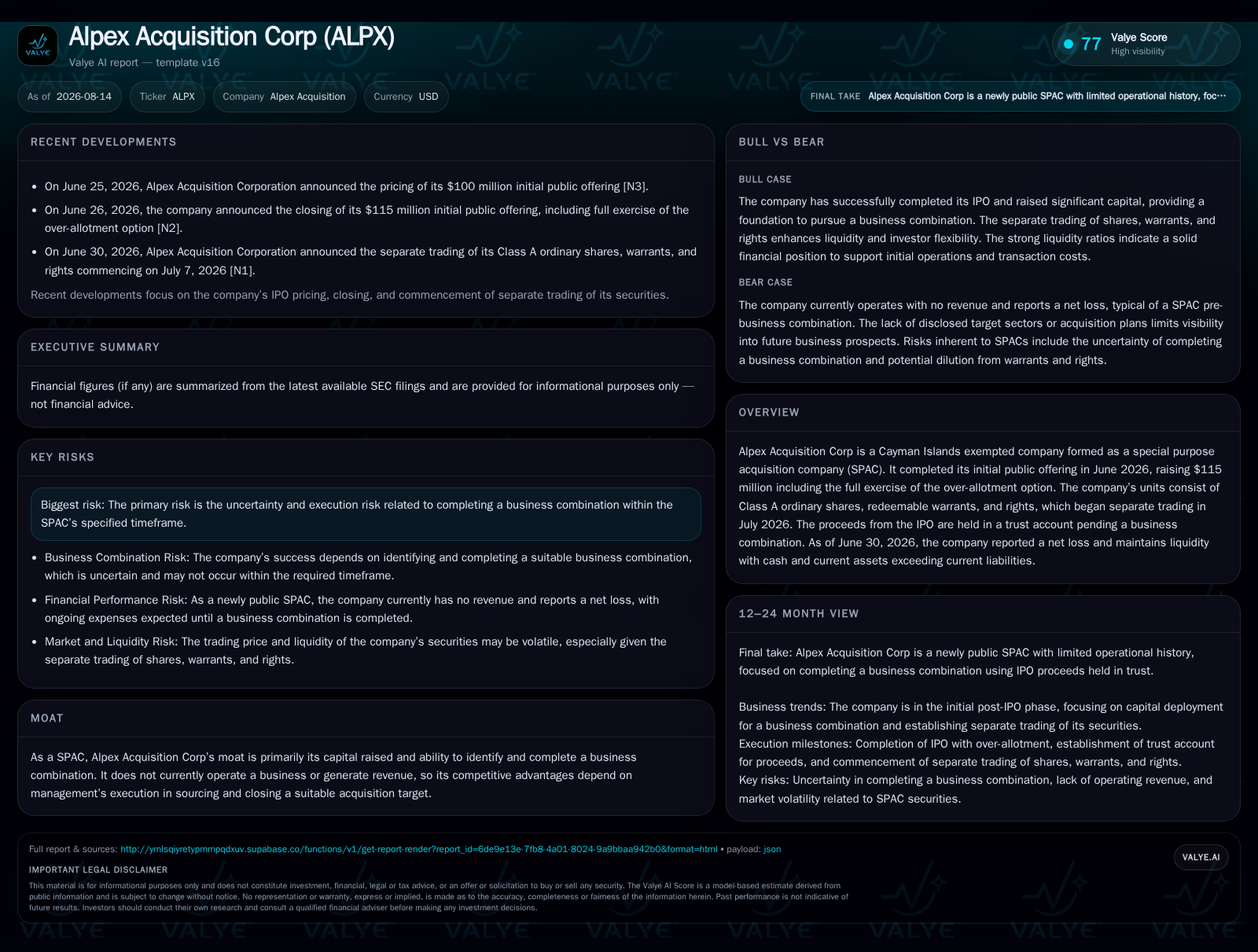
Alpex Acquisition Corp completed its IPO in June 2026, raising $115 million through units that include Class A shares, redeemable warrants, and rights. The proceeds are securely held in trust pending a qualifying business combination expected within the typical two-year SPAC deadline. As of the latest quarterly filing in August 2026, Alpex reports no material change in risk factors and demonstrates strong liquidity with approximately $755 thousand in cash and a current ratio near 3.7, supporting operational readiness. However, inherent SPAC risks persist, including execution timelines, shareholder redemptions that could impact trust liquidity, and dilution from outstanding warrants. Success hinges on management’s deal sourcing capabilities amid competitive market conditions and investor sentiment.
Latest Quarterly Filing: Confirmed Capital and Risk Status
Alpex Acquisition Corp’s latest SEC filing dated August 13, 2026, provides an updated financial snapshot shortly after its IPO which closed in June 2026 [S2], [S3]. The company raised approximately $115 million inclusive of exercise of the over-allotment option through issuance of units composed of one Class A ordinary share, one redeemable warrant to purchase a Class A share at $11.50 strike price, and one right to acquire one-fourth of a Class A share [S3]. This capital raise forms the backbone of its trust account funds held pending consummation of a business combination.
As of June 30, 2026, Alpex reported cash and cash equivalents at about $755 thousand alongside total current assets near $875 thousand versus current liabilities approximating $238 thousand for a strong current ratio of roughly 3.68 [F1]. This liquidity profile supports ongoing operating costs while preserving capital integrity required by SPAC regulations. Notably, there were no material changes to risk factor disclosures relative to those outlined in the IPO prospectus, confirming stability in known operating environments despite inherent structural risks faced by all SPACs [S2].
SPAC Business Model: Capital Holding to De-SPAC Value Creation
Alpex operates as a Cayman Islands exempted special purpose acquisition company (SPAC), whose business model revolves around raising capital through an initial public offering (IPO) structured as units consisting of shares paired with redeemable warrants and rights. These units commenced separate trading as individual components starting July 7, 2026 [N1], unlocking liquidity and investor choice post-lockup.
Critically, prior to completing a de-SPAC transaction—merging with or acquiring an operating private company—Alpex generates no revenue. Instead, net losses primarily arise from management fees and other administrative expenses funded from operating expenses outside the trust account balance earmarked strictly for acquisition purposes. The trust account protects shareholders by ring-fencing IPO proceeds until approval and closing of an acquisition or liquidation occurs.
Redemption rights grant shareholders discretion to redeem their shares for cash if dissatisfied with proposed mergers or uncertain about valuation or timing. This dynamic injects complexity into transaction structuring since high redemption rates reduce available merger consideration cash and could strain the timeline constraints imposed on party execution.
Liquidity Buffer Strength Amid Redemption and Timing Risks
The latest quarter reveals a liquidity buffer supported by cash exceeding liabilities by over threefold on a current ratio basis (~3.68) and net debt positioning that is significantly negative at about minus $536 thousand (cash minus debt) [F1]. This solid balance sheet foundation underpins Alpex’s capacity to fund operational expenditures during the search phase while maintaining compliance with trust account rules that limit use of IPO proceeds.
However, the SPAC model’s financial viability hinges heavily on shareholder redemption behaviors occurring around any announced merger. Elevated redemptions reduce trust account funds deployable toward acquisition value creation, increasing pressure on deal terms or possibly triggering liquidation scenarios if sufficient capital is not retained.
Moreover, typical SPAC mandates impose strict deadlines—frequently within two years—by which the business combination must close or else face dissolution or return of funds [valye_report_excerpt.moat]. Thus timing risk intensifies as months elapse without announced mergers.
Management Experience and Pipeline: The Fulcrum of Execution
As a pure play capital vehicle without operations or revenue prior to acquisition closure, Alpex’s competitive advantage predominantly rests upon management’s ability to identify attractive targets that align with shareholder expectations within mandated timeframes [valye_report_excerpt.moat]. This includes negotiating favorable deal terms amidst competitive deal sourcing landscapes.
While Alpex has not publicly disclosed details regarding specific acquisition pipelines or management team backgrounds beyond general prospectus disclosures [S2], industry context underscores that SPAC success correlates strongly with seasoned leadership demonstrated through precedents akin to Pershing Square Tontine Holdings or Churchill Capital entities which provide benchmarks for track record importance.
Absent proprietary pipeline insights means investors must monitor forthcoming announcements closely for validation of management capability.
Industry Peer Reference: Benchmarking Capital Raise and Market Reception
Relative to recent mid-sized SPAC peers also executing IPOs near mid-2026 timing brackets, Alpex’s total capital raise around $115 million positions it solidly within an established cohort targeting similar markets and investor appetite segments, [N1]. The commencement of separate trading for shares, warrants, and rights early July signifies transition from initial aggregation phase toward active dealmaking periods.
This cohort competes indirectly against traditional IPO avenues favored by private companies desiring public listings but attracted by purported speed advantages offered through de-SPAC routes despite evolving regulatory scrutiny.
Redemption rates following merger proposals often serve as proxy markers for shareholder confidence; though undisclosed yet for Alpex given absence of announced transactions, this metric will become a critical early indicator once transactions surface.
Growth Prospects Driven by Private Company Demand for Public Markets
The broader market tailwinds sustaining SPAC activity include sustained interest among private companies contemplating more efficient public access alternatives beyond lengthy traditional IPO processes. Favorable regulatory frameworks accommodating SPAC structures further facilitate this trend alongside innovations like PIPE (private investment in public equity) financing which augment capital resources post-combination.
Alpex stands poised to capitalize on these drivers conditional on proactive deal sourcing aligned with evolving market demands. Nevertheless growth remains contingent on successful conversion from blank-check status into operational public entity ownership.
Risks Centered on Deal Timelines, Market Sentiment, and Dilution
Despite positive capital positioning today, structural risks pervade Alpex’s operational horizon. Failure to consummate an approved business combination within prescribed statutory timelines typically results in liquidation or return of funds minus fees negatively impacting shareholder value [valye_report_excerpt.risks], [S2].
Furthermore market volatility can adversely affect investor sentiment prompting unanticipated redemptions limiting available merger cash pools. Dilution risk arises from dilutive instruments embedded via redeemable warrants exercisable at fixed strike prices potentially diluting post-merger equity stakes affecting long-term holders.
Subsequent proxy materials will reveal redemption patterns offering early quantitative insight into investor confidence levels while approval vote outcomes will validate management effectiveness or signal potential execution delays needing monitoring [S2], [N1].
Alertness toward these cadence checkpoints provides practical framework for evaluating trajectory toward value realization through successful de-SPAC completion.
Financial Profile Discussion: The Balance Sheet Foundation for Deal Execution
From a financial perspective at quarter-end June 30, 2026, Alpex reflects net losses totaling approximately $123 thousand attributable primarily to pre-acquisition administrative expenses consistent with typical SPAC operating profiles lacking revenue streams [F1]
Cash reserves near $755 thousand combined with manageable debt levels indicate sufficient runway covering short-term costs as the company pursues its first business combination target while preserving principal capital in trust compliantly. This financial positioning aligns with general sector patterns where disciplined cost management prior to de-SPAC event is essential given absence of operating revenues alongside reliance on trust-held IPO proceeds safeguarded from premature deployment except under approved business combinations or liquidations.
This analysis does not constitute investment advice but serves as an informed overview synthesizing publicly available data with sector-contextual expertise relevant to stakeholders monitoring Alpex Acquisition Corp’s progression through the SPAC lifecycle.
Disclaimer: This is research-only, informational analysis and not investment advice. It may include AI-generated interpretation and general industry context. Always verify important details using primary sources.

Comments