
Veeva Systems Surpasses Q2 FY2027 Expectations with AI and CRM Momentum
Strong Q2 results driven by AI-powered Falcon and CRM products, supported by robust liquidity and strategic acquisition integration.
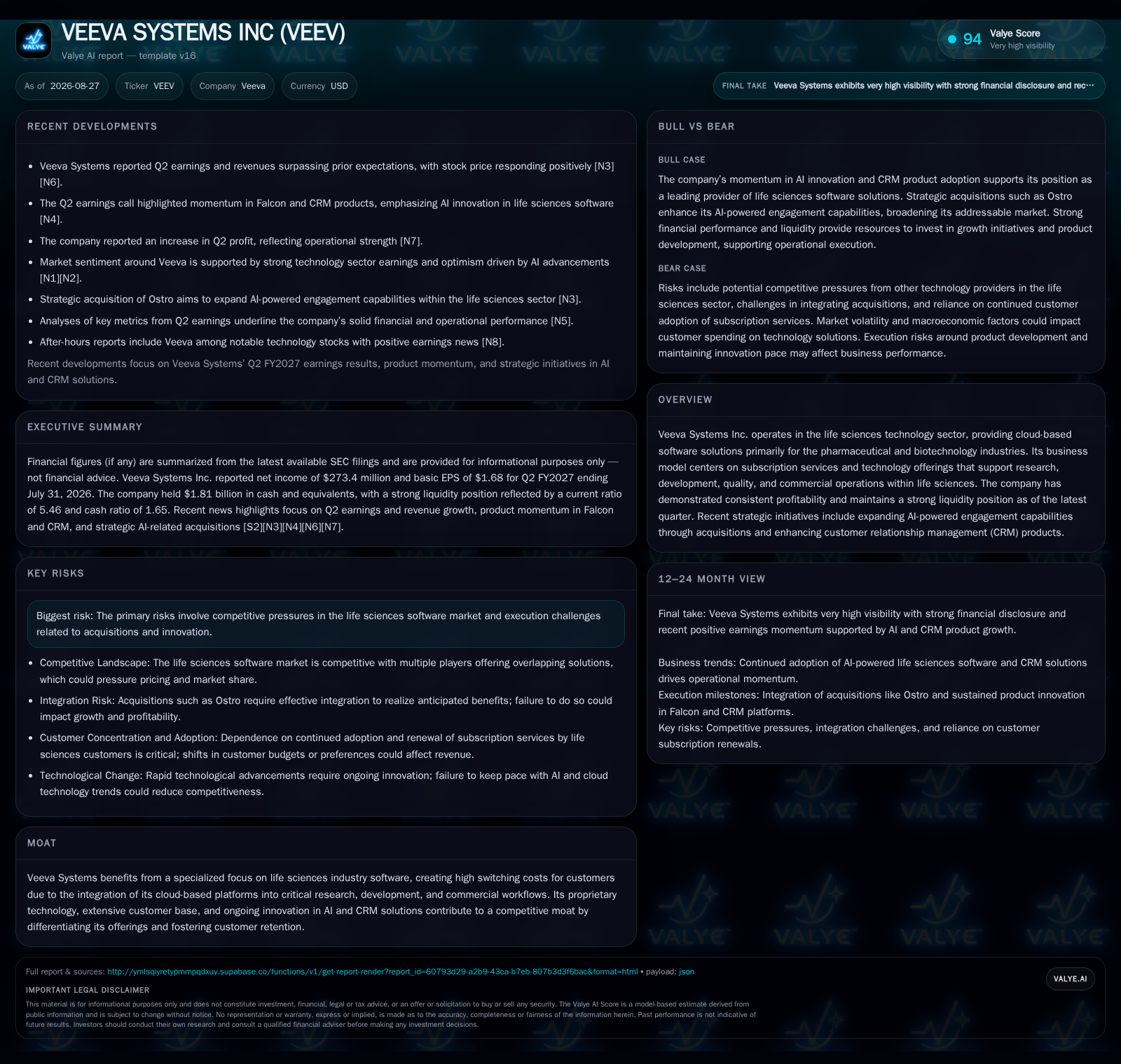
Veeva Systems Inc. reported Q2 FY2027 net income of $273.4 million and basic EPS of $1.68, exceeding prior expectations. Revenue recognized from deferred revenue rose to $640 million, reflecting growth in subscription adoption driven by AI-enhanced Falcon and CRM platforms. The company maintains a strong liquidity position with $1.81 billion in cash and equivalents and a current ratio of 5.46 as of July 31, 2026. Strategic acquisition Ostro is being integrated to expand AI-powered engagement capabilities, reinforcing Veeva’s competitive positioning in life sciences software.
Veeva Systems Inc. reported net income of $273.4 million and basic earnings per share of $1.68 for the second quarter of fiscal year 2027 ended July 31, 2026, surpassing prior expectations and reflecting an increase in revenue and profit compared to the same period in fiscal 2026 [S2]. The company maintained strong liquidity with cash and equivalents totaling $1.81 billion and a current ratio of 5.46, underscoring its operational strength and financial capacity to invest in strategic initiatives amid robust momentum in its AI and CRM product offerings [N4][F1].
This growth is largely driven by Veeva’s AI-powered Falcon platform and customer relationship management (CRM) products, which have enhanced customer engagement and retention in the life sciences sector [S2][N4]. These platforms integrate advanced artificial intelligence capabilities to support pharmaceutical and biotechnology firms’ research, development, regulatory compliance, and commercial operations, creating differentiated value and increasing switching costs for customers.
Supporting this operational strength, Veeva maintains a robust liquidity position with cash and cash equivalents totaling $1.81 billion as of July 31, 2026, and a current ratio of 5.46, reflecting ample short-term resources relative to current liabilities [F1]. This liquidity provides the company with financial flexibility to invest in growth initiatives, including product development and strategic acquisitions, while absorbing integration risks [F1][S2].
One such strategic move is the recent acquisition of Ostro, aimed at expanding Veeva’s AI-powered engagement capabilities within the life sciences software market. While integration is ongoing, this acquisition is expected to enhance product differentiation and broaden the addressable market by augmenting AI-driven customer engagement tools [N3][N5].
Veeva’s business model centers on recurring subscription revenue from cloud-based software solutions tailored to life sciences companies, supplemented by technology service fees [S2]. The increase in revenue recognized from deferred revenue underscores expanding subscription contract billings and renewals, which provide visibility into future revenue streams and support margin stability typical of SaaS businesses.
The company’s competitive advantage stems from its specialized focus on life sciences, which embeds its platforms deeply into critical workflows, thereby creating high switching costs. Continuous innovation in AI and CRM further strengthens this moat by enhancing product capabilities and customer retention [S2][N4]. However, risks remain, including competitive pressures from other technology providers offering overlapping solutions, integration challenges related to Ostro, and reliance on continued customer adoption and subscription renewals. Rapid technological changes in AI and cloud computing also require ongoing investment to maintain differentiation [S1][N3].
Investors should monitor quarterly subscription bookings and deferred revenue trends as indicators of sustained growth, along with updates on Ostro integration progress and customer renewal rates [S2][F1]. The integration of Ostro and continued innovation in AI-powered engagement represent key factors that could accelerate growth and deepen customer relationships, while competitive and execution risks warrant close observation.

Comments