
Bio-Techne Faces Strategic and Regulatory Risks Ahead of Merck KGaA Merger
Pending merger with Merck KGaA introduces execution risks amid stable operating results and strong liquidity as of mid-2026.
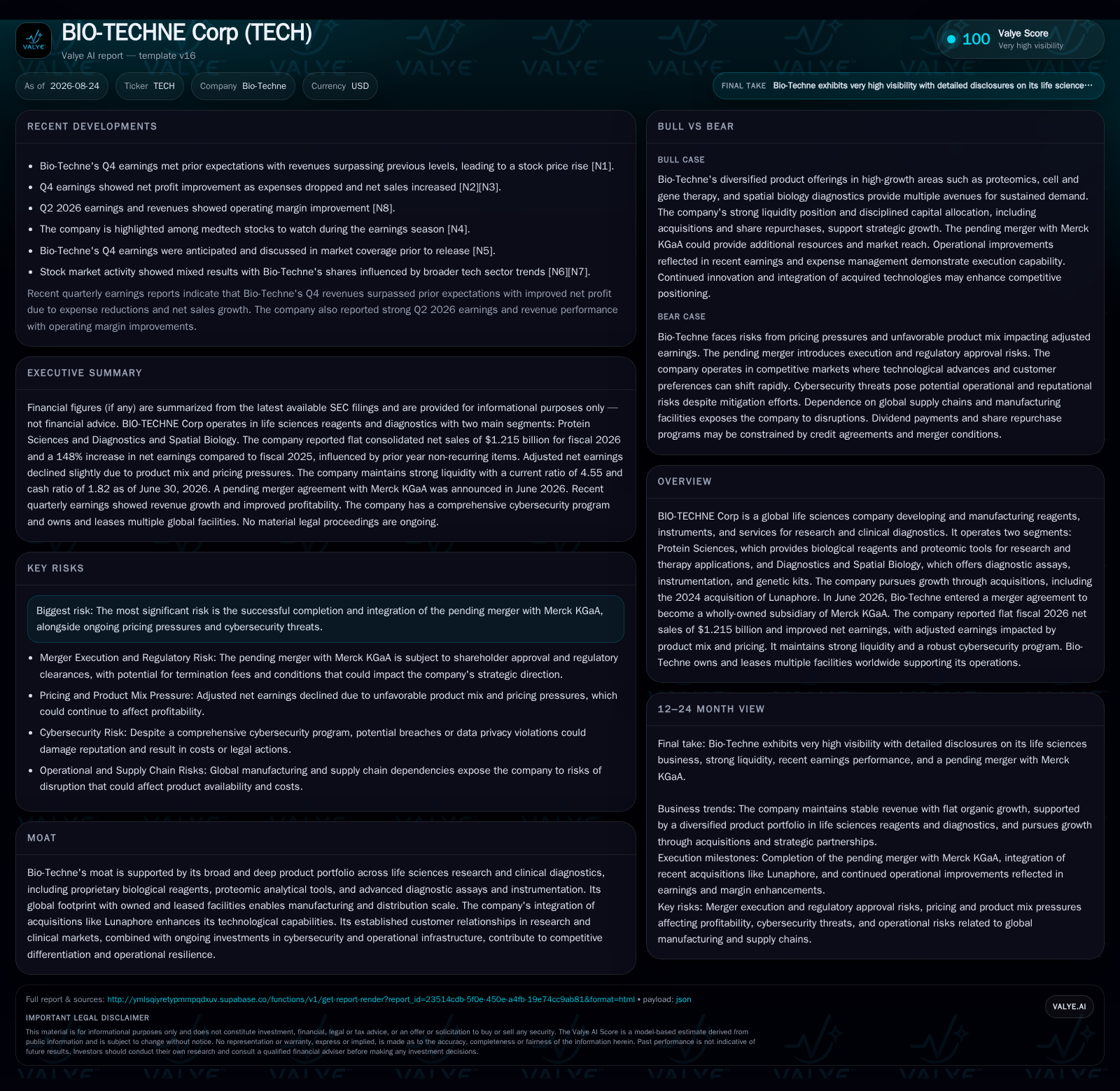
Bio-Techne Corporation announced a pending merger agreement with Merck KGaA in June 2026, marking a transformational event that introduces significant strategic and regulatory execution risks. Despite flat net sales for the nine months ended March 31, 2026, Bio-Techne reported a 40% increase in net earnings year-over-year, reflecting improved expense management and operational efficiency. The company’s liquidity position remains strong with a current ratio of 4.55 and a net cash position of approximately $64.7 million as of June 30, 2026, supporting operational flexibility and merger-related obligations. However, ongoing pricing and product mix pressures continue to constrain adjusted earnings growth.
Bio-Techne Corporation’s announcement in June 2026 of a pending merger agreement with Merck KGaA represents a significant strategic development that introduces material execution and regulatory risks [S3][S1]. This merger is expected to materially affect Bio-Techne’s ownership structure, strategic priorities, and capital allocation decisions, marking a pivotal point for the company’s future trajectory.
Operating results for the nine months ended March 31, 2026, show flat net sales compared to the prior year period, indicating stable demand for Bio-Techne’s portfolio of biological reagents, proteomic tools, diagnostic assays, and laboratory instruments [S2]. Despite this flat top-line performance, net earnings increased to $127.2 million during the same period, reflecting margin expansion from expense control and operational leverage, partially offset by product mix pressures [S2].
The company’s liquidity position as of June 30, 2026, includes a current ratio of 4.55 supported by $264.7 million in cash and equivalents against $163.7 million in current liabilities [F1]. Total debt was $200 million, resulting in a net cash position of approximately $64.7 million [F1]. This working capital position provides Bio-Techne with financial flexibility to support ongoing operations, acquisitions, and merger-related expenditures.
However, margin pressures persist [S1]. Adjusted net earnings have been constrained by an unfavorable product mix and competitive pricing dynamics within Bio-Techne’s diverse product portfolio. These factors reduce per-unit profitability and limit the potential for further margin expansion despite stable revenue, reflecting ongoing challenges in balancing consumables and instrumentation sales and navigating pricing pressures in the life sciences reagents and instruments sector.
Bio-Techne’s business model centers on supplying life sciences research institutions, clinical diagnostic laboratories, and pharmaceutical and biotechnology companies with consumable biological reagents, proteins, antibodies, diagnostic assays, proteomic tools, spatial biology products, and laboratory instruments. Revenue is generated primarily through direct sales and distributors, supplemented by service contracts and royalties [S1][S2]. The company’s broad and diversified product portfolio, combined with a global manufacturing footprint, supports operational scale and competitive differentiation.
Operational resilience is further supported by Bio-Techne’s comprehensive cybersecurity program, which aligns with industry best practices. The company actively monitors and mitigates cybersecurity risks through internal teams, third-party providers, and regular risk assessments. This program is integral to maintaining data integrity and business continuity across its global operations [S1].
The pending merger with Merck KGaA introduces significant execution and regulatory risks. Completion of the transaction depends on obtaining shareholder and regulatory approvals, with potential for termination fees and strategic shifts if approvals are not secured. These uncertainties could materially impact Bio-Techne’s strategic direction and capital allocation, making merger execution a key watchpoint for investors [S3][S1].
Looking ahead, Bio-Techne’s ability to sustain operational performance may depend on navigating pricing and product mix pressures, integrating recent acquisitions such as Lunaphore, and managing merger-related complexities. The company’s liquidity position and recent earnings trends could provide a basis to support these initiatives, but the outcome of the merger process and evolving market conditions will be important factors influencing future growth and profitability.
Investors should monitor merger regulatory approval progress, shareholder vote outcomes, subsequent quarterly earnings releases for revenue and margin trends, updates on acquisition integration, adjusted earnings trajectory, cybersecurity risk disclosures, and any supply chain or manufacturing disruptions affecting product availability. These factors will provide important indicators of Bio-Techne’s strategic execution and operational stability during this transformative period.

Comments