
Standard Nuclear Secures Binding TRISO Fuel Supply Agreement with Antares Nuclear
Standard Nuclear announced a binding TRISO fuel supply contract with Antares Nuclear alongside its Q2 2026 financial results showing strong liquidity but ongoing net losses.
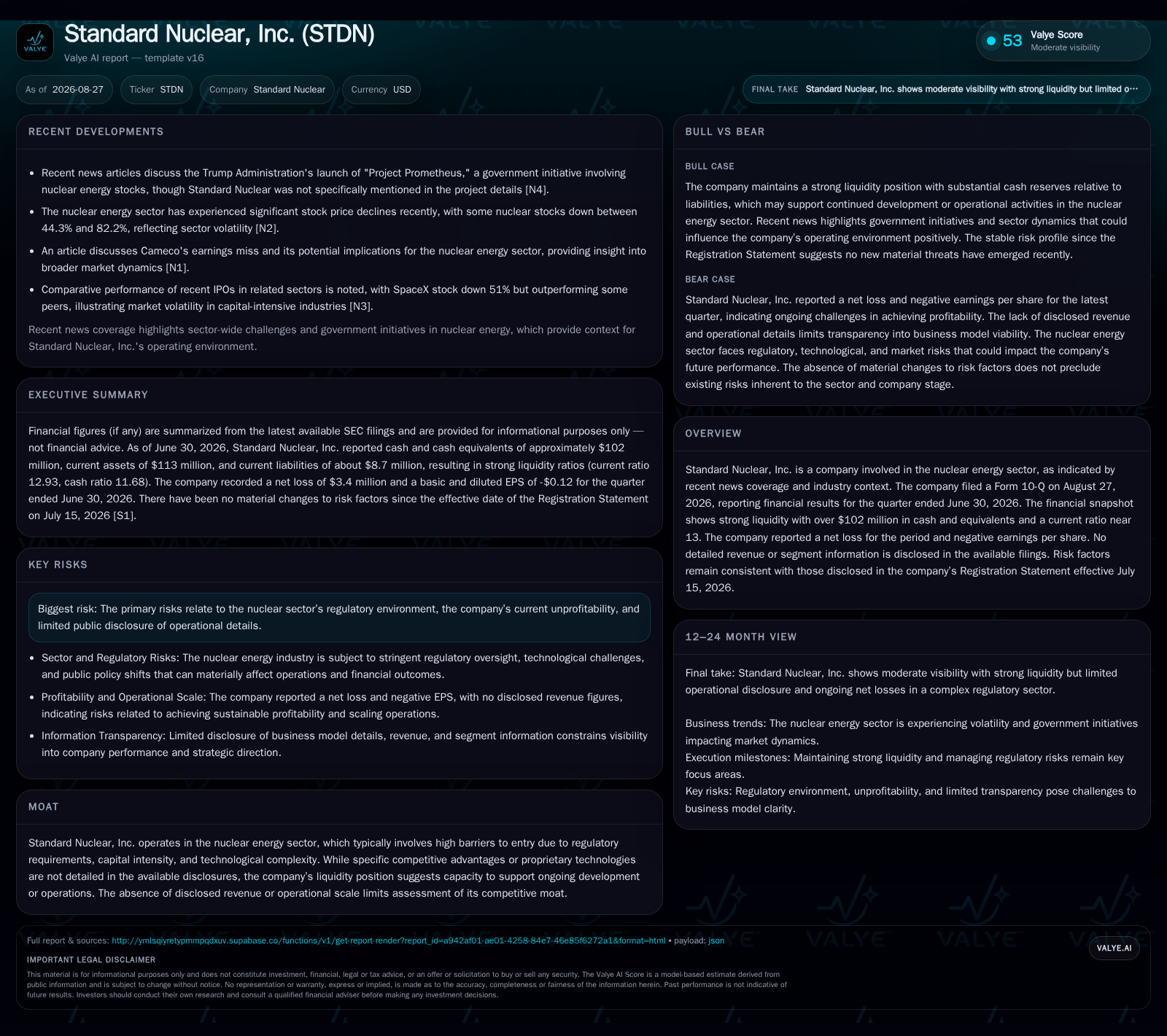
Standard Nuclear, Inc. reported its Q2 2026 financial results highlighting a strong liquidity position with $102.2 million in cash and equivalents and a current ratio of 12.93, while continuing to operate at a net loss. Concurrently, the company executed a binding TRISO fuel supply agreement with Antares Nuclear, marking a significant commercial milestone as the only U.S. firm with industrial-scale TRISO fuel fabrication capabilities. This contract represents tangible validation of Standard Nuclear’s production technology and could serve as a catalyst for future revenue growth, although current financial performance remains unprofitable and operational scale details are limited.
Standard Nuclear, Inc. reported its Q2 2026 financials showing continued net losses and negative earnings per share, while simultaneously announcing a binding TRISO fuel supply agreement with Antares Nuclear. The contract represents a material commercial development that could validate Standard Nuclear’s industrial-scale TRISO fuel fabrication capabilities and potentially catalyze future revenue growth, although no current revenue impact from this contract has been disclosed.
On August 27, 2026, Standard Nuclear announced the execution of a binding TRISO fuel supply agreement with Antares Nuclear, a developer of microreactors for defense and space applications [S3]. This contract is the first publicly disclosed binding supply agreement for Standard Nuclear, leveraging its unique position as the only U.S. company with industrial-scale TRISO fuel fabrication facilities. The agreement validates the company’s capability to produce advanced TRISO nuclear fuel at scale, addressing a niche market critical for advanced microreactors where reliability and safety are paramount. While no revenue from this contract has yet been disclosed, it could serve as a catalyst for future growth if successfully executed.
Standard Nuclear’s Q2 2026 financial results reveal continued net losses and negative earnings per share, reflecting ongoing challenges in scaling nuclear fuel fabrication. As of June 30, 2026, the company maintains a strong liquidity position with $102.2 million in cash and equivalents, a current ratio of 12.93, current assets of $113.1 million, and current liabilities of $8.7 million [F1]. This liquidity provides a substantial buffer to support operational scale-up necessary to fulfill the new TRISO fuel supply agreement and pursue additional commercial opportunities [F1], [S2].
The nuclear fuel fabrication industry requires significant upfront investment in specialized equipment, regulatory compliance, and quality assurance. Standard Nuclear’s continued net losses underscore the early-stage nature of its operations and the long lead times typical in this sector. While liquidity supports ongoing operations, the path to profitability depends on successful contract execution, production scale-up, and market adoption of TRISO fuel.
Standard Nuclear’s business model centers on fabricating TRISO nuclear fuel, a specialized product used in advanced nuclear reactors including microreactors. Revenue is generated primarily through binding fuel supply agreements with reactor developers and operators, exemplified by the recent contract with Antares Nuclear [S3]. Margins and cash flow depend heavily on production scale, fabrication efficiency, and contract execution. As the sole U.S. industrial-scale TRISO fuel fabricator, the company holds a unique competitive position supported by high regulatory barriers and technological complexity.
This exclusivity addresses a critical niche in the nuclear energy value chain, supplying fuel assemblies essential for next-generation reactors focused on defense and space applications. The stringent regulatory environment and technological complexity create significant barriers to entry, protecting Standard Nuclear’s position and limiting competition [S3].
Revenue mechanics involve securing binding supply agreements that translate into production orders and revenue recognition upon delivery. Achieving efficient production scale and managing costs will be critical for converting contracts into profitable operations. Given the capital-intensive nature of the business, cash conversion and margin improvement are key metrics to monitor.
The company reported no material changes to its risk factors since its Registration Statement effective July 15, 2026. These risks include regulatory compliance challenges, capital intensity, technological hurdles in fuel fabrication, and long sales and production cycles inherent in the nuclear fuel sector [S2]. Regulatory risk is particularly salient given the stringent safety and environmental standards. Delays or adverse regulatory developments could impact production timelines and contract fulfillment. Sustained investment is required to support scale-up, which could pressure liquidity if revenue growth does not materialize. Technological risks persist as scaling production while maintaining quality and safety is complex.
These risks highlight the importance of monitoring operational milestones and regulatory developments. While the recent contract with Antares Nuclear is a positive commercial development, execution risks remain significant.
Scenario analysis suggests the binding TRISO fuel supply agreement materially advances Standard Nuclear’s commercial validation and could catalyze future revenue growth if successfully executed. A bull scenario includes additional binding supply agreements, production scale-up, and eventual profitability, confirmed by quarterly filings showing revenue recognition and improved margins. A base case involves gradual ramp-up with limited immediate revenue, continued net losses, and stable liquidity. A bear scenario involves failure to convert the contract into meaningful revenue, liquidity deterioration, and operational delays.
Investors should watch for future quarterly filings for revenue recognition tied to TRISO fuel supply, updates on additional supply agreements, changes in liquidity, operational milestones related to fabrication scale-up, and regulatory developments affecting nuclear fuel production.
In summary, Standard Nuclear’s recent binding contract with Antares Nuclear marks a significant commercial development that could move toward validation of its industrial-scale TRISO fuel fabrication capability. However, significant risks remain, including regulatory challenges and the capital-intensive nature of the business. The path to profitability could depend on successful contract fulfillment, additional commercial traction, and efficient production scaling. Investors should monitor concrete revenue recognition and operational progress in upcoming filings to assess the company’s transition toward sustainable financial performance.

Comments