
Burlington Stores Advances Growth with Store Expansion and New Georgia Distribution Center
Q2 2026 results and operational investments highlight Burlington's scalability and supply chain improvements amid retail challenges.
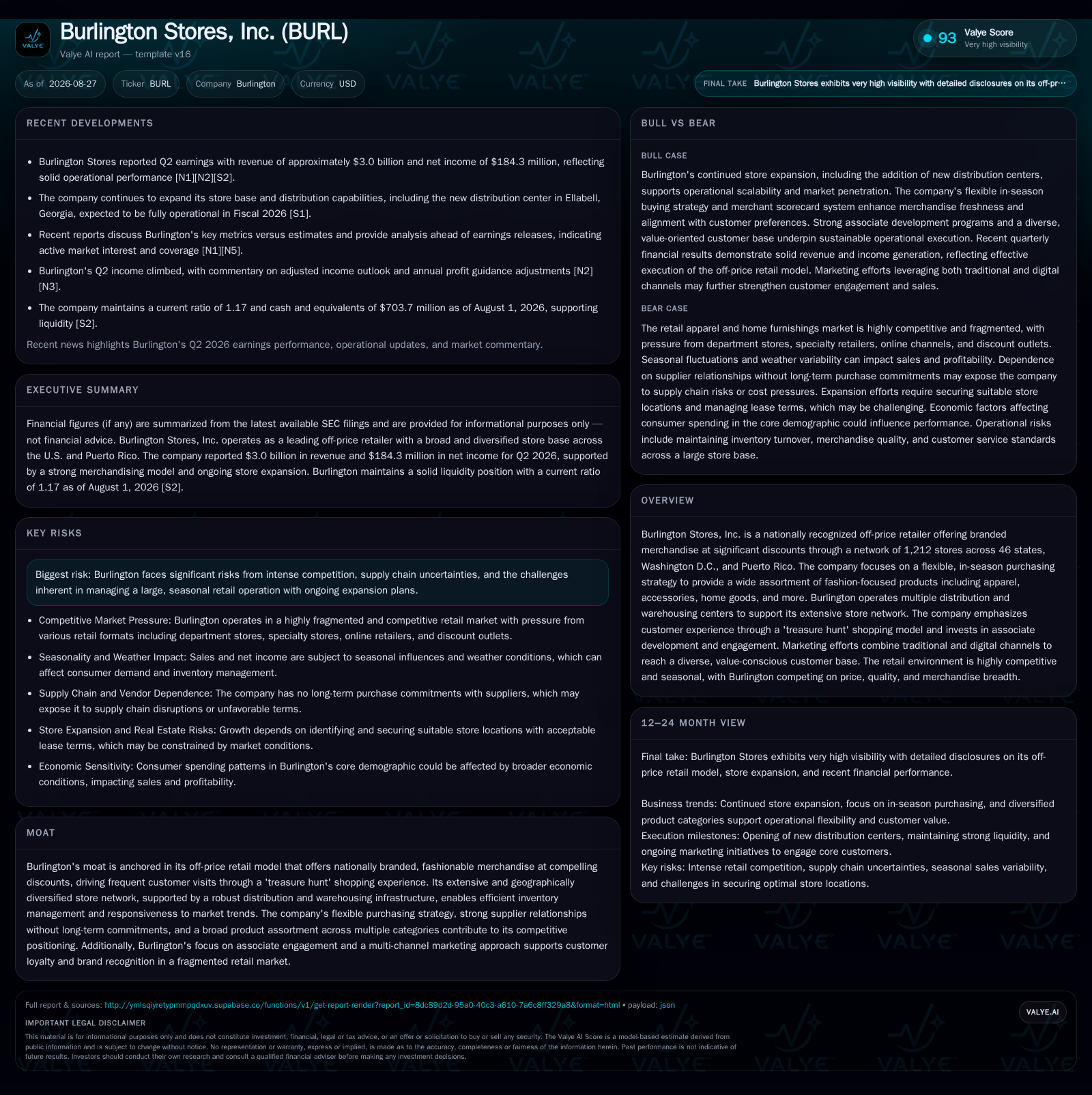
Burlington Stores, Inc. reported approximately $3.0 billion in revenue and $184.3 million in net income for Q2 2026, reflecting solid execution of its off-price retail model. The company expanded its store footprint and opened a new distribution center in Ellabell, Georgia, enhancing scalability and supply chain efficiency. Liquidity metrics remain supportive with a current ratio of 1.17 and cash reserves of $703.7 million as of August 1, 2026. These developments reinforce Burlington's competitive positioning while ongoing retail market risks persist.
Burlington Stores, Inc. reported financial results for the second quarter ended August 1, 2026, with revenue of approximately $3.0 billion and net income totaling $184.3 million [S2][N1][N2]. These figures coincide with the company's ongoing operation of its off-price retail model and recent growth initiatives amid a competitive retail landscape.
Central to Burlington's recent developments is the continued expansion of its store base, which reached 1,212 locations across 46 states, Washington D.C., and Puerto Rico as of Fiscal 2025 [S1]. This geographic diversification supports broader market penetration and customer accessibility. Complementing this footprint growth is the opening of a new distribution center in Ellabell, Georgia, scheduled to be fully operational within Fiscal 2026 [S1][S2]. This facility enhances Burlington's supply chain capacity, enabling more efficient inventory distribution and responsiveness to in-season market demands.
Burlington's business model emphasizes a flexible purchasing strategy that balances pre-season and in-season buying. This approach allows the company to maintain merchandise freshness and align inventory with evolving customer preferences, which is critical in the off-price retail sector where assortment breadth and turnover drive the "treasure hunt" shopping experience [S1]. The merchant scorecard system further supports this flexibility by enabling real-time adjustments to purchasing decisions, helping to preserve margins and reduce inventory obsolescence risks.
As of August 1, 2026, the company reported a current ratio of 1.17, indicating that current assets exceed current liabilities and providing a buffer to manage working capital requirements amid retail volatility [F1]. Cash and equivalents totaled $703.7 million, while total debt stood at $1.91 billion, resulting in an approximate net debt of $1.2 billion [F1]. This moderate leverage level necessitates continued cash flow generation to service debt obligations but is consistent with industry norms for a retailer of Burlington's scale.
The new distribution center in Ellabell, Georgia, is expected to significantly improve Burlington's supply chain efficiency by reducing lead times and transportation costs for stores in the southeastern U.S. This enhancement supports the company's flexible purchasing strategy by enabling quicker replenishment of in-season merchandise, which is crucial for maintaining the freshness and appeal of the product assortment. The operational scalability gained through this facility also allows Burlington to better manage inventory levels, reducing markdowns and improving gross margins over time [S1][S2].
While these developments reinforce Burlington's competitive positioning, the company continues to face material risks inherent in the retail apparel and home goods market. Competitive pressures from department stores, specialty retailers, discount outlets, and online channels contribute to sales volatility and margin pressure [S1][S2]. Additionally, supply chain dependencies, including the absence of long-term purchase commitments with suppliers, expose Burlington to potential cost fluctuations and inventory availability challenges.
Burlington's strategic investments include physical expansion and supply chain infrastructure. The company also maintains associate development programs through blended learning and career growth opportunities [S1]. Multi-channel marketing initiatives, combining traditional and digital platforms, are intended to enhance customer engagement and drive traffic to stores, which may support the off-price retail model's effectiveness.
Looking ahead, key indicators to monitor include the operational impact and throughput of the new Georgia distribution center, same-store sales trends, merchandise turnover rates, and liquidity and debt metrics in subsequent quarters. These factors will provide insight into whether Burlington can sustain its growth trajectory and margin stability amid ongoing competitive and seasonal challenges.
In summary, Burlington Stores' Q2 2026 financial results and operational advancements validate its scalable off-price retail model. The expansion of its store network alongside the new distribution center enhances market reach and supply chain efficiency, supporting the company's ability to deliver value to customers. However, competitive intensity and supply chain risks remain relevant considerations that could influence future performance. Continued execution of flexible purchasing and inventory management strategies, combined with effective capital deployment, will be critical to maintaining Burlington's market position and financial health.

Comments