
Affirm Holdings Reports Q4 FY2026 Growth in GMV and Consumer Base Amid Funding Risks
Affirm’s Q4 FY2026 results show platform expansion supported by proprietary risk models and merchant network scale, while funding access remains a key risk.
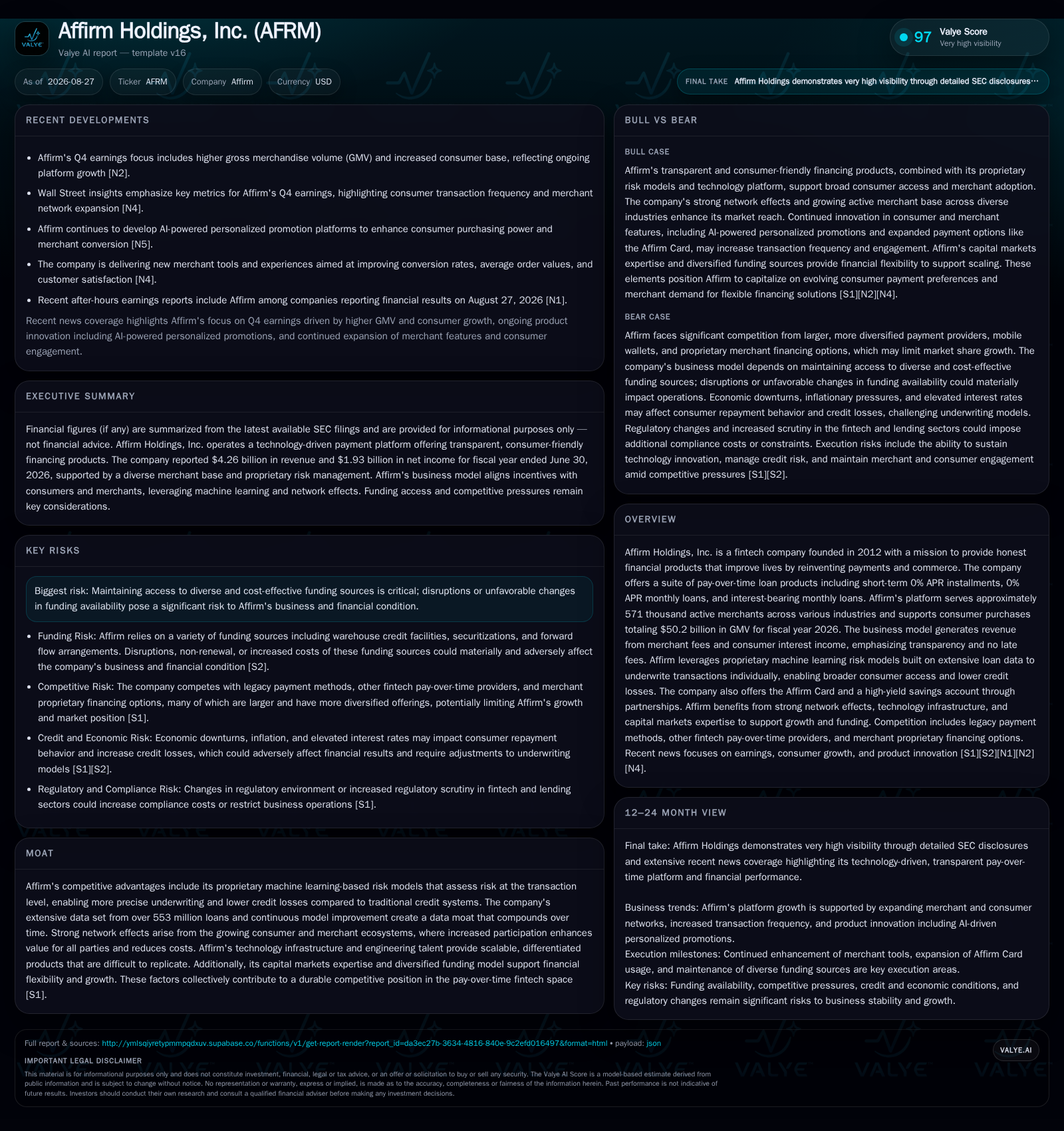
Affirm Holdings, Inc. reported increased gross merchandise volume (GMV) and a larger consumer base in Q4 FY2026 ended June 30, 2026, reflecting ongoing platform growth. The company’s proprietary machine learning risk models, built on data from over 553 million loans, continue to enable precise transaction-level underwriting that supports lower credit losses and broader consumer access. Funding risk remains a material concern due to reliance on diverse credit facilities and securitizations amid macroeconomic pressures. Affirm’s international expansion into Australia and plans for Europe add growth avenues but are at an early stage.
Affirm Holdings, Inc. reported continued platform growth in its fourth fiscal quarter ended June 30, 2026 (Q4 FY2026), marked by increases in gross merchandise volume (GMV) and consumer base size [S3]. This growth underpins revenue expansion and strengthens network effects critical to Affirm’s competitive positioning in the pay-over-time fintech market.
The company’s platform serves approximately 571,000 active merchants as of June 30, 2026, spanning a broad range of industries including electronics, fashion, home goods, and services [S1]. This extensive merchant network contributes to Affirm’s ability to facilitate a diverse array of consumer transactions, enhancing the platform’s scale and value.
Central to Affirm’s business model is its proprietary machine learning risk model, which assesses and prices credit risk at the transaction level rather than relying solely on traditional static credit scores. This model, built on data from roughly 553 million loans to date, is designed to continuously improve with scale and may enable the company to approve a wider and more diverse consumer segment while potentially maintaining lower credit losses compared to legacy credit systems [S1]. The precision of these risk models could support underwriting quality and credit loss management, which are important considerations for profitability and scaling in the capital-intensive fintech lending environment.
Affirm offers three main loan products: short-term 0% APR installment plans (Pay-in-X), 0% APR monthly installment loans, and interest-bearing monthly installment loans. Affirm relies on a variety of funding arrangements, including warehouse credit facilities, securitization trusts, master trust facilities, and forward flow agreements with a diverse set of institutional investors such as private credit funds. The company’s capital-intensive model requires continuous access to these credit sources to finance consumer loans and support GMV growth. Macroeconomic pressures, including inflation, elevated interest rates, and recession concerns, could disrupt credit markets or increase funding costs, potentially constraining Affirm’s growth capacity [S2][S1]. Affirm's proprietary risk model leverages data from approximately 553 million loans, enabling transaction-level underwriting that improves risk assessment precision. This approach allows Affirm to approve a broader consumer base, including those underserved by traditional credit scoring, while maintaining lower credit losses. The continuous learning aspect of the model means that as more transactions occur, the model's predictive accuracy and efficiency improve, creating a data moat that enhances underwriting quality and supports scalable growth [S1].
As of June 30, 2026, Affirm held $1.63 billion in cash and equivalents against $9.85 billion in total debt, reflecting significant leverage consistent with its funding model [F1]. This leverage underscores the importance of maintaining favorable funding terms and access to diverse capital sources.
On the international front, Affirm began a limited launch in Australia in the first quarter of fiscal year 2027 and has announced plans for further expansion into continental Europe [S1]. While these initiatives offer potential for geographic diversification and incremental growth, they remain early-stage developments.
Competitive pressures from larger payment providers and fintech peers remain a medium-term challenge. These competitors may limit Affirm’s market share growth and exert margin pressure, emphasizing the importance of ongoing innovation and platform enhancements.
Affirm is actively developing AI-powered personalized promotion platforms and merchant tools aimed at increasing transaction frequency, average order values, and customer satisfaction. Successful adoption of these features could accelerate growth and deepen network effects, reinforcing Affirm’s competitive position [N2][N4].
In summary, Affirm’s Q4 FY2026 results confirm ongoing platform expansion supported by its proprietary risk models and merchant network scale.
These factors will be critical in determining Affirm’s ability to sustain growth and underwriting performance in the evolving pay-over-time fintech landscape.

Comments