
HealthEquity Q2 2026: Market Leadership and Platform Integration Sustain Growth
HealthEquity’s Q2 2026 update confirms its leading position in HSAs and consumer-directed benefits, backed by a proprietary technology platform and solid financial footing.
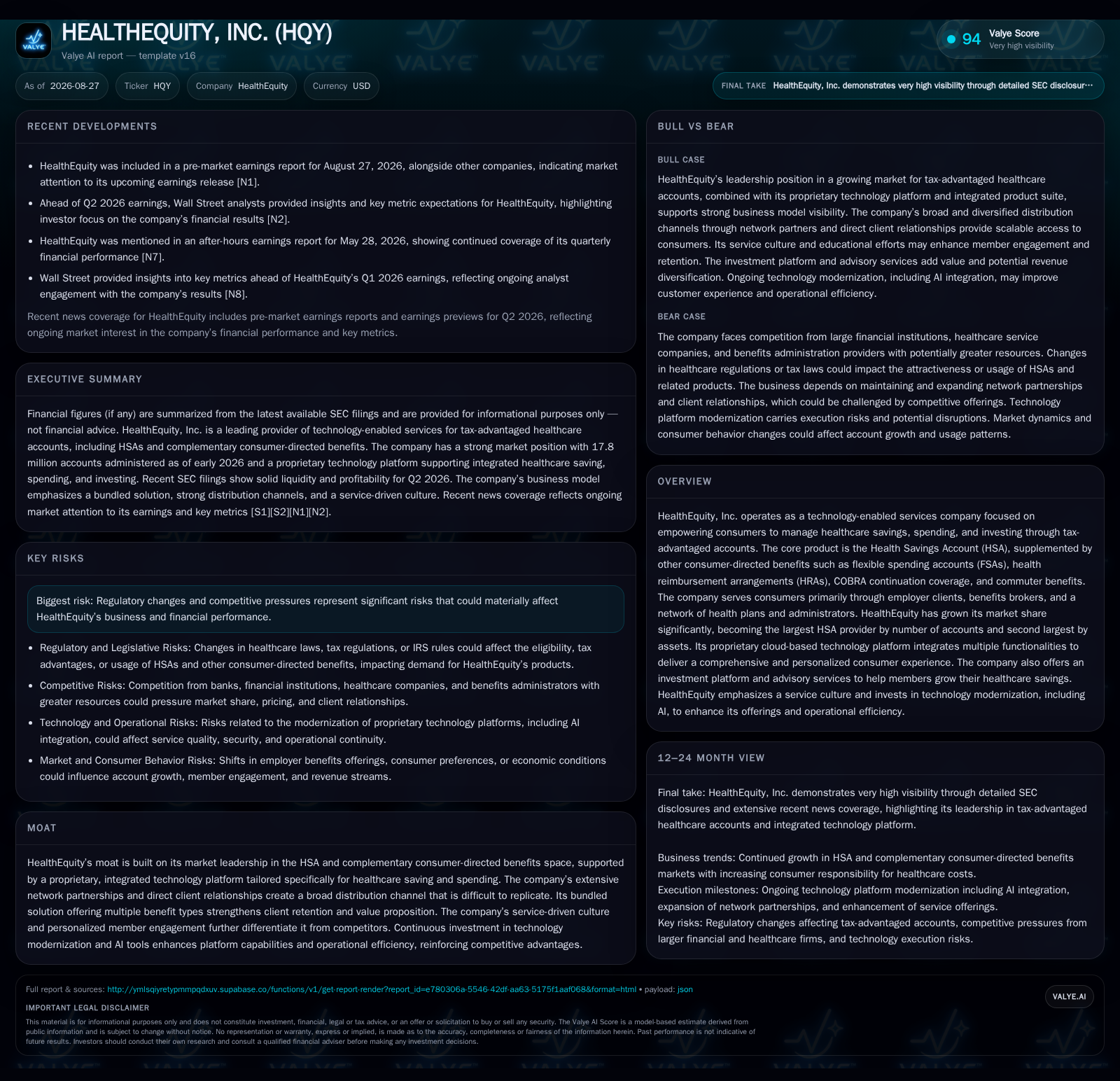
HealthEquity, Inc. reported in its latest quarterly filing as of August 27, 2026, sustained market leadership with 10.6 million Health Savings Accounts (HSAs) and 7.2 million complementary consumer-directed benefit accounts administered as of January 31, 2026. The company’s proprietary cloud-based platform integrates multiple benefit services and incorporates AI enhancements to improve operational efficiency and user experience. Its financial position remains strong, with $256 million in cash, $935 million in total debt, and a current ratio of 2.99 as of July 31, 2026. These factors together support HealthEquity’s durable competitive advantages amid ongoing regulatory risks.
Q2 2026 Operating Update and Market Position
HealthEquity, Inc.'s latest quarterly filing dated August 27, 2026, confirms its sustained leadership in the Health Savings Account (HSA) market and complementary consumer-directed benefits (CDBs). As of January 31, 2026, the company administered 10.6 million HSAs holding $36.5 billion in assets, alongside 7.2 million other consumer-directed benefit accounts, totaling 17.8 million accounts under administration [S1]. This scale positions HealthEquity as the largest HSA provider by number of accounts and the second largest by assets, supported by a broad distribution network integrated with over 200 Network Partners, including health plans, benefits administrators, and retirement plan recordkeepers [S1][S2].
Such market leadership is significant because the recurring fees HealthEquity earns from service, custodial, and interchange revenue streams scale with the number of accounts and assets under administration. A large and growing account base generates consistent revenue and creates switching costs that reinforce client retention and competitive positioning in a market structurally driven by increasing consumer responsibility for healthcare costs and tax-advantaged savings incentives.
Technology Platform and AI Integration
Central to HealthEquity’s competitive advantage is its proprietary, cloud-based technology platform that integrates multiple core functionalities essential to managing healthcare savings and spending. This platform encompasses custodial administration of savings and investment accounts, card and electronic funds transaction processing, benefits enrollment and eligibility, claims processing, medical bill presentment, tax-advantaged reimbursement account administration, HSA trust administration, online investment advice, and advanced analytics [S1]. The platform’s integration enables seamless management of diverse benefit types within a single, secure, and compliant system, enhancing user experience and operational efficiency. HealthEquity continues to invest in AI-powered tools to automate processes, reduce costs, and personalize member interactions, which supports ongoing improvements in customer engagement and operational scalability [S1][S2].
These technological capabilities are critical in an industry where platform uptime, data security, and ease of use directly impact client satisfaction and retention. The integration of AI is a current confirmation of the company’s commitment to innovation that could further differentiate its service offerings.
Balance Sheet and Financial Position
As of the quarter ended July 31, 2026, HealthEquity reported cash and cash equivalents of $256 million and total debt of $935 million, resulting in net debt of approximately $679 million [F1]. Current assets stood at $460 million versus current liabilities of $154 million, yielding a current ratio of 2.99, indicating that the company maintains nearly three times more current assets than current liabilities [F1]. This liquidity position suggests sufficient short-term resources to cover operating obligations such as payroll, interest payments, and capital expenditures.
While the company carries moderate leverage, the balance sheet metrics support financial flexibility to invest in technology modernization and growth initiatives. The availability of a $1 billion senior secured revolving credit facility maturing in 2029 further underpins HealthEquity’s capacity to fund acquisitions or other strategic investments if opportunities arise [S1].
Risks and Regulatory Environment.
HealthEquity’s business is materially dependent on the tax advantages associated with HSAs and other consumer-directed benefits.
Regulatory risk remains a key watchpoint given that federal or state governments might enact tax reforms that limit or eliminate deductions for HSA contributions. Such changes could lead to account attrition and margin pressure [S2]. However, the company’s risk disclosures indicate no material changes in risk factors since the last annual report.
Outlook and Considerations
HealthEquity’s sustained market leadership, supported by a large and diversified account base, integrated proprietary technology platform, and financial position, may contribute to competitive advantages in the growing HSA and consumer-directed benefits market. The company’s ongoing investments in AI and platform modernization could enhance operational efficiency and customer engagement, which may drive future revenue growth and margin expansion if account and asset growth continue.
Investors should monitor quarterly updates on accounts administered and assets under administration, regulatory developments affecting HSA tax advantages, and progress in technology platform enhancements. Confirming trends would include sustained or increasing account growth, stable regulatory support for tax-advantaged accounts, and positive customer feedback on platform innovations. Conversely, declines in account growth, adverse tax legislation, or technology platform disruptions would challenge the company’s growth thesis.
Overall, HealthEquity’s Q2 2026 disclosures indicate its position as a market leader with integrated technology capabilities and a balance sheet that could support efforts to capitalize on structural growth drivers in consumer-directed healthcare savings and benefits administration.

Comments