
Ambarella’s Transition to Advanced AI SoCs Challenges Profitability Despite Robust Operating Cash Flow
Ambarella is pivoting toward automotive and robotics AI SoCs with proprietary CVflow technology, balancing heavy R&D investment and competitive pressures.
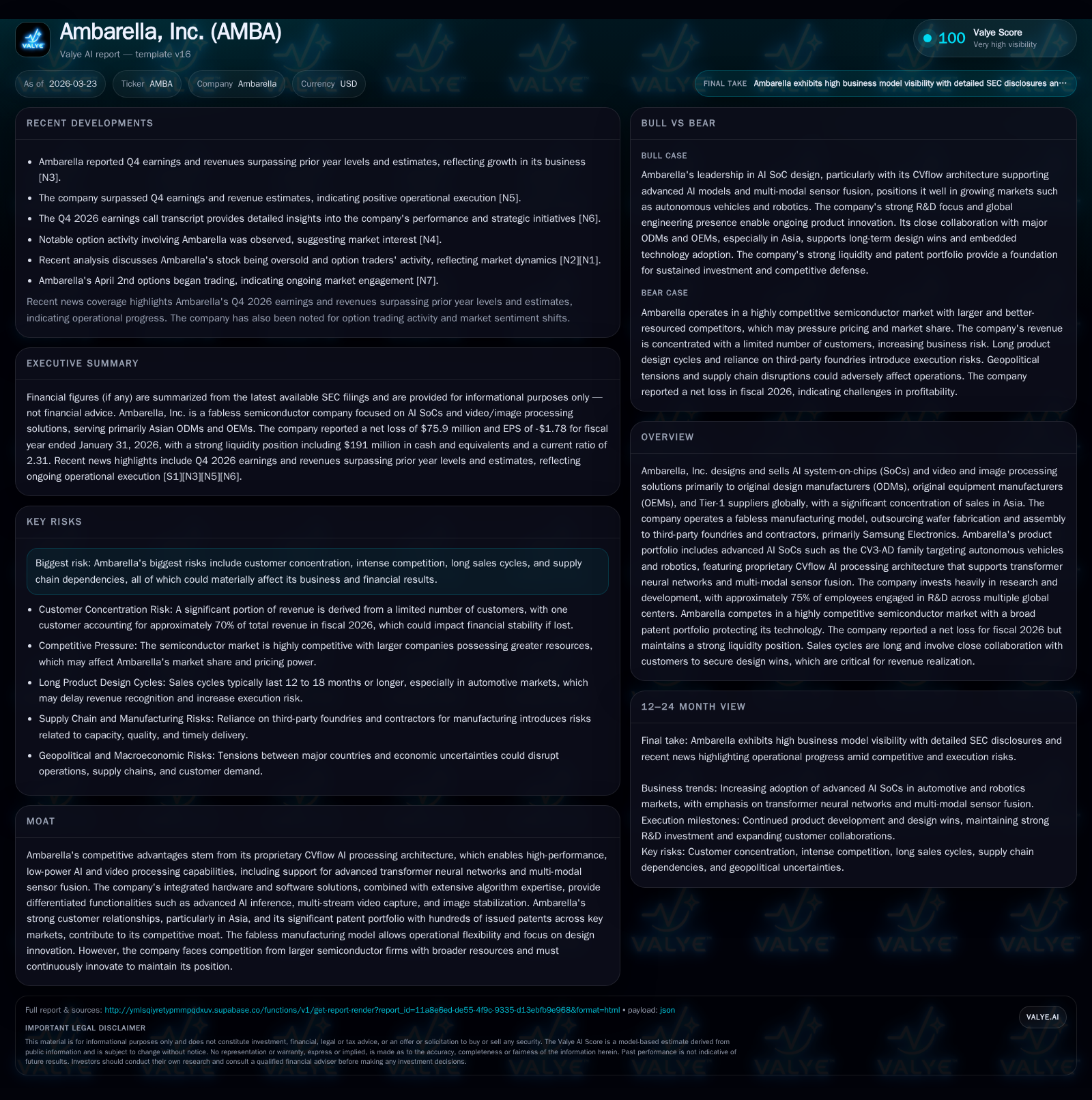
Ambarella has evolved from primarily video processing solutions for consumer devices to cutting-edge AI system-on-chips targeting autonomous vehicles and robotics. Despite a contraction in revenue and ongoing operating losses through fiscal 2026, the company demonstrates improving cash flow generation supported by robust R&D efforts concentrated on its proprietary CVflow architecture. Heavy customer concentration in Asia and intense competition from semiconductor giants pose persistent risks. Future growth hinges on successful commercialization of advanced AI SoCs, traction in longer design cycles for automotive markets, and operational scalability amid supply chain constraints.
Company Overview and Market Positioning
Ambarella Inc., incorporated in 2004, operates as a fabless semiconductor company developing system-on-chips (SoCs) tailored for edge AI inference, video processing, and computer vision applications. The firm’s unique value proposition lies in its proprietary CVflow AI processor architecture which optimizes high-performance transformer-based neural network operations and multi-modal sensor fusion — an essential feature set for autonomous vehicles (L2+ to L4 levels), robotics, and advanced driver assistance systems (ADAS).
Historically established as a provider of video compression and image processing chips targeting human-viewing-centric markets like IP security cameras, drones, sport cameras, and wearables, Ambarella has successfully transitioned toward physical AI applications requiring real-time environmental perception with deep fusion of radar, stereo camera inputs, lidar, thermal imaging, and near-infrared sensors [S23][S19]. This shift reflects broader industry trends converging on edge inference devices over cloud-based GPU centralized approaches due to latency, bandwidth, privacy considerations [S28].
Historical Financial Performance (FY2015-FY2026)
Historical performance (annual)
| FY | Net ($mm) | CFO ($mm) | OpInc ($mm) | Net YoY |
|---|---|---|---|---|
| 2026 | -76 | 74 | -83 | +35.2% |
| 2025 | -117 | 34 | -127 | +30.9% |
| 2024 | -169 | 19 | -155 | -159.1% |
| 2023 | -65 | 44 | -74 |
Source: SEC companyfacts cache [F1].
Capital returns and efficiency (annual)
| FY | Buybacks ($) | ROE% |
|---|---|---|
| 2026 | 1000000 | -12.8 |
| 2025 | -20.9 | |
| 2024 | -30.3 | |
| 2023 | 0 | -10.8 |
Source: SEC companyfacts cache [F1].
Revenue declined approximately 4.8% year-over-year in FY2026 while operating losses narrowed by roughly 35%, indicating improved cost control amid continued heavy investment in research and development [F1]. Operating cash flow more than doubled to $73.5 million during the same period enabling positive free cash flow after modest capital expenditures [F1]. Share repurchases remain minimal with only $1 million executed in FY2026 [F1].
Revenue Drivers & Market Segments
Approximately 88% of revenues derive from Asia-Pacific customers (primarily Taiwan and China), reflecting heavy reliance on ODMs/Tier-1 suppliers located there [S4][S6]. The primary revenue contributors have evolved from traditional consumer electronics segments into automotive OEM markets where Tier-1 suppliers embed Ambarella’s CV3-AD domain controllers into ADAS/autonomous systems [S22]. These products harness third-generation CVflow SoCs integrating neural accelerators capable of performing complex sensor fusion including HD radar plus multi-camera inputs [S19][S24][S25].
The company actively supports these platforms with software development kits (SDKs), comprehensive APIs, and the Cooper Development Platform enabling customers to tailor neural network implementations for specific AI workloads—facilitating sticky customer relationships and higher switching costs [S21][S22].
Competitive Landscape
Ambarella faces competition from semiconductor leaders including NVIDIA, Qualcomm, Intel-Mobileye subsidiaries alongside regional competitors such as HiSilicon (Huawei) and Novatek offering overlapping solutions for IoT camera systems or automotive-grade vision processors [S7]. Its competitive advantage stems from combined hardware-software integration expertise centered on low-power image/video processing fused with scalable AI inference capabilities supporting state-of-the-art transformer models up to approximately 34 billion parameters—a rare capability for edge devices [S19][S21].
However,
- Larger competitors exert pricing pressure due to economies of scale.
- Ambarella's smaller size limits marketing resources relative to these giants.
- Continuous innovation is required to maintain competitiveness given rapid advances in semiconductor process technologies [S25].
Operational Challenges & Risks
Customer concentration risk remains high; WT Microelectronics accounted for approximately 70% of total revenues in FY2026 [S6]. Dependence on a single large customer creates potential revenue volatility.
Design wins with OEMs/ODMs involve extended sales cycles ranging from twelve to over eighteen months; even longer timelines apply for safety-critical automotive applications due to regulatory validation processes [S4][S5]. While this limits near-term revenue visibility, it secures multi-year embedded product lifecycles once designs are adopted.
Manufacturing is outsourced exclusively to third-party foundries primarily Samsung Electronics utilizing advanced process nodes including 10nm, 5nm, and 4nm with recent tape-outs at bleeding-edge 2nm processes [S20][S25]. Although this fabless model reduces capital intensity and provides operational flexibility amid fluctuating chip demand profiles, it introduces exposure to supply chain risks exacerbated by global semiconductor shortages.
Geopolitical tensions impose export controls and trade restrictions impacting customer access and supply chain stability [S13][S29].
Research & Development Focus
R&D forms the core of Ambarella's strategy with approximately three-quarters of its workforce engaged globally across centers in the United States, Taiwan/China, and Italy focusing on hardware-software co-design for next-generation edge AI SoCs [S9][S29].
Recent developments include third-generation CVflow platforms delivering roughly twentyfold improvements in neural network performance over predecessors coupled with specialized engines for dense stereo depth sensing and optical flow critical for autonomous navigation stacks [S19][S24][S25].
Additionally, adaptive AI radar software enhances perception capabilities leveraging conventional radars via software overlays achieving higher resolution without new hardware—key for reducing bill-of-material costs important to OEMs [S22][S28].
Financial Liquidity & Capital Allocation
As of January 31, 2026, Ambarella held $191 million in cash and equivalents against $178 million current liabilities yielding a current ratio of approximately 2.31 indicating sound liquidity [F1][S12]. Operating cash flow surged over prior year levels to $73.5 million despite negative net income signaling strong underlying cash generation supported by working capital efficiency [F1]. Capital expenditures remain modest relative to cash flow consistent with fabless operations minimizing fixed asset investments [F1], resulting in free cash flow around $71 million after capex.
Capital allocation emphasizes reinvestment into R&D with minimal recent share repurchases ($1 million in FY2026) and no dividends declared or paid recently as per filings suggesting focus on sustaining technological leadership rather than returning capital to shareholders [F1][S12].
Outlook Considerations & What To Watch (Analysis)
Though explicit quantitative guidance is absent beyond recent quarterly earnings beats reported early calendar year [N1][N2], future growth depends significantly on:
- Commercial adoption success of CV3-AD family SoCs within Tier-1 automotive suppliers meeting regulatory standards for progressively higher autonomy levels;
- Broadening customer base beyond dominant partners while expanding into adjacent markets such as intelligent robotics;
- Maintaining technology leadership via continued tape-outs advancing sub-5nm nodes adapting rapidly to process innovations;
- Navigating global supply chain constraints ensuring delivery amidst demand cycles;
- Managing margin pressure amid intensified competition requiring disciplined cost control. Evidence from recent conference calls reflects optimism on pipeline expansion tempered by cyclical industry risks and geopolitical uncertainties impacting cross-border commerce [N3][N7].
Conclusion
Ambarella stands at a pivotal juncture evolving away from legacy video compression chips aimed at consumer IoT devices toward deeply integrated edge AI processors designed for complex autonomous systems leveraging proprietary architectures like CVflow optimized for transformer neural networks and advanced sensor fusion. Despite significant hurdles including concentrated customer exposure, prolonged sales cycles typical in automotive markets, unrelenting competition from tech giants with deeper pockets, the company demonstrates improving cash flow underpinning sustainability through ambitious R&D investment powering future roadmaps.
Investors should monitor upcoming design win momentum within automotive Tier-1 ecosystems alongside adoption rates by emerging physical AI markets plus evolving semiconductor supply dynamics shaping near-term commercial success against this transformative backdrop.
This report summarizes publicly available information as of March 23, 2026. It does not constitute investment advice or recommendations.
Disclaimer: This is research-only, informational analysis and not investment advice. It may include AI-generated interpretation and general industry context. Always verify important details using primary sources.

Comments