
Polaryx Therapeutics Advances Pediatric LSD Treatment with PLX-200 Phase 2 Plans
Polaryx builds on its repurposed therapy PLX-200 and multi-modality pipeline to address rare pediatric lysosomal storage disorders, initiating a Phase 2 basket trial in late 2026.
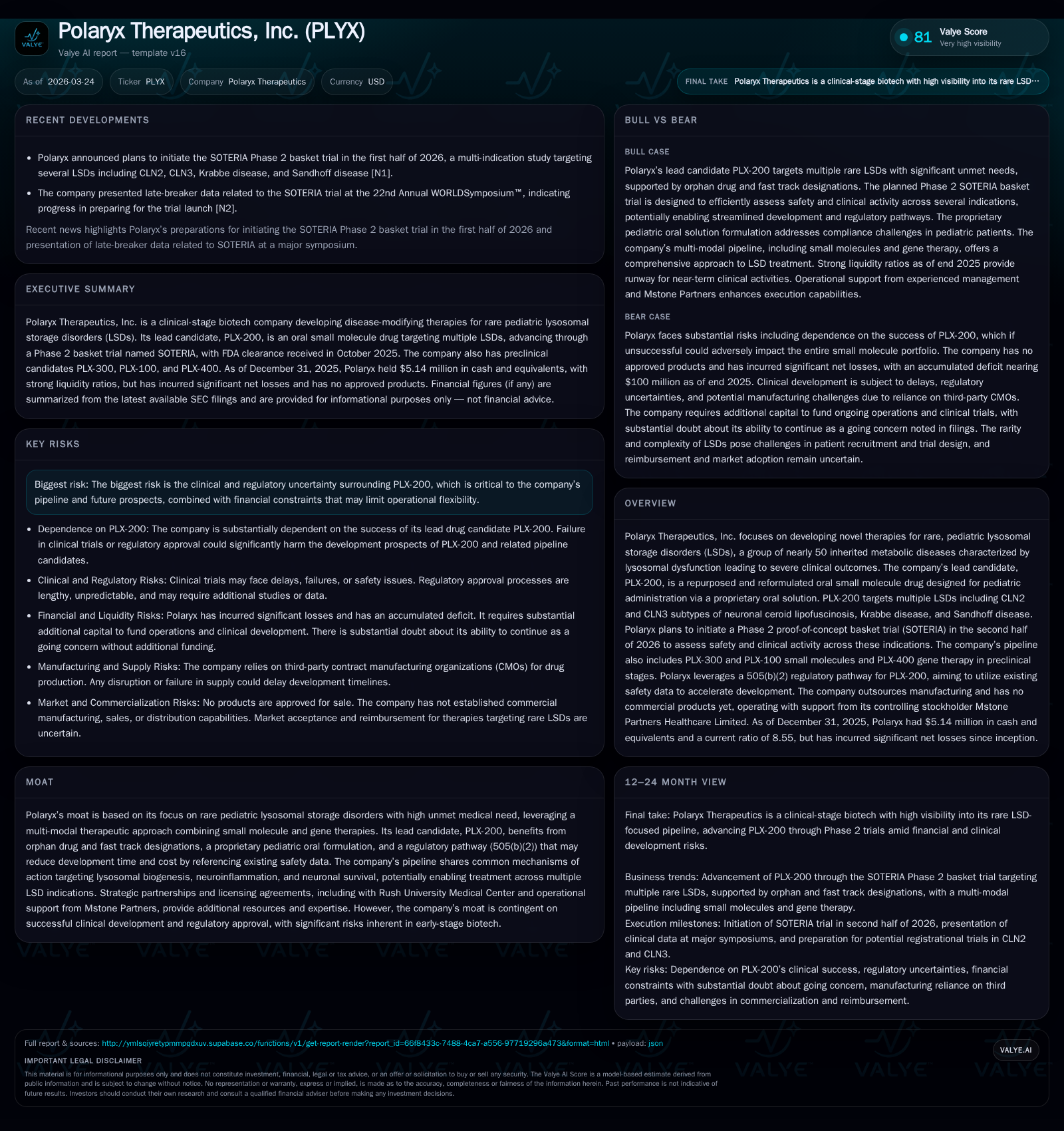
Polaryx Therapeutics is focused on developing novel therapies for underserved rare pediatric lysosomal storage disorders (LSDs) using a combination of small molecule and gene therapies. Its lead candidate, PLX-200, is an oral, repurposed drug targeting four LSD indications and is poised to enter a pivotal Phase 2 proof-of-concept basket trial, SOTERIA, expected in the second half of 2026. While financial metrics reflect typical developmental-stage biotech losses with a strong liquidity position, the company's regulatory progress, proprietary formulation, and orphan drug advantages position it well—albeit with significant clinical and operational risks ahead. Investors should closely monitor clinical readouts from SOTERIA alongside execution on manufacturing scale-up and regulatory milestones.
Historic Performance Highlights and Financial Snapshot
Polaryx Therapeutics remains in the early clinical-stage of development with no commercialized products to date. As of fiscal year ending December 31, 2025, the company posted an operating loss of approximately $7.8 million and a net loss of about $9.0 million [F1]. Despite these losses—which are common for nascent biotechs focused heavily on R&D—Polaryx holds cash and equivalents valued at roughly $5.1 million alongside current assets totaling about $5.17 million against current liabilities near $605 thousand; this yields a notably healthy current ratio of 8.55 [F1].
The equity base supports a derived return on equity (ROE) near -197%, reflecting deep reinvestment in clinical development rather than profitability. Liquidity trends confirm that Polaryx maintains sufficient near-term financial resources to advance planned trials without immediate capital raises but will require funding beyond initial milestones.
Historical performance (annual)
| FY |
|---|
| 2025 |
Source: SEC companyfacts cache [F1].
PLX-200: Repurposed Therapy Paving the Path in LSDs
PLX-200 stands as Polaryx’s flagship compound—a repurposed small molecule originally based on gemfibrozil—reformulated into a proprietary oral solution designed explicitly for pediatric administration to address pediatric lysosomal storage disorders (LSDs). The drug targets multiple severe LSD indications: Classic Late Infantile Neuronal Ceroid Lipofuscinosis (CLN2), Juvenile Neuronal Ceroid Lipofuscinosis (CLN3), Krabbe disease, and Sandhoff disease [N1][S1].
By leveraging the FDA's 505(b)(2) regulatory pathway, Polaryx aims to expedite development by referencing existing safety data from prior approvals of gemfibrozil while adapting formulations suitable for children [S1]. This approach can streamline the development timeline and reduce costs associated with traditional de novo new chemical entity pathways common in orphan drug development.
The proprietary oral liquid formulation addresses pediatric treatment challenges such as dose accuracy and ease of administration—critical factors in rare pediatric populations where pill swallowing may be difficult.
Multi-modality Pipeline and Strategic Collaborations Driving R&D
Beyond PLX-200, Polaryx pursues a diversified pipeline that includes additional small molecules—PLX-100 and PLX-300—and gene therapy candidate PLX-400 currently at preclinical stages [N1][S1]. These candidates share target mechanisms involving enhancement of lysosomal biogenesis pathways, mitigation of neuroinflammation, and promotion of neuronal survival—key pathogenic drivers in LSD progression.
Collaborations significantly supplement Polaryx’s internal capabilities: notably with Rush University Medical Center offering translational research expertise alongside contracted operational support from Mstone Partners Healthcare Ltd., which helps deliver specialized services without capital dilution through equity issuance [S18][S1]. Such strategic partnerships help bridge resource gaps typical for smaller biotechnology firms developing complex rare disease therapies.
Phase 2 SOTERIA Trial: A Pivotal Step for Clinical Validation
Scheduled for initiation in the second half of calendar year 2026, the open-label SOTERIA Phase 2 master basket trial represents Polaryx's critical efficacy and safety proof-of-concept study integrating multiple LSD subpopulations within one protocol [N1][S1]. This design allows simultaneous investigation across CLN2, CLN3, Krabbe disease, and Sandhoff disease patients under one regulatory umbrella.
Regulatory acceptance was secured following an FDA safe-to-proceed letter post-IND submission in October 2025 after preliminary pre-IND discussions occurred earlier that year [S1]. The trial's primary objectives focus on safety assessments while gathering preliminary signals on clinical activity across indications.
Successful SOTERIA outcomes would clear pathways toward registrable pivotal trials specific to each condition. Additionally, precedent FDA accelerated approval could be pursued for some subtypes such as CLN2/CLN3 using surrogate or earlier measurable endpoints aligned with prior approvals in this space.
Regulatory Landscape and Orphan Drug Advantages
Polaryx benefits from key regulatory designations supporting expedited development—most notably orphan drug designation across targeted LSDs and Fast Track status granted to PLX-200 for Juvenile NCL (CLN3) [S1][S23]. These incentives provide procedural advantages including enhanced FDA communication channels and eligibility for marketing exclusivity upon approval.
However, inherent uncertainties persist: drug development within these ultra-rare disorders involves unpredictable recruitment hurdles owing to small patient populations; nuanced FDA expectations around clinical endpoint validation; stringent requirements for compliance with current Good Manufacturing Practice (cGMP) and Good Clinical Practice (GCP); along with evolving policy landscapes particularly outside the U.S. [S4][S7][S25].
Global pricing pressures represent an additional headwind; European market rules impose tight price controls often necessitating comparative cost-effectiveness trials post-approval before reimbursement authorization—a factor not unique but acute in rare disease launches [S3][S25]. The interplay between orphan drug exclusivity provisions and biosimilar competition also introduces potential patent protection challenges longer term [S15].
Key Operational and Financial Risks to Monitor
Chief among risks is Polaryx’s dependence on the successful clinical progression of PLX-200. Failure or delays at any phase could materially impair commercial viability given its centrality in the pipeline [S1]. Manufacturing scale-up risks compound this uncertainty as complex biologics production demands investments that could strain resources if not carefully managed [S1][S6].
Regulatory setbacks remain possible despite Fast Track status; FDA reviews might extend due to heterogeneous indication responses or need for further trials causing timeline elongation [S4][S14]. Legislative reforms targeting specialty drug pricing coupled with global reimbursement variability could limit revenue potential even upon approval [S7][S25][S27].
Furthermore, compliance risks encompass data privacy laws such as GDPR/UK GDPR affecting clinical trial operations internationally alongside anti-corruption statutes relevant given potential overseas collaborations [S9][S19][S28]. Legal exposure nonetheless appears controlled currently with no active material litigation recorded [S8], yet future patent infringement suits remain plausible given competitive biotech patent landscapes [S10][S21].
Capital Strategy, Cash Position, and Return Metrics
Fiscal year-end data exhibit a net loss near $9 million which aligns with consistent operating expenditure investment into R&D activities essential at this stage while revenues remain absent due to lack of approved products [F1]. Cash reserves at above $5 million form an adequate runway toward SOTERIA initiation but likely insufficient past pivotal data readouts necessitating additional capital raises eventually.
No dividends or share repurchases exist given allocation priorities toward advancing clinical trials rather than shareholder distributions typical for developmental biotech entities currently generating negative return ratios—the latest calculated ROE was about -197%, reflecting loss concentration funded by equity stakeholders [F1]. Management’s disclosure does not currently indicate announced capital deployment plans beyond sustained investment in pipeline progression [F1][S1].
Outlook and Watchpoints for Future Milestones
The upcoming launch of the SOTERIA Phase 2 basket trial by late 2026 stands as the foremost near-term catalyst shaping Polaryx’s trajectory; interim safety reports followed by preliminary efficacy indicators during or shortly after trial completion will be crucial barometers of viability across targeted LSD indications [N1][S1].
Following these outcomes will be assessment points regarding transition into registrable pivotal studies potentially unlocking accelerated approval paths particularly in CLN2/CLN3 domains where unmet needs remain acute with few alternatives.
Parallel advancement of manufacturing infrastructure—including scaling formulation production—and expansion or renewal of research partnerships may influence operational robustness going forward.
Additional watchpoints involve global regulatory engagements especially as foreign market entry requires navigation through variable approval climates affecting commercialization timing.
Disclaimer:
This memorandum is prepared solely for informational purposes based on publicly available data as of March 24, 2026. It does not constitute investment advice or recommendations regarding any securities mentioned herein.
Disclaimer: This is research-only, informational analysis and not investment advice. It may include AI-generated interpretation and general industry context. Always verify important details using primary sources.

Comments