
LENZ Therapeutics’ Market Debut Hinges on VIZZ Commercial Execution and Patent Protection
The company's 2025 FDA approval of VIZZ marks a pivotal shift from development to commercialization amid significant operational challenges and competitive risks.
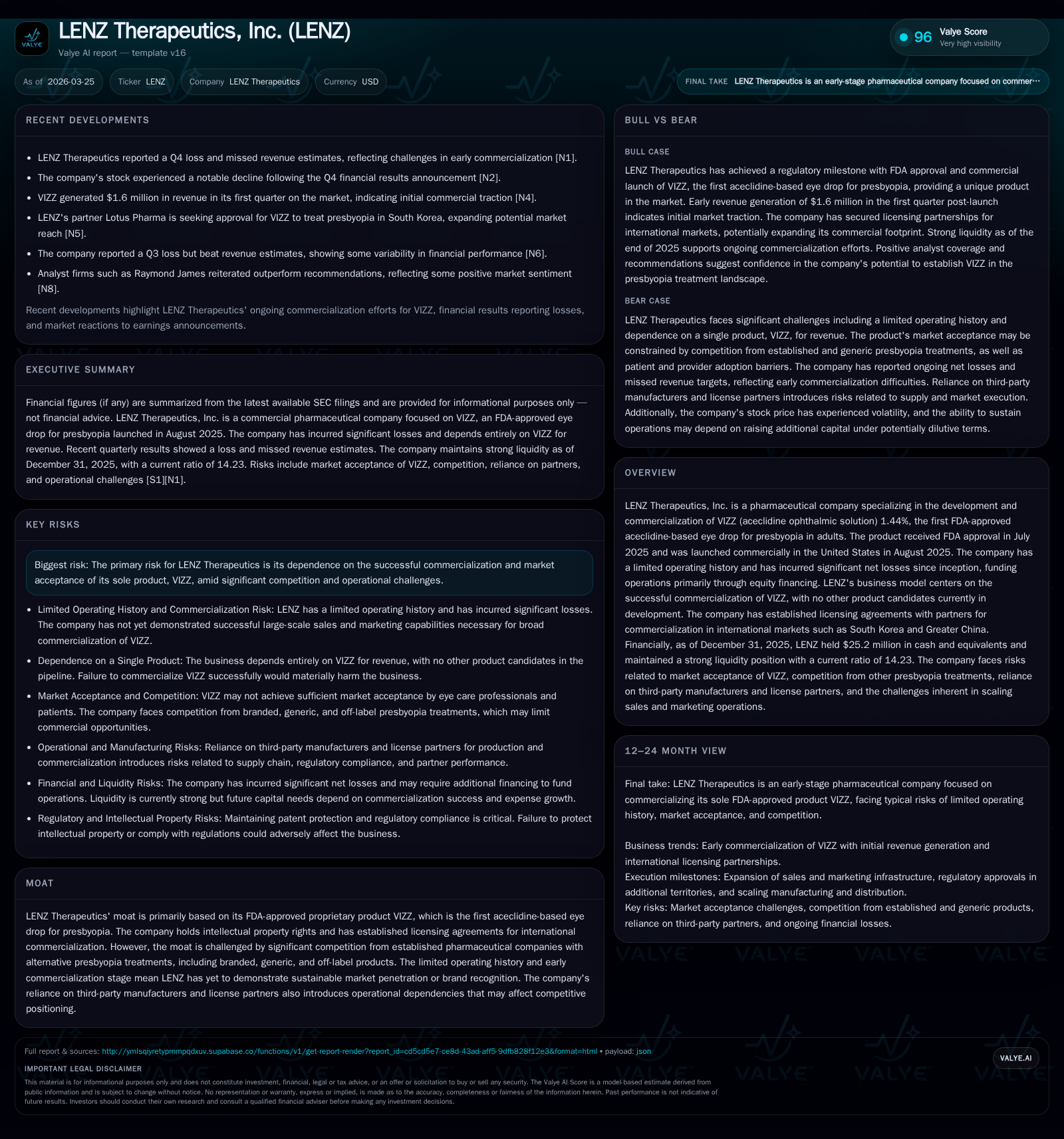
LENZ Therapeutics secured FDA approval for VIZZ, the first aceclidine-based eye drop for presbyopia, in mid-2025 and launched it commercially in the U.S. since August 2025. Despite this milestone, the company remains unprofitable with substantial operating losses and negative cash flow reflecting early commercialization investments. LENZ’s growth depends on market adoption of VIZZ within the large U.S. presbyopia population, scaling sales efforts, and protecting intellectual property amid competitive pressures. International licensing extends reach but increases reliance on partners. Monitoring sales traction, competitive landscape, and regulatory developments will be critical to assessing LENZ’s trajectory.
Company Background and Business Model
LENZ Therapeutics is a commercial pharmaceutical company that transitioned from development to active commercialization following FDA approval of its lead product, VIZZ (aceclidine ophthalmic solution) 1.44%, in July 2025 [S1]. This represents a global first for an aceclidine-based eye drop treating presbyopia—a condition affecting about 1.8 billion people worldwide including an estimated 128 million adults in the U.S. [S1]. LENZ's business model centers on commercializing VIZZ domestically while leveraging licensing partnerships internationally.
VIZZ operates via a novel pupil-selective miotic mechanism producing a pinhole effect by contracting the iris sphincter muscle to enhance near vision without inducing myopic shifts typical of ciliary muscle stimulants [S1]. This pharmacological differentiation positions VIZZ uniquely within a competitive presbyopia treatment landscape comprising alternative pharmaceuticals and optical devices.
Historical Financial Performance
Financial data from [F1] illustrates persistent net losses since inception driven initially by R&D investment and now by substantial selling, general & administrative expenses related to early commercialization:
Historical performance (annual)
| FY | Net ($mm) | CFO ($mm) | OpInc ($mm) | Capex ($mm) | Net YoY |
|---|---|---|---|---|---|
| 2025 | -82 | -69 | -91 | 1 | -65.0% |
| 2024 | -50 | -59 | -59 | 0 | +60.1% |
| 2023 | -125 | -90 | -135 | 11 | -23.4% |
| 2022 | -101 | -88 | -106 | 7 |
Source: SEC companyfacts cache [F1].
Capital returns and efficiency (annual)
| FY | FCF ($mm) | ROE% |
|---|---|---|
| 2025 | -70 | -28.9 |
| 2024 | -60 | -24.4 |
| 2023 | -101 | -67.9 |
| 2022 | -95 | -34.1 |
Source: SEC companyfacts cache [F1].
Capital expenditures declined sharply post-2023 reflecting a shift from development infrastructure investment toward commercial activities [F1]. Operating cash flow remained deeply negative at approximately -$69 million in FY25, aligned with ongoing commercialization costs exceeding revenues; free cash flow similarly negative near -$70 million after modest capex [F1]. There were no dividends or share repurchases.
As of December 31, 2025, LENZ held approximately $25.2 million in cash and equivalents with a strong current ratio around 14 indicating short-term liquidity resilience despite continued cash burn [F1]. Equity increased notably over recent years due to capital raises funding operations [F1].
Product Launch & Commercial Execution
Following FDA approval on July 31, 2025 [S1], LENZ launched VIZZ commercially in August targeting eye care professionals (ECPs), including optometrists and ophthalmologists [S1]. Sample distribution began in October to encourage trial use among clinicians while commercial shipments via an e-pharmacy partner started concurrently; retail pharmacies broadly stocked VIZZ by November [S1].
This rapid go-to-market approach combines direct field sales efforts with digital pharmacy partnerships to establish presence swiftly in a predominantly out-of-pocket U.S market segment. The company emphasizes its leadership team's clinical and commercial experience as key to category leadership ambitions.
Intellectual Property & Competitive Positioning
A core competitive advantage lies in proprietary rights protecting aceclidine’s use for presbyopia treatment: patent protection extends through at least 2044 alongside five-year New Chemical Entity exclusivity valid until mid-2030 [S1]. This intellectual property portfolio provides meaningful barriers against generic competition near term.
However, challenges remain:
- Competition includes major pharmaceutical firms marketing alternative therapies plus generic and off-label options that may constrain uptake [S1].
- Reliance on third-party manufacturers introduces supply chain risks potentially affecting product availability or pricing flexibility [S1].
- Limited operating history creates uncertainty regarding sustainable brand recognition or physician prescribing patterns establishment.
Patent litigation risk exists as generic challengers or competitors may seek invalidation or infringement claims potentially complicating outlook [S7][S8][S9].
Market Dynamics & Growth Prospects
The addressable U.S presbyopia market opportunity exceeds $3 billion encompassing roughly 128 million adults experiencing near vision decline [S1]. LENZ targets patients seeking non-device solutions improving near vision without reading glasses dependency.
Growth drivers include:
- Continuing education of ECPs supported by credible clinical data demonstrating efficacy,
- Scaling direct sales force effectiveness,
- Expanding retail pharmacy penetration,
- Positive patient adoption sustaining repeat purchases,
- Broadening international licensing agreements facilitating global revenue streams (currently South Korea & Greater China) [N1][S1], though timelines depend on partner execution.
Growth constraints include:
- Slower-than-anticipated market penetration or prescription conversion due to conservative physician or patient adoption,
- Pricing pressures given out-of-pocket payment model vulnerable to macroeconomic factors,
- Competitive advancements offering improved efficacy/safety/cost profiles,
- Potential regulatory changes impacting promotional activities or reimbursement—even though current focus is out-of-pocket segments.
Outlook & Milestones to Monitor
LENZ does not provide explicit forward revenue guidance given its nascent commercial phase [N1][S3]. Investors should monitor quarterly disclosures for emerging top-line traction signaling market acceptance:
- Sales volume trends,
- Share gains within presbyopia eye drop category,
- Physician prescribing behavior insights,
- Margin improvements indicating operational scalability,
- Updates on geographic license expansions beyond current territories,
- Management commentary on competition or regulatory environment shifts.
These indicators will be vital for evaluating LENZ's transition from early adopter status toward sustainable commercialization.
Capital Allocation & Returns Profile
Financial history shows consistent net losses driven by prior R&D intensity followed by high SG&A spending during commercial ramp-up resulting in FY25 operating loss of $91.1 million and net loss of $82.1 million versus prior years (net income worsened 65% YoY) [F1]. Operating cash flow remains deeply negative (-$69 million) while capital expenditures are minimal reflecting the post-development phase [F1]. Return-on-equity based on FY25 results approximates -28.9%, consistent with early-stage pharmaceutical companies investing heavily ahead of profitability [F1].
No dividends or share repurchases have been declared nor are expected until profitability or sustained positive free cash flow materializes given capital constraints typical during initial growth phases post-launch.
Risks Summary
Key risks include:
- Total reliance on commercial success of a single product candidate without pipeline diversification heightens vulnerability,
- Intense competition from established pharmaceutical companies with deeper resources,
- Supply chain risks stemming from third-party manufacturing dependencies,
- Regulatory compliance complexities within highly regulated pharmaceutical markets that could impose costly restrictions or enforcement actions,
- Operational risks from international licensing partnerships limiting direct control over foreign markets,
- Macroeconomic factors impacting discretionary healthcare spending within out-of-pocket markets targeted by VIZZ.
Conclusion
LENZ Therapeutics stands at a critical juncture following regulatory approval of its flagship product VIZZ coupled with an aggressive commercial launch targeting an expansive U.S presbyopia market exceeding $3 billion annually. Despite this breakthrough and robust patent protection extending through mid-century, financial performance reflects challenges inherent in transitioning from development to early-stage revenue generation characterized by significant losses and cash consumption.
Success hinges on achieving widespread clinical adoption among eye care professionals and patients seeking alternatives to optical aids; managing manufacturing and partnership dependencies effectively; navigating competitive pressures; and sustaining intellectual property defense amid typical pharmaceutical legal dynamics.
Stakeholders should closely monitor quarterly KPIs including unit sales momentum, international licensing contributions, margin trends signaling operational leverage gains, along with management commentary addressing competitive landscape evolution and regulatory considerations shaping strategic priorities.
This report synthesizes publicly available filings including LENZ Therapeutics’ SEC disclosures through March 24th, 2026 ([S1]-[S29]) augmented by financial XBRL data ([F1]) plus recent NASDAQ news coverage ([N1]-[N3]). It provides informed company context strictly grounded in documented evidence without investment advice.
Disclaimer: This is research-only, informational analysis and not investment advice. It may include AI-generated interpretation and general industry context. Always verify important details using primary sources.

Comments