
Kiora Pharmaceuticals Advances Vision Restoration Amid Clinical and Financial Challenges
Clinical-stage development of novel ophthalmic therapies underpinned by strategic partnerships and evolving trial data.
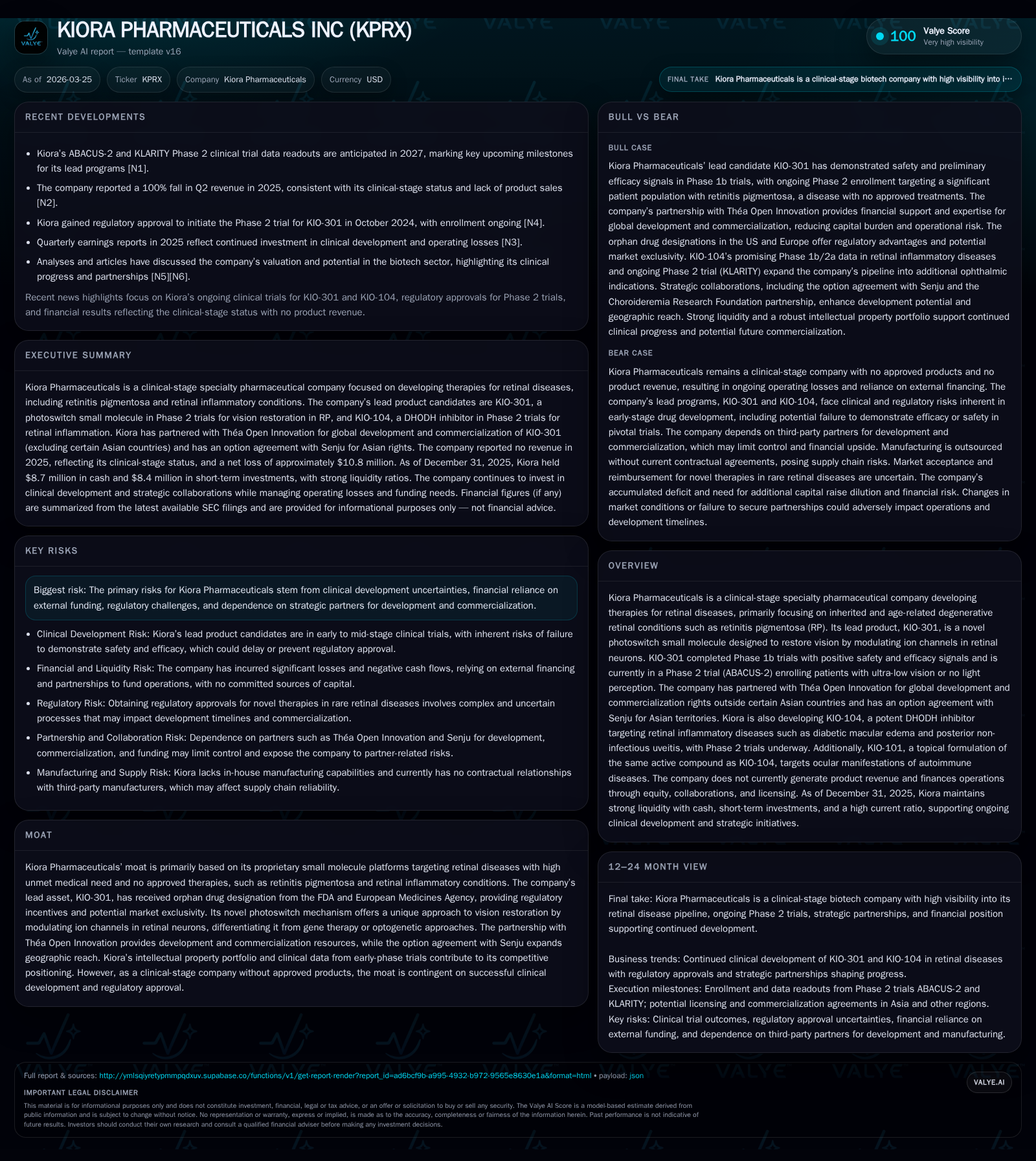
Kiora Pharmaceuticals is focused on developing small molecule therapies targeting retinal diseases such as retinitis pigmentosa (RP) and retinal inflammatory conditions. The company’s lead candidate, KIO-301, has completed Phase 1b trials and is undergoing a Phase 2 study enrolling ultra-low vision patients, supported by a partnership with Théa Open Innovation. KIO-104 is entering Phase 2 for retinal inflammation indications. Despite promising clinical signals and regulatory progress, Kiora remains a pre-revenue company with substantial operating losses, reliant on external capital sources to fund ongoing R&D and clinical programs. Its cash runway extends into late 2027 absent unforeseen acceleration in spending.
Company Background and Business Focus
Kiora Pharmaceuticals is a clinical-stage specialty pharmaceutical company dedicated to developing therapies for degenerative and inflammatory retinal diseases. The firm’s proprietary small molecule platforms focus on high unmet medical needs such as retinitis pigmentosa (RP), a genetically heterogeneous group of inherited retinal degenerations leading to progressive vision loss, and retinal inflammatory diseases including diabetic macular edema (DME) and posterior non-infectious uveitis.
The company's lead investigational drug, KIO-301, utilizes an innovative 'photoswitch' mechanism whereby it selectively enters viable retinal ganglion cells—which lose input from degenerated photoreceptors—and converts them into light-sensitive cells capable of signaling the brain. This small molecule approach contrasts with gene therapy or optogenetic strategies, representing a unique method potentially applicable broadly across RP sub-types regardless of the underlying genetic mutation [S1].
Another key asset, KIO-104, is an intravitreally delivered, non-steroidal dihydroorotate dehydrogenase (DHODH) inhibitor that exerts potent immunomodulatory effects designed to treat retinal inflammation by suppressing T-cell activity. Importantly, KIO-104 seeks to provide improved safety over existing DHODH inhibitors [S1].
Historical Performance and Growth Drivers
Kiora acquired KIO-301 through its acquisition of Bayon Therapeutics in October 2021, propagating its entry into vision restoration therapeutics. The initial Phase 1b study (the ABACUS trial) conducted during late 2022 through September 2023 demonstrated positive safety and efficacy signals, with topline data presented publicly in November 2023 [S1]. Following this milestone, the company partnered strategically with Théa Open Innovation (TOI) in January 2024 securing exclusive global development and commercialization rights outside certain Asian countries. The collaboration yielded a significant upfront payment of $16 million plus potential milestone payments aggregating up to $285 million, alongside tiered royalties capped in the low twenties on net sales [S1][S11].
Regulatory authorization was granted in October 2024 to initiate the Phase 2 ABACUS-2 trial focusing on patients with ultra-low vision or no light perception—an important population segment previously lacking therapeutic options. Enrollment began mid-2025 with dosing commencing soon after [S1]. Meanwhile, KIO-104 was acquired via Panoptes Pharma acquisition and entered Phase 2 studies (KLARITY trial) for retinal inflammation; it demonstrated encouraging early clinical proof-of-concept in reducing intraocular inflammation and improving visual acuity in earlier phases [S1].
Financially, the company’s revenue was $16 million in FY2024, predominantly driven by upfront payments from licensing deals such as TOI's license agreement. However, top-line revenue fell to zero in FY2025 as there were no new milestone recognitions or product sales given the clinical-stage status [F1]. Operating income swung from positive $4.5 million in FY2024 back into an operating loss of about $12.8 million in FY2025 following increased R&D spend supporting multiple clinical trials (see table below). Net income mirrored these trends moving from profit in FY2024 to an approximate $10.8 million loss last fiscal year [F1].
Historical performance (annual)
| FY | Rev ($mm) | Net ($mm) | CFO ($mm) | OpInc ($mm) | Rev YoY | Net YoY |
|---|---|---|---|---|---|---|
| 2025 | 0 | -11 | -10 | -13 | -100.0% | -401.4% |
| 2024 | 16 | 4 | 9 | 5 | +128.7% | |
| 2023 | -13 | -10 | -13 | +7.9% | ||
| 2022 | -14 | -10 | -12 |
Source: SEC companyfacts cache [F1].
Capital returns and efficiency (annual)
| FY | FCF ($mm) | ROE% |
|---|---|---|
| 2025 | -10 | -67.2 |
| 2024 | 9 | 14.0 |
| 2023 | -204.8 | |
| 2022 | -10 | -119.1 |
Source: SEC companyfacts cache [F1].
The decline back into operating losses stems largely from increased investment into advancing clinical development programs while revenues reflected non-recurring upfront licensing fees without commercial product sales [F1][S1][S11][S14].
Future Growth Prospects
Kiora's growth prospects hinge critically on the successful clinical advancement and eventual regulatory approvals of KIO-301 and KIO-104.
The ongoing ABACUS-2 Phase 2 study evaluating multiple doses across approximately 36 patients aims to validate novel functional vision endpoints suitable for registration purposes globally—potentially expediting market approval if successful given the orphan disease status awarded by both FDA and EMA [S1]. If positive efficacy is established, subsequent pivotal studies could broaden therapeutic application beyond RP’s later stages.
Parallel progress with KIO-104 targeting retinal inflammation has shown promising phase I/II signals including dose-dependent intraocular inflammation reduction and macular edema improvement without serious adverse events [S1]. The May 2025 initiation of the KLARITY trial generating robust safety/tolerability data will inform commercial readiness for addressing inflammatory retinal disorders like DME.
Strategic licenses remain vital to support capital-intensive late-stage development efforts: TOI controls global rights except Asia where an exclusive option agreement with Senju Pharmaceutical may unlock up to $111 million in payments plus royalties upon exercise [S5][S11]. Success may hinge upon effective geography-tailored commercialization partnerships.
Key risks limiting growth include regulatory hurdles inherent in novel modalities targeting hard-to-treat neuronal tissues; reliance on partner funding structures potentially diluting control or shifting timelines; raising additional capital amid macroeconomic volatility; and competition from advanced gene or cell therapy platforms pursuing similar indications [S10][S12][S22].
Forecasts and Milestones to Monitor
No explicit forward guidance was provided beyond ongoing trial initiation details; however, key near-term milestones include:
- Completion of enrollment and interim analyses from ABACUS-2 Phase 2 study (expected during late 2026–early 2027).
- Safety and efficacy readouts from KLARITY trial assessing multiple doses of KIO-104.
- Potential execution or decline decision of Senju's option agreement.
- Updates on partnering deals or licensing revenue recognition triggered by trial outcomes.
Regulatory progress enabling use of validated functional endpoints could significantly accelerate approval pathways for these therapies given their focus on severe visual impairment subsets currently lacking any approved treatment [S1]. These upcoming triggers warrant attention as indicators of de-risking.
Returns and Capital Allocation Considerations
From inception through December 31, 2025, Kiora has accumulated operational losses totaling approximately $154 million reflective of heavy R&D investments without commercialized products or sales revenue generation so far [S5][F1]. In FY2025 alone, net loss stood at around $10.8 million translating into a negative return on equity near -67%, highlighting current absence of profitability [F1].
Operating cash flows remain negative crossing nearly $10 million outflow in FY2025 consistent with increasing expenditures on clinical programs [F1]. Capital expenditures are relatively insignificant (~$111 thousand in FY2025), reflecting asset-light operations typical for clinical-stage biotech companies focused primarily on R&D activities conducted via third parties or partnerships [F1].
Capital infusion sources comprise equity offerings historically totaling roughly $149 million raised since IPO plus upfront collaboration payments aggregating over $30 million along with government grants and tax credits [S11]. In January 2024 alone, TOI partnership delivered a $16 million upfront license payment which materially bolstered liquidity.
As of December 31, 2025, the Company maintains about $8.7 million cash & equivalents plus approximately $8.4 million short-term investments—a combined liquidity base of roughly $17 million—and minimal outstanding debt usage under its revolving credit facility that saw balanced borrowings/payments during the year [F1][S8][S11]. Management believes available capital suffices to fund operations through late 2027 subject to spending adjustments but anticipates need for additional financing thereafter presumably via equity/debt offerings or further collaborations [S11][S21].
Notably, no dividends or stock repurchase initiatives have been undertaken consistent with prioritizing reinvestment toward advancing pipeline assets rather than returning capital to shareholders at this stage [S13].
Industry Context Analysis (Non-company specific)
Retinal diseases such as RP represent orphan indications characterized by complex pathophysiology and lack effective treatments beyond supportive care; thus innovative modalities like photoswitch small molecules offering functional vision restoration address critical unmet needs positioned for orphan exclusivity-driven premium pricing frameworks across US/EU markets.
Simultaneously, diabetic macular edema remains one of the leading causes of vision impairment globally—existing treatments like anti-VEGF agents require frequent injections associated with patient burden—thereby catalyzing interest in oral/injectable immunomodulatory alternatives such as DHODH inhibitors if proven efficacious/safe.
Clinical development costs for ophthalmic small molecules span tens-to-hundreds of millions USD dependent on indication complexity/trial size while regulatory agencies increasingly demand demonstrable functional improvements measured through novel endpoints—underscoring importance of robust clinical design employed by Kiora's ongoing Phase 2 studies.
Partnership models combining regional expertise for development/commercialization mitigate execution risks commonly seen among emerging biotechnology firms exclusively focused on innovation but constrained financially or geographically.
Conclusion Summary
Kiora Pharmaceuticals stands at a critical juncture advancing two differentiated ophthalmic therapeutic candidates through pivotal clinical trials buttressed by strategic alliances enabling resource leverage beyond internal capabilities. While early data around its novel photoswitch molecule KIO-301 and immunomodulator KIO-104 show promising signs relevant for significant patient populations suffering from degenerative retina disease and retinal inflammation respectively, the company remains burdened by persistent operating losses amid no current product sales.
Maintaining sufficient liquidity into late 2027 affords runway flexibility though eventual successful commercialization hinges heavily on navigating regulatory uncertainty around acceptance of innovative endpoints and forging suitable partnership/licensing arrangements particularly across Asian territories represented by Senju's option agreement.
Continuous monitoring will be essential around clinical milestones delivering proof-of-concept confirmation while managing financing strategies appropriately given prevailing macroeconomic pressures impacting investor appetite within specialty biopharma sectors focusing on rare ophthalmic diseases.
This analysis is based solely on publicly available regulatory filings dated through March 25, 2026-related disclosures ([S#]) and financial data ([F1]). It does not constitute investment advice.
Disclaimer: This is research-only, informational analysis and not investment advice. It may include AI-generated interpretation and general industry context. Always verify important details using primary sources.

Comments