
Health In Tech’s 2025 Surge: From AI-Driven Market Shift to Capital Efficiency
HIT accelerated top-line and cash flow growth through its AI-driven underwriting platform and expanded broker network, while managing operational tradeoffs amid a concentrated service provider environment.
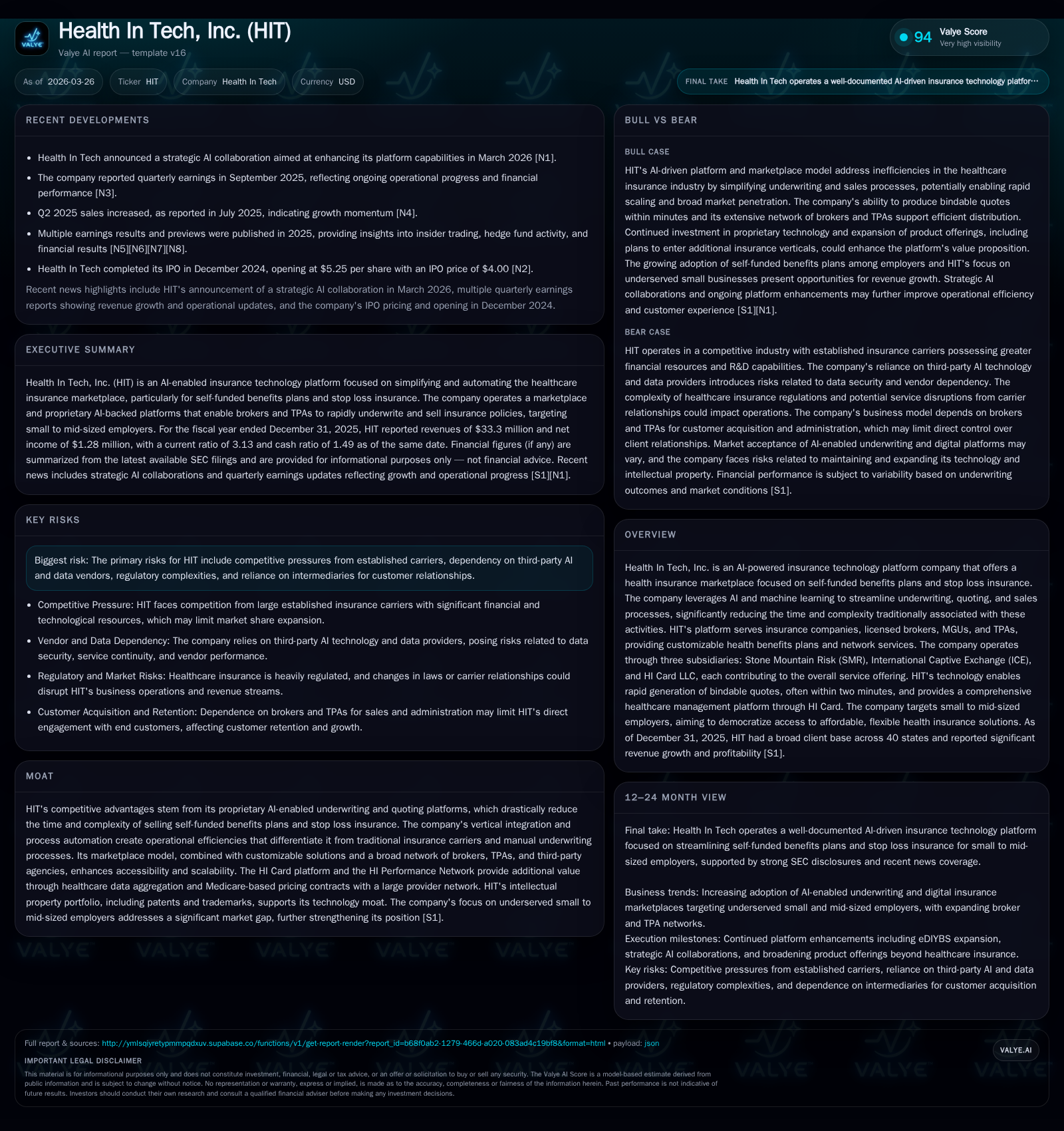
Health In Tech, Inc. (HIT) recorded a remarkable 71% revenue increase in FY2025, driven by rapid adoption of its proprietary AI-powered underwriting and quoting technology alongside a growing network of brokers and TPAs. The company’s three subsidiaries—Stone Mountain Risk (SMR), International Captive Exchange (ICE), and HI Card LLC—function as an integrated platform offering complex self-funded benefits and stop-loss insurance solutions with scalable technology. Despite margin compression linked to higher cost of revenues and increased operating expenses, HIT demonstrated strong operating cash flow growth (+44%) and maintains solid liquidity supported by a current ratio above 3x. Key risks include concentration in certain carrier relationships and dependency on third-party AI vendors, balanced against HIT’s unique vertical integration and automation-driven competitive moat. Future catalysts hinge on expanded marketplace participation and strategic alliances, amid evolving regulatory dynamics.
Strong Revenue Growth Powered by AI-Enabled Underwriting and Broker Expansion
In fiscal year 2025, Health In Tech (HIT) showcased an impressive revenue leap to approximately $33.3 million, representing a notable year-over-year increase of 71% from $19.5 million in the prior year [F1]. This growth is intricately tied to the accelerated adoption of HIT's proprietary AI-backed underwriting and quoting platform, the eDIYBS system, which compresses what traditionally took weeks or even months into turnaround times frequently under two minutes for generating bindable quotes within insurer risk thresholds [S6][S14][S18].
The expansion of HIT's registered broker ecosystem played a pivotal role: by year-end, the platform hosted 583 licensed brokers alongside 12 third-party administrators (TPAs) and another 263 third-party agencies operating across 40 states [S7]. This extensive distribution network amplified marketplace penetration while facilitating increased volumes of stop loss insurance policies sold through self-funded benefits plans.
Notably, subsidiary operations under SMR (Stone Mountain Risk) strengthened their foothold significantly, driving roughly 79.4% of consolidated revenues in FY2025 compared with approximately half in FY2024 [F1][S15]. Complementing this was ICE's contribution at just over 20%, focused primarily on managed general underwriting (MGU) functions underpinning stop loss carrier relationships via an advanced SaaS quoting technology [S6][S15]. Meanwhile, HI Card LLC's offerings serve as value-added integrations rather than standalone revenue sources.
Breaking Down HIT’s Platform: Subsidiary Roles and Product Synergies
HIT operates an interconnected family through its three wholly owned subsidiaries—SMR, ICE, and HI Card—that collectively embody its core service ecosystem [S6][S15][S22]. Stone Mountain Risk functions as the program manager designing customized self-funded benefits plans tailored to employers’ needs by orchestrating network selection, vendor management, and benefit structuring [S15].
International Captive Exchange acts as an MGU specializing in underwriting support using its machine learning-enabled quoting portal aligned with insurance carriers’ risk acceptance thresholds [S15]. The interdependence between SMR’s plan design capabilities and ICE’s underwriting workflow automation creates a seamless marketplace pipeline which cannot be effectively replicated if either subsidiary were isolated.
HI Card complements this system by aggregating healthcare data through a unified digital interface that offers patients, TPAs, brokers, and providers real-time access to plan details including claim status and medical records—all accessible through one login [S8][S10]. The HI Performance Network further enhances plan value by providing Medicare-based pricing contracts across more than one million providers nationwide [S10].
The platform’s technology stack thus combines rapid binding quote generation with healthcare record transparency—a potent mix supporting cost reduction objectives while expanding accessible market reach.
Concentration Risks and Service Provider Dependencies Underpin Operational Dynamics
While HIT's distribution channels broaden, certain revenue concentrations reflect operational dependencies that merit attention. Carrier A represented approximately 27.3% of total gross revenues in FY2025 – up from Carrier B’s similar share in FY2024—and accounted for nearly half (47.1%) of accounts receivable at year-end [S4][S5]. Such concentration raises potential volatility risks tied to ongoing contractual relationships.
On the cost side, HIT's three primary service providers—including a critical third-party AI data vendor—constituted an aggregate of approximately 77.6% of the company's cost of revenues in FY2025; this illustrates continued reliance on select external partners for key components such as machine learning data feeds used in underwriting models [S4][S12][S21]. Notably this represents a shift from prior year composition where two major providers drove over two-thirds of costs.
These concentrated expenditures highlight both potential bargaining power limitations against larger providers/insurers and underline the importance of maintaining multiple qualified vendor options to mitigate service disruption risks.
Profitability Trends Amid Rapid Top-Line Expansion: Gross Margin and Expense Analysis
Despite stellar revenue growth figures, HIT faced margin pressure during FY2025. Gross profit totaled roughly $20.9 million versus $15.4 million in FY2024; however, gross margin fell from around 79.2% down to about 62.8% due primarily to a sharp rise in cost of revenues—from roughly $4.1 million to $12.4 million—a near tripling equating to a +$8.3 million increase [F1][S1]. This reflects volume-related increases but also supplier cost escalations linked heavily to the concentrated vendor base.
Operating expenses grew markedly with sales & marketing outlays rising about 33% to $4.2 million while general & administrative expenses ballooned by more than 60%, reaching over $13.6 million or close to 41% of total revenue [S1]. Conversely research & development spending decreased year-over-year from around $2.8 million down to $1.6 million (approximately 4.7% of sales), suggesting a strategic reallocation away from foundational platform development toward scaling existing systems.
This expense structure marks an inflection point where HIT balances investing for growth against sustaining underlying profitability levels—indicative of typical post-scale-up phases within insurtech businesses focusing intensely on market share capture.
Capital Allocation: Assessing ROE, Operating Cash Flow, and Liquidity Metrics
Capital discipline emerges as another favorable aspect amid HIT’s expansion trajectory. Based on reported net income around $1.28 million juxtaposed against stockholders' equity approximating $17.1 million at December ’25 end yields an indicative return on equity near 7.5% [F1]. Although not outstanding relative to mature insurers or financial platforms yet positive given HIT's growth stage.
Operating cash flow rose robustly by about 44%, reaching over $3.1 million in FY2025 versus $2.2 million in prior year—a reflection of improved revenue collections efficiency supported by backend automation tools deployed on accounts receivable processes [F1][S25]. That cash generation capacity supports incremental investments without excessive external financing reliance.
Equally important is HIT’s liquidity position: with current assets exceeding current liabilities over threefold (current ratio approx. 3.13), the firm demonstrates strong short-term financial flexibility conducive to weathering volatility or funding targeted expansion pushes without immediate capital raises [F1][S16]. Dividend payments or share repurchases were neither declared nor planned according to recent filings consistent with prioritized reinvestment strategies.
Competitive Advantages Rooted in Proprietary AI and Vertical Integration
HIT's moat largely rests on digital transformation delivered through proprietary underwriting algorithms married with vertical integration spanning product design (SMR), automated quoting (ICE), marketplace facilitation (platform portal), and value-added healthcare data aggregation via HI Card [S13][N1].
The firm's eDIYBS system employs extensive big-data analytics combined with external third-party AI feeds embedded into internal risk scoring models—capable of conducting digital medical underwriting rapidly without human intervention except for outlier cases requiring supplemental health applications input via electronic channels [S14][S24]. This process optimization contrasts starkly with legacy insurers relying heavily on manual underwriting workflows that can extend quoting timelines into weeks or months.
Vertical full-service integration encompassing MGUs coordination with brokers plus incorporated TPA collaboration expedites placement cycles while reducing frictional costs—a significant differentiator within health insurance stop loss markets where speed-to-bind can materially affect client acquisition costs and premium volume growth [S7][S14].
Forecast Indicators: Strategic Partnerships and Market Penetration to Watch
Although explicit forward guidance is not provided within available disclosures, recent announcements suggest continued momentum through strategic AI collaborations aimed at refining machine learning capabilities coupled with efforts to onboard large brokerage firms onto the marketplace platform ([N1]). These partnerships signal growth potential by unlocking broader carrier participation alongside enhanced data intelligence features intended for claims processing automation.
Industry observers should monitor quarterly cadence changes in registered broker counts beyond current levels (~583 brokers plus affiliated entities) plus incremental carrier additions expected from ongoing discussions noted within internal plans ([N1][S23]). Regulatory approvals needed for expanded product sets including Property & Casualty lines will also influence timing horizons for material diversification gains ([S8]).
Addressing Regulatory Complexity and Third-Party Dependencies
Operating nationally under ERISA preemption grants HIT operational jurisdictional breadth bypassing restrictive state-level mandates affecting fully insured plans; however evolving regulations applicable to data privacy/security laws require constant vigilance ([S23]). Compliance demands especially affect HIT due to reliance on external AI/data vendors integrating confidential health information through API interfaces introducing potential cybersecurity vulnerabilities ([S24]).
Moreover, customer relationship dependency on intermediaries such as brokers and TPAs introduces layers that could become points of friction should market conditions change or if any partner-experienced disruptions arise ([S20]). Effective risk management frameworks involving contractual safeguards are thus critical components underpinning platform sustainability.
Summary Table: Key Historical Financials Highlighting Dynamic Growth Trajectory
Historical performance (annual)
| FY | Rev ($mm) | CFO ($mm) | Rev YoY |
|---|---|---|---|
| 2025 | 33 | 3 | +71.0% |
| 2024 | 19 | 2 |
Source: SEC companyfacts cache [F1]. Gross margin decline reflects surge in cost associated with scaling vendor services; CFO increase signals improved operating liquidity.
This analysis is prepared solely for informational purposes based on SEC filings as of March 2026 and does not constitute investment advice nor recommendation regarding Health In Tech shares or securities related thereto.
Disclaimer: This is research-only, informational analysis and not investment advice. It may include AI-generated interpretation and general industry context. Always verify important details using primary sources.

Comments