
Prudential PLC Strengthens Earnings Momentum Through Emerging Markets Expansion
Prudential PLC’s robust profit growth is anchored in its focused strategy on high-growth emerging markets and disciplined capital management.
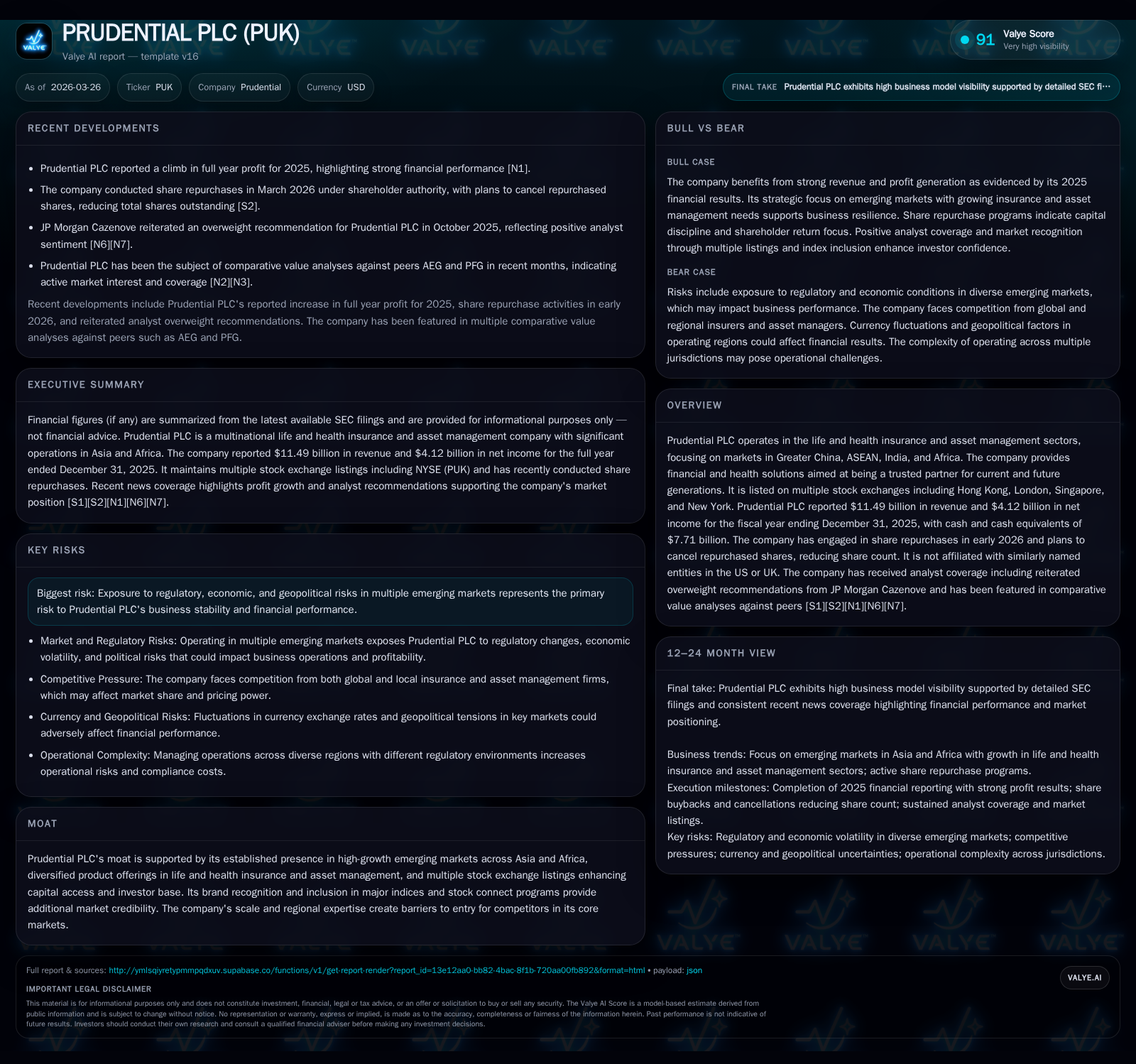
Prudential PLC demonstrated strong earnings growth with net income rising over 70% year-over-year in 2025, driven by growth in life and health insurance and asset management across Greater China, ASEAN, India, and Africa. The company’s revenue grew 7% to $11.49 billion, supported by operational leverage and disciplined underwriting. Prudential executed systematic share repurchases in early 2026, enhancing capital efficiency amid a solid return on equity near 19%. Investors should monitor updates on free surplus generation and solvency margins to gauge sustainability of growth and capital discipline.
Powering Growth: Historical Revenue and Profit Dynamics
Prudential PLC reported revenues of $11.49 billion for the fiscal year ending December 31, 2025, marking a 7% increase compared to $10.74 billion in FY2024, itself up from $9.74 billion in FY2023 [F1]. This steady growth underscores effective penetration within its target emerging markets—Greater China, ASEAN, India, and Africa—where rising middle-class populations drive demand for life and health insurance products.
Net income surged approximately 70.6% year-over-year to $4.12 billion in FY2025 from $2.42 billion in FY2024 [F1]. This reflects strong operating leverage as underwriting results improved due to disciplined risk selection and favorable claims experience across lines. Asset management fee income also contributed positively.
Equity grew to $21.36 billion at end-2025 from $18.67 billion at end-2024 [F1], indicating healthy retained earnings accumulation alongside prudent capital deployment. Based on net income relative to equity at year-end [F1], the approximate return on equity (ROE) was 19.3% for FY2025, reflecting efficient capital use within the firm's risk-adjusted framework.
Historical performance (annual)
| FY | Rev ($bn) | Net ($bn) | Rev YoY | Net YoY |
|---|---|---|---|---|
| 2025 | 11.5 | 4.1 | +7.0% | +70.6% |
| 2024 | 10.7 | 2.4 | +10.3% | +41.1% |
| 2023 | 9.7 | 1.7 | -55.6% | +70.0% |
| 2022 | 21.9 | 1.0 |
Source: SEC companyfacts cache [F1].
Capital returns and efficiency (annual)
| FY | Div ($mm) | ROE% |
|---|---|---|
| 2025 | 714 | 19.3 |
| 2024 | 583 | 12.9 |
| 2023 | 540 | 9.5 |
| 2022 | 482 | 5.9 |
Source: SEC companyfacts cache [F1].
Note: The significant revenue drop from FY2022 to FY2023 likely reflects structural events or segment reclassifications not detailed here.
Strategic Footprint: Leveraging Emerging Markets and Diversified Product Lines
Prudential's competitive advantage lies in its expertise across growing markets including Greater China, ASEAN countries, India, and Africa where insurance penetration remains comparatively low but economic growth trends are favorable [F1], [N1], [S1]. Its life and health insurance offerings align closely with local consumer needs addressing healthcare gaps and long-term savings demands.
Bancassurance partnerships provide scalable distribution access to established bank client bases—a key channel across Asia—supplementing premium revenue with fee income streams [S1]. Asset management activities enhance earnings diversification through fund management fees derived from expanding wealth pools.
Scale advantages yield cost efficiencies and stronger negotiating positions with regional distributors while building barriers via regulatory expertise across complex jurisdictions.
Capital Discipline: Share Buybacks, Dividends, and Financial Returns
In early 2026, Prudential undertook systematic share repurchases via JP Morgan Securities plc under authority granted at the company’s AGM . Purchases ranged daily between approximately £10.48 and £10.99 per share with aggregate buyback volumes exceeding one million shares during March alone . The company intends to cancel all repurchased shares, reducing share count and enhancing earnings per share metrics.
Dividend payments steadily increased from $482 million in FY2022 to $714 million in FY2025 [F1], demonstrating balanced shareholder returns despite market headwinds.
These buybacks were conducted as on-market transactions compliant with London Stock Exchange Listing Rules and Hong Kong Code on Share Buy-Backs—highlighting rigorous regulatory adherence for this multinational issuer . The firm maintains an approximate ROE of nearly 19%, underscoring effective capital allocation within an investment-grade credit environment.
Risk Profile: Regulatory and Macroeconomic Challenges Across Key Markets
Key risks include navigating diverse regulatory frameworks alongside macroeconomic uncertainties within core markets [S1]. The group’s sovereign debt holdings form significant portfolio components monitored closely for credit quality amid global rate fluctuations.
Corporate debt investments totaled $4.9 billion as of December 31, 2025—with over 95% rated investment grade—reflecting stringent credit controls [S1]. Financial sector exposure is material but managed; no non-financial sector exceeds a portfolio weight of 15%, mitigating idiosyncratic risks [S1].
Risk mitigation includes counterparty limits, collateral arrangements particularly for derivatives and reinsurance contracts, portfolio diversification policies, and regular credit reviews by Investment Committees [S1]. These measures manage default risk amid emerging market funding pressures related to tariffs or inflationary cycles.
Operational risks such as compliance breaches or technology disruptions receive ongoing attention given increasing reliance on digital infrastructure.
Outlook: Milestones and Investor Considerations
While explicit forward guidance post-FY2025 filings is absent [N1], investors should watch disclosures on free surplus generation—a key cash source enabling dividends or buybacks—and solvency margin fluctuations amid multi-jurisdictional market conditions [N1], [N2].
Analysts highlight valuation appeal supported by robust earnings momentum driven by expanded insured lives penetration coupled with scalable asset management businesses less sensitive to regulation than direct insurance underwriting operations [N1].
Additional monitoring points include potential regulatory reforms affecting capital adequacy in Asian markets and currency impact disclosures linked to USD-denominated investments subject to foreign exchange volatility.
Prudential's dual primary listings on the London Stock Exchange (LSE) and Hong Kong Exchanges facilitate broad capital market access but entail varied disclosure obligations that could influence investor sentiment amid geopolitical tensions affecting cross-border flows [S19].
Disclaimer: This analysis is based solely on public filings and reputable sources as of March-April 2026 without offering investment recommendations or forecasts beyond stated facts or citations.
Disclaimer: This is research-only, informational analysis and not investment advice. It may include AI-generated interpretation and general industry context. Always verify important details using primary sources.

Comments