
Seafarer Exploration Corp’s Financial Strains Challenge Speculative Shipwreck Recovery Model
The company’s niche focus on archaeologically-sensitive shipwreck exploration is constrained by sustained operating losses and mounting debt defaults.
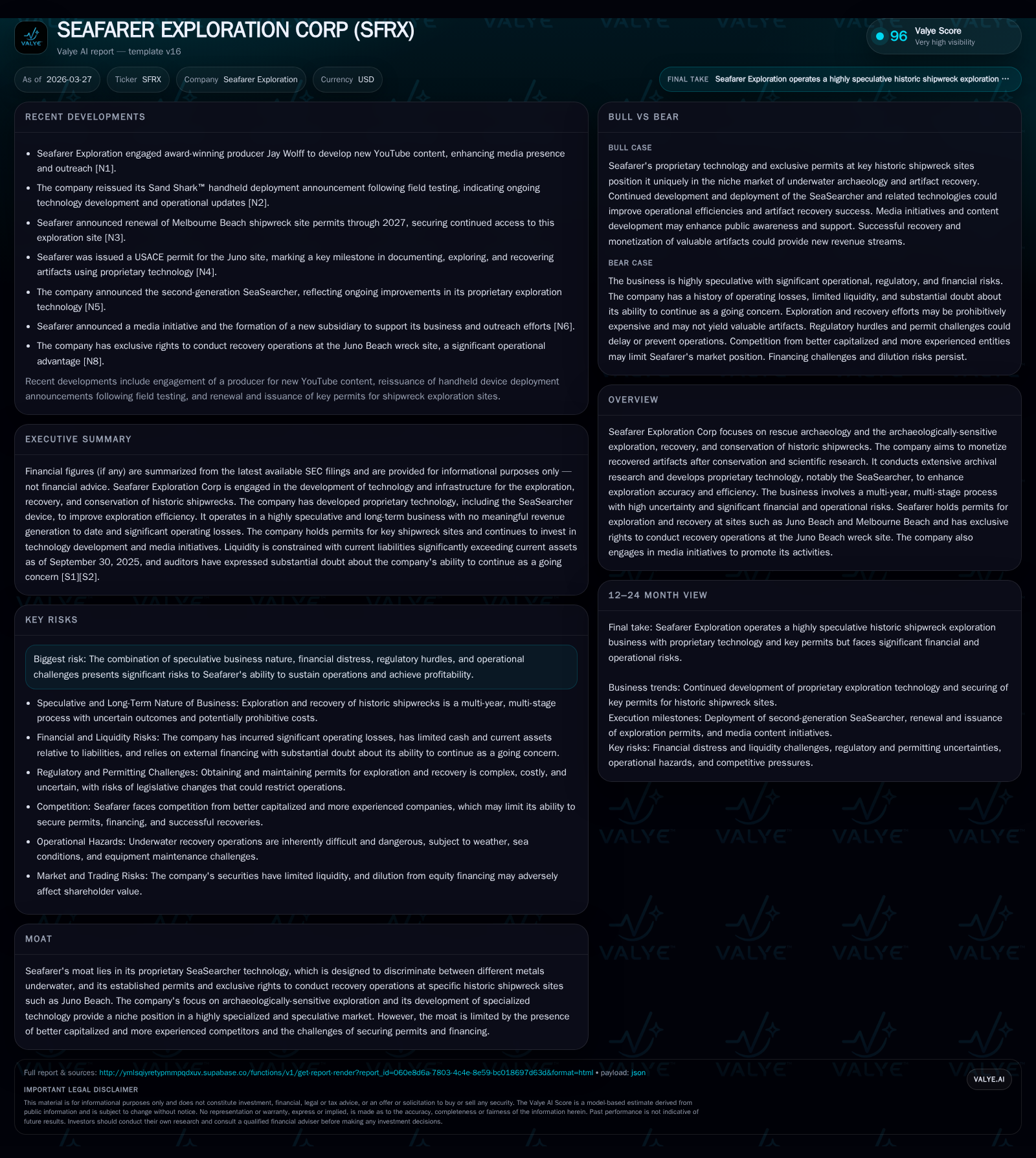
Seafarer Exploration Corp, specializing in historic shipwreck recovery supported by proprietary SeaSearcher technology, has faced persistent revenue declines and significant financial distress. Despite holding exclusive permits at sites like Juno Beach, its operations remain speculative, with multi-year timelines and uncertain outcomes. The company’s liquidity position is weak, burdened by convertible notes and other debts in default, raising substantial doubt about its ability to continue as a going concern.
Company Overview and Business Model
Seafarer Exploration Corp (SFRX) is a specialized firm focused on rescue archaeology — exploring, recovering, conserving, and monetizing artifacts from historic shipwrecks. Incorporated in Florida since 2003 (formerly Organetix, Inc.), Seafarer's strategy combines archival research with technological innovation to operate at archaeologically sensitive underwater sites.
At the core of its operations is the proprietary SeaSearcher technology, which discriminates between different metals underwater such as gold and silver. This device enhances detection precision at wreck sites including Juno Beach and Melbourne Beach. The company holds exclusive rights for recovery operations at the Juno Beach site — a critical asset amid a highly speculative sector with regulatory hurdles and high capital demands [S1].
Historical Financial Performance
Seafarer's recent financial results illustrate the capital-intensive and speculative nature of its business model. Revenues peaked at approximately $19,235 in fiscal year 2023 before declining about 15% to $16,303 in FY2024 — reflecting the long timelines typical of underwater archaeology where commercialization often lags discovery by years or decades.
Operating losses have grown from around $2.4 million in FY2022 to approximately $3.3 million in FY2024 — a near 10% worsening YoY trend. Net income losses deepened by over 22%, reaching nearly $3.9 million last fiscal year [F1]. These figures underscore challenges transitioning exploratory work into revenue-generating artifact recoveries.
Operating cash flows have been consistently negative — from almost $(1.9) million in FY2020 worsening to $(2.9) million in FY2024 — highlighting substantial cash burn without meaningful inflows from artifact sales or partnerships [F1]. This deficit strains liquidity and necessitates costly financing.
Capital expenditures spiked sharply to more than $58k in FY2024 primarily due to R&D costs related to refining SeaSearcher technology — pivotal for future efficiency but weighing heavily on cash [F1].
Historical performance (annual)
| FY | Rev ($) | Net ($mm) | CFO ($mm) | OpInc ($mm) | Rev YoY | Net YoY |
|---|---|---|---|---|---|---|
| 2024 | 16303 | -4 | -3 | -3 | -15.2% | -22.5% |
| 2023 | 19235 | -3 | -2 | -3 | +48.3% | -21.6% |
| 2022 | 12972 | -3 | -2 | -2 | ||
| 2020 | 10622 | -2 | -3 |
Source: SEC companyfacts cache [F1].
Capital returns and efficiency (annual)
| FY | Buybacks ($) | FCF ($mm) | ROE% |
|---|---|---|---|
| 2024 | 2400 | -3 | 138.6 |
| 2023 | 2400 | -2 | 193.8 |
| 2022 | -2 | 174.9 | |
| 2020 | -2 |
Source: SEC companyfacts cache [F1].
Figures represent USD; Buybacks reported only for FY2023 [F1].
Capital Structure and Liquidity Challenges
Liquidity is a critical risk for Seafarer: as of September 30, 2025, the company's current assets totaled approximately $30K versus current liabilities exceeding $3.5 million — yielding an extremely low current ratio around 0.01 [F1][S5][S8]. This imbalance raises substantial doubt about the company's ability to continue as a going concern.
Its capital structure relies heavily on convertible notes payable along with various notes payable that are largely in default due to missed principal and interest payments [S3][S4][S5][S8]. Defaults involve both unrelated lenders and related parties; consequently, lenders could initiate legal actions including foreclosure on collateralized assets potentially disrupting operations.
Convertible notes carry conversion rights favoring lenders at prices significantly dilutive relative to market values; management has indicated plans to negotiate further conversions into equity—likely increasing shareholder dilution materially [S3]. This dynamic exerts downward pressure on share price alongside ongoing cash flow challenges.
Despite repeated equity financing rounds raising roughly $1.4–$1.5 million per period aimed at sustaining operations [S18], burn rates remain well above inflows requiring continued capital raises under difficult conditions.
Growth Outlook and Milestones
Seafarer’s growth depends on successful recoveries that can be monetized through artifact sales or licensing after conservation and research phases [S1]. However, the timing remains uncertain given lengthy project horizons and technical challenges locating valuable artifacts within sediment-laden wrecks.
The SeaSearcher technology investment aims to improve operational efficiency by reducing search times and minimizing environmental disturbance—potentially offering a competitive advantage over rivals lacking similar tools [S1]. Exclusive permits for key wreck sites such as Juno Beach create legal barriers for competitors locally; yet, sustained discoveries amid environmental complexities remain unproven.
Regulatory risks persist given preservation laws governing historic artifacts; permitting delays or restrictions could extend timelines or limit scope [S20]. The sector features better-capitalized competitors able to absorb protracted development periods.
No explicit milestones or revenue guidance appear in filings; investors should watch for progress toward artifact recovery milestones, technology validation updates regarding SeaSearcher improvements, and developments around working capital or debt restructuring efforts [S1]-[S28].
Returns and Capital Allocation
Returns remain deeply negative reflecting ongoing losses with no profitability history; approximate return on equity is distorted by negative book equity but indicates severe deficits (approximate ROE near -138%) [F1]. Free cash flow after capex remains substantially negative (around $(2.93) million in FY2024).
No dividends have been declared given lack of free cash flow generation; buybacks are minimal ($2.4K reported only for FY2023) indicating negligible capital returned to shareholders [F1]. Capital allocation focuses primarily on technology development expenses, administrative costs, and servicing defaulted debt where feasible.
Summary Assessment
Seafarer Exploration Corp operates within an extremely niche field blending deep-sea archaeology with advanced sensor engineering amidst complex permitting regimes. Its proprietary SeaSearcher device offers differentiated capabilities that may enhance exploration efficiency; however, the company continues to face revenue declines coupled with substantial operating losses exceeding $3 million annually. Financial condition is fragile amid widespread convertible note defaults plus other debts pushing liquidity toward critical lows. Future viability requires successful capital raises supporting ongoing R&D while navigating regulatory constraints around protected artifact sites. The inherently speculative business model entails years-long gestation before commercial rewards might emerge—heightening execution risk against stronger-capitalized players able to endure extended timelines. Securing new funding without excessive dilution or creditor enforcement represents a key near-term challenge.
This analysis is based exclusively on documented SEC filings ([S1]-[S28]) and validated financial data ([F1]). Forward-looking observations reflect inherent business characteristics described therein without speculation beyond stated facts. This report does not constitute investment advice or recommendations.
Disclaimer: This is research-only, informational analysis and not investment advice. It may include AI-generated interpretation and general industry context. Always verify important details using primary sources.

Comments