
VirTra’s Patented Simulator Technology and Government Contract Exposure Shape Outlook
VirTra balances innovative simulation products with significant government contract dependency amid a sharp revenue drop.
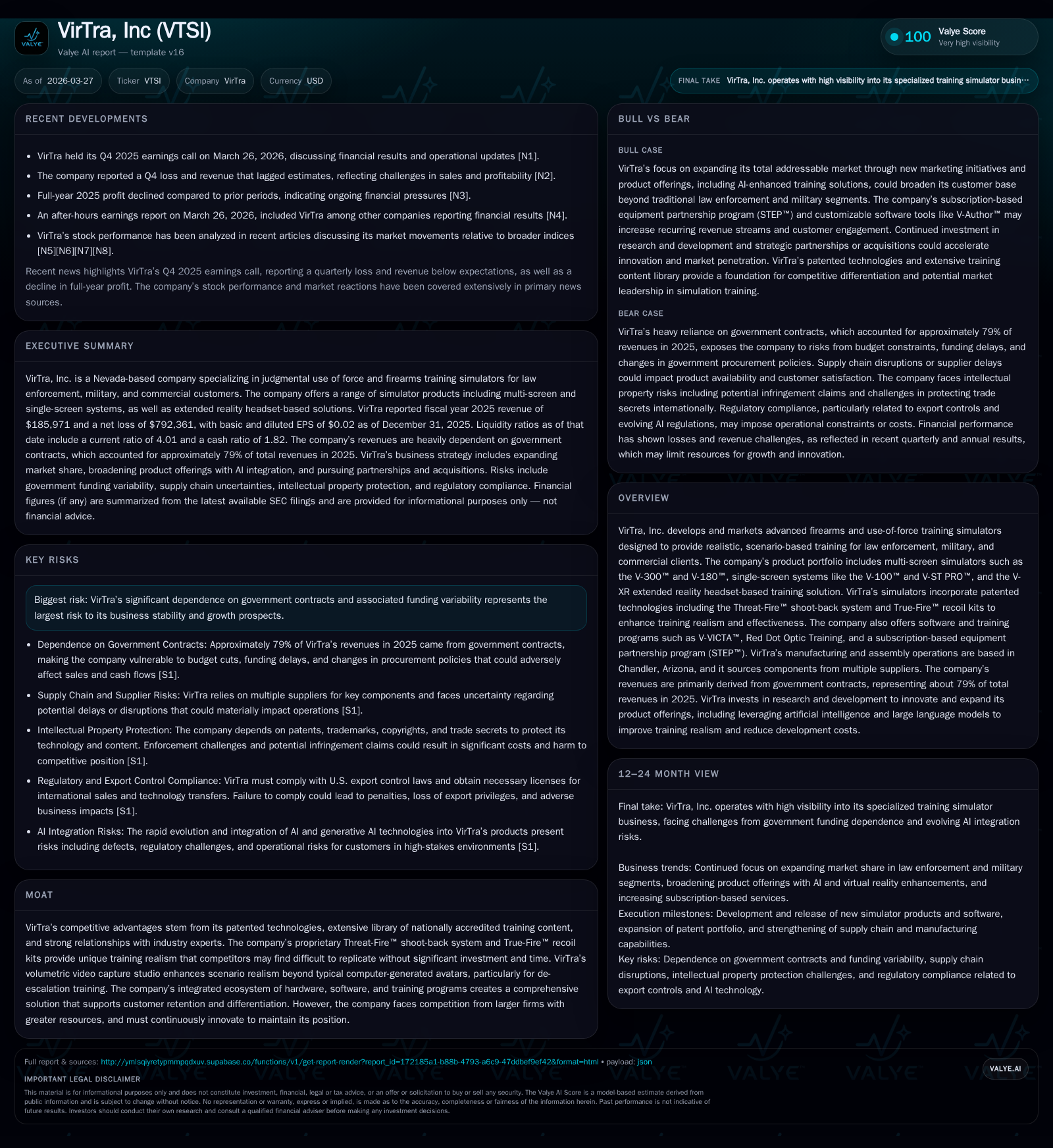
VirTra, Inc reported a severe 75% decline in revenue in FY2025 juxtaposed with a strong surge in operating cash flow, highlighting operational efficiency amidst contraction. The company relies heavily on government procurement, which exposes it to budgetary and regulatory risks that could impede growth. Its proprietary Threat-Fire™ and True-Fire™ technologies underpin a differentiated product suite, but competitive pressures and funding uncertainties pose ongoing challenges. Future performance will hinge on successful market expansion and product innovation, particularly leveraging AI and extended reality modalities.
VirTra’s Revenue Trajectory and Margin Trends: Unpacking FY2025 Performance
VirTra’s fiscal year 2025 was marked by a striking reversal in top-line dynamics. Annual revenues nosedived by approximately 75%, collapsing from nearly $748K in FY2024 to just under $186K in FY2025 [F1]. This precipitous decline was accompanied by a significant compression of operating income, which shrank by over 78% year-over-year to $437K while the bottom line swung into negative territory with a net loss of $792K—versus a net profit exceeding $1.36M the prior year [F1]. Despite these headwinds at the earnings level, operational cash flows surged—jumping roughly 265% to around $4.6M—suggesting efficient working capital management or non-cash accounting impacts that buoyed liquidity for the period [F1], [N2], [N4].
The divergent trend between revenue erosion and cash flow strength underscores underlying complexities potentially tied to timing of project completions, contract fulfillment schedules, or receivables collection acceleration amid fewer sales. VirTra’s earnings call transcript hints at challenges linked to fiscal year-end procurement delays and contract awards timing that constrained revenue recognition despite steady backlog conversion efforts [N1]. The absence of corresponding profit generation indicates elevated fixed costs or R&D expenditures weighing on net results.
Historical performance (annual)
| FY | Rev ($) | Net ($mm) | CFO ($mm) | OpInc ($mm) | Rev YoY | Net YoY |
|---|---|---|---|---|---|---|
| 2025 | 185971 | -1 | 5 | 0 | -75.1% | -158.1% |
| 2024 | 747977 | 1 | 1 | 2 | -83.8% | |
| 2023 | 8 | 7 | 10 | +329.6% | ||
| 2022 | 2 | -3 | 3 |
Source: SEC companyfacts cache [F1].
Capital returns and efficiency (annual)
| FY | FCF ($mm) | ROE% |
|---|---|---|
| 2025 | 3 | -1.7 |
| 2024 | -1 | 3.0 |
| 2023 | 6 | 19.7 |
| 2022 | -6 | 5.8 |
Source: SEC companyfacts cache [F1].
Note: Revenue shows substantial contraction between FY2024 and FY2025 as per latest Form-10-K disclosures [F1].
Dependence on Government Contracts: Opportunities and Vulnerabilities
VirTra’s revenue blueprint is predominantly anchored in contracts awarded by federal, state, local, and international government entities. Approximately 79% of total revenues derived from such clients in FY2025 illustrate deep alignment with public sector procurement dynamics [S7]. This concentration presents a double-edged sword: while government contracts provide substantial order backlog visibility when stable, they also subject VirTra to budgetary shifts that are outside management control.
Procurement risks include tightening national and regional budgets impacting defense, transit agencies, law enforcement training mandates, as well as evolving fiscal policies that may reduce funding pools available for discretionary training technology purchases like simulators [S7]. Additionally, contracting frameworks increasingly favor short-duration awards requiring frequent recompetes, elevating uncertainty for future revenues. Delayed appropriations or payment processing issues within government payment offices further exacerbate cash flow predictability challenges [S7].
Moreover, changes in government purchasing rules—such as increasing reliance on lowest-priced technically acceptable criteria—and reassessments of small business set-aside definitions can disadvantage smaller specialized providers like VirTra despite technical superiority of products [S7]. Altogether these factors create an environment where forecast accuracy is delicate, requiring attention to multi-jurisdictional policy nuances.
Innovation Edge: Patented Technologies and Product Ecosystem
VirTra's defensive moat is heavily fortified by proprietary innovations that elevate realism in firearms and use-of-force simulation training beyond industry norms. Core patented components include:
- Threat-Fire™ shoot-back system: An interactive feature imposing real-time reactive pressure on trainees enhances stress inoculation more authentically than conventional simulators.
- True-Fire™ recoil kits: Gas-powered recoil mechanisms providing tactile feedback emulate actual firearm behavior with precision laser activation enhancements introduced recently that reduce unintentional triggers acting as reliability advancements [S25].
- Volumetric video capture studio: Facilities enabling ultra-realistic scenario content creation surpassing traditional CGI avatars help make de-escalation training more effective due to higher verisimilitude in human character animation; a growing strategic differentiator especially for policing applications requiring nuanced interactions.
These hardware advances coexist within a broader integrated software ecosystem including scenario authoring tools (V-Author™), nationally accredited curricula (V-VICTA™), optically focused drills (Red Dot Optic Training), subscription-based equipment programs (STEP™), and complementary non-lethal devices such as TASER® simulators enhancing multi-modal training realism , [S14], [S25].
Such layered product architecture fosters customer stickiness by blending content customization flexibility with hardware reliability — difficult for competitors without comparable patent portfolios or content libraries to replicate readily given significant R&D lead times required.
Exploring Future Growth Channels and Market Expansion Strategies
Looking forward, VirTra aims to expand its Total Addressable Market through dynamic new product rollouts complemented by technological incorporation of artificial intelligence (AI) capabilities that could heighten scenario realism via generative AI-powered interaction modeling while streamlining content development cycles meaningfully [S4],[N5].
The launch of the V-XR extended reality headset solution reflects a commitment to meet emerging immersive training demands while facilitating portability; designed for quick deployment with all-in-one kits including multiple headsets plus integrated networking infrastructure certified for three years warranty coverage provides turnkey readiness attractive for smaller agencies lacking permanent range infrastructure ,[S14].
Strategic partnerships remain integral to scaling outreach particularly internationally where local distributors aid regulatory navigation and logistical complexities. The company has acknowledged openness toward acquisitions either inbound or outbound if synergistic opportunities arise enabling accelerated innovation or expanded customer reach without dilutive internal resource drain [S4],[N6].
Nonetheless without explicit forward guidance disclosed publicly as of the March earnings call dated March 26, investors should watch contract awards pipeline status metrics closely alongside early commercial adoption signals for new VR/XR offerings to assess the fruition of these growth ambitions effectively [N1],[N5],[N6].
Financial Health Assessment: Cash Flows, Capital Allocation, and Shareholder Returns
The perplexing financial mosaic from FY2025 reveals VirTra sustaining robust liquidity alongside operational challenges. Cash & equivalents totaled approximately $18.6M year-end December 2025 contributing to a healthy current ratio exceeding four times coverage—pointing toward minimal short-term solvency concerns despite top-line shrinkage and profitability losses seen concurrently [%][F1].
Operating cash flow registered nearly $4.6M for FY2025 while capital expenditures dipped modestly year-over-year to about $1.5M—producing an estimated free cash flow approaching $3.1M that can underpin investments into R&D or debt servicing comfortably even amid net losses totaling $792K resulting in an approximate negative Return on Equity near -1.7% reflecting depressed earnings vs a stable equity base near $45.6M [$][F1],[S24],[N2].
Importantly there were no dividends declared or share repurchase programs underway during recent periods highlighting conservative capital stewardship prioritizing reinvestment over direct shareholder distributions presently—a typical posture among development-stage specialized tech vendors facing demand cyclicality risk alongside emergent commercial models in subscription services like STEP™[F1],[S24].
Key Risks in Intellectual Property and Procurement Regulations
VirTra operates within an IP-intensive domain where assertions of infringement claims could impose costly litigation overheads irrespective of ultimate outcomes given depth of competing patent portfolios held by major defense contractors or simulation technology leaders; outcomes might compel licensing agreements or redesign expenses potentially disruptive financially and strategically albeit none currently pending beyond routine litigation noted in filings [S5],[S16],[S29].
Supply chain interruptions remain an omnipresent risk especially considering geopolitical tensions affecting component sourcing globally compounded occasionally by pandemic-related logistics slowdowns posing manufacturing continuity threats impacting delivery cadence critical for meeting contracted timelines—a vital determinant for sustaining reputation among government buyers accustomed to strict compliance expectations [S6],[S8].
Regulatory evolutions introducing tougher constraints on contract terms (e.g., uncapped indemnifications requests), export controls enforcement on military tech transfers abroad along with shifting procurement policies towards shorter duration awards carry significant potential adverse effects warranting sustained management focus since these factors directly influence order book stability as well as profit margin profiles with limited avenues for pass-through adjustments given government pricing scrutiny regimes typical in defense contracting environments.[S7],[S10],[S26]
Performance Benchmarks to Monitor in 2026 and Beyond
Absent formal forward guidance amidst ongoing industry volatility, key performance indicators deserving close monitoring comprise:
- Backlog levels reflecting new government contract wins versus losses after FY2025 steep revenue fallback providing signals on recovery trajectory[N1]
- Profitability improvements including swing back from net losses supported by sustained positive free cash flow generation validating operational leverage capture[N2]
- Market reception trends related to innovative XR headset deployment plus incremental AI-driven offerings determining technology adoption curves[N5],[N6]
- Competitive positioning preemptively gauged through announcements regarding patent grants/pending filings status potentially fortifying IP portfolio advantages[S22]
- Capital allocation decisions signaling strategic priorities related either toward organic R&D investments versus inorganic expansion steps[S27]
- Regulatory developments impacting procurement processes or legal exposures influencing risk profile adjustments[S7],[S28]
Together these dimensions will shape the narrative arc guiding VirTra’s evolution through what appears currently as an inflection phase driven equally by technological innovation imperatives balanced against prevailing macro-fiscal funding constraints characteristic of public sector reliance.
This analysis synthesizes currently available data from audited SEC reports up to fiscal year-end December 2025 alongside recent public disclosures without projecting investment advice or price targets. Readers should consider broader external market developments when forming opinions about future company performance.
Disclaimer: This is research-only, informational analysis and not investment advice. It may include AI-generated interpretation and general industry context. Always verify important details using primary sources.

Comments