
Functional Brands Inc.: Growth, Challenges, and Health Tech Integration in Nutraceuticals
Functional Brands combines Kirkman’s heritage with new digital health innovations while confronting operational and financial headwinds.
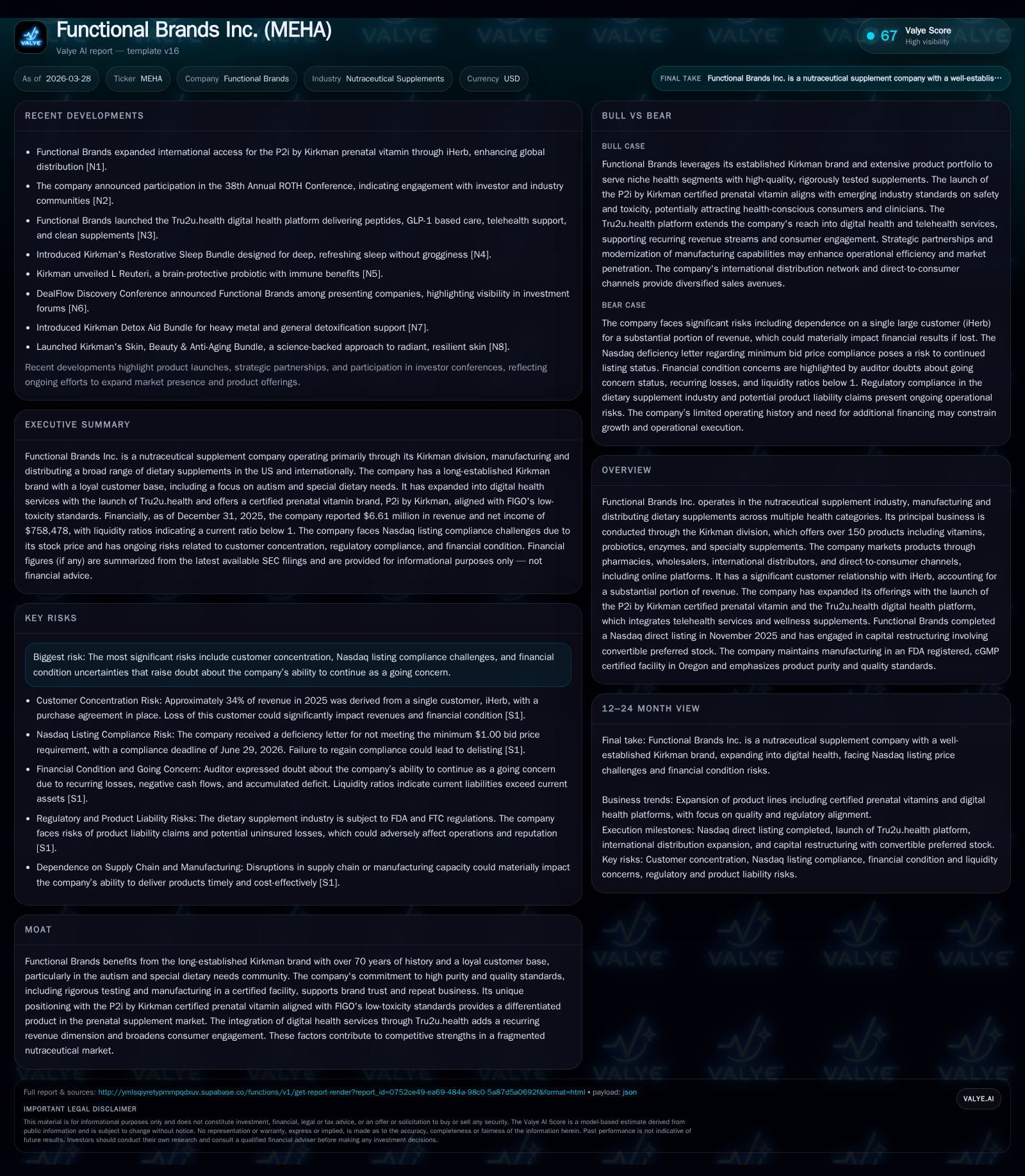
Functional Brands Inc., operating primarily through its Kirkman division, leverages a legacy in specialized nutraceutical supplements enhanced by recent launches such as the P2i certified prenatal vitamin and Tru2u.health telehealth platform. Despite a positive net income and strong brand trust built over seven decades, significant risks persist including customer concentration, Nasdaq listing compliance challenges, and ongoing going concern doubts reflected in negative operating cash flows. The company’s international expansion via iHerb distribution channels and its capital restructuring efforts signal attempts at growth and stability but underline operational scalability risks. Monitoring sales trajectory and regulatory environment will be key to assessing MEHA’s progress from legacy nutraceuticals toward integrated health solutions.
Legacy Growth Through Kirkman’s Product Portfolio
Functional Brands Inc.'s core strength lies in its longstanding Kirkman division, with over seven decades of expertise crafting nutraceutical supplements tailored for sensitive populations. The Kirkman brand encompasses more than 150 products spanning vitamins, probiotics, enzymes, and specialty supplements focused on areas such as autism spectrum support and special dietary needs [S1][S27]. This breadth supports brand loyalty founded on high purity standards and rigorous testing protocols conducted within certified manufacturing environments — factors critical in ensuring repeat business in this fragmented market.
Historically, the company refined its portfolio by discontinuing less synergistic lines like hemp-derived products under the Hemptown brand as these had limited overlap with core offerings or faced legal complexities in different jurisdictions [S1]. Such strategic pruning underscores a focus on consolidating strengths within niche nutraceutical categories that align with Kirkman’s reputation for hypoallergenic formulations.
Revenue Drivers and Customer Concentrations
The company generated roughly $6.6 million in revenue for fiscal year 2025 but contended with operational losses amounting to nearly $1.4 million; a positive net income of $758k was realized primarily through non-operational gains or accounting adjustments rather than core margin expansion [F1].
A critical revenue source is the iHerb partnership—the largest single customer—which contributed approximately 34% of total revenues in 2025, down slightly from 26% a year earlier yet remaining a substantial concentration risk [S4][S20]. Functional Brands depends heavily on independent distributors who do not have long-term contractual commitments, exposing the business to volatility should major distributors or their retail accounts be lost.
These dynamics highlight vulnerability around channel risk: any disruption or loss could materially affect liquidity and impede market expansion especially as new international markets introduce complexities relating to local regulations and competitive pressures.
Innovations: P2i Prenatal Vitamin and Tru2u.health Platform Launch
In an effort to diversify beyond traditional supplement lines, Functional Brands introduced the P2i by Kirkman certified prenatal vitamin—a formulation officially aligned with FIGO's October 2023 position statement emphasizing low-toxicity prenatal care standards. This specialty supplement addresses an underserved market niche prioritizing both efficacy and safety for expectant mothers [N1][S24].
Complementing this product innovation is the February 2026 launch of the Tru2u.health platform that merges telehealth-enabled supplementation with peptide therapies and GLP-1 based care under supervision from board-certified clinicians [N3]. This digital health platform represents a strategic pivot toward integrated wellness services delivering clean supplements alongside medical guidance aimed at chronic conditions such as metabolic disorders.
Such moves position Functional Brands advantageously to capture recurring revenue streams driven by subscription-based telehealth interventions linked with nutritional support—an emerging trend reshaping consumer healthcare engagement.
Geographic Expansion and International Distribution Focus
Functional Brands actively expanded its reach through enhanced international accessibility of key products like P2i prenatal vitamins via iHerb’s global channels spanning over 35 countries [N1][S11]. However, this broader footprint has introduced significant operational overhead including compliance with diverse regulatory frameworks governing imports, labeling requirements, taxation regimes, and consumer safety laws across jurisdictions.
Management acknowledges increased upfront investment in infrastructure, staff training, regulatory approvals, as well as ongoing operational expenses associated with currency exchange volatility risks—factors that accentuate cost pressures on gross margins [S5].
The company also adheres strictly to FDA cGMP guidelines despite its products being classified as dietary supplements exempt from drug approvals—a delineation that still subjects manufacturing processes to scrutiny given evolving FDA enforcement priorities around product labeling claims under DSHEA legislation [S8][S14].
Financial Performance Snapshot: Profitability Amid Headwinds
The financial snapshot for FY 2025 shows mixed outcomes: revenues stood at approximately $6.6 million; however operating income was negative nearly $1.4 million reflecting ongoing investment into growth initiatives coupled with supply chain inefficiencies [F1]. Net income reported positive at $758k despite this operating loss profile indicates one-off or financing-related effects cushioning bottom-line figures.
Free cash flow remains negative near $1.28 million indicative of working capital strains compounded by capex outlays for modernizing manufacturing capabilities as part of planned capacity enhancements.
The current ratio at around 0.9 signals short-term liquidity constraints when juxtaposed against current liabilities exceeding current assets—underscoring elevated balance sheet risk amidst cyclical funding needs [F1]. Return on equity approximates an impressive near-50% level but requires cautious interpretation given overall going concern warnings from auditors due to accumulated deficits and recurring negative cash flows raising material uncertainties about sustainable profitability paths [F1][S1].
Historical performance (annual)
| FY |
|---|
| 2025 |
Source: SEC companyfacts cache [F1].
Note: Cash flow related figures are approximate derived values combining CFO minus capex given data limitations; no YoY computed due to absence of prior year comparables in provided facts.
Risks: Going Concern Doubts and Market Dependencies
The company faces pronounced risks flagged extensively in recent SEC filings: auditors explicitly express substantial doubt about Functional Brands’ ability to continue as a going concern given recurring losses, cash flow deficits, and current liabilities exceeding assets which collectively impair operational flexibility [S1].
Customer dependency remains paramount—iHerb contributes over one-third of revenues although contractual terms lack long-term lock-ins making renewal or replacement critical yet uncertain. Disruptions within distributor networks or significant retail account losses could materially impact top-line stability [S4][S20].
Legal proceedings also represent material exposures including ongoing royalty disputes following asset acquisitions (e.g., True Health litigation over intellectual property rights leading to payment conflicts) along with other lawsuits complicating operational focus and potentially incurring costs or reputational damage if unfavorable outcomes ensue [S5][S8][S21].
Regulatory landscapes are complicated by FDA evolving oversight over dietary supplement claims alongside FTC advertising scrutiny requiring truthful substantiation—all imposing added compliance costs alongside risks of fines or enforced product halts if standards are not met rigorously [S8][S14].
Nasdaq listing faces imminent risk given trading prices below minimum bid requirements prompting a compliance window ending mid-2026; failure to meet requirements heightens delisting probability which could erode investor confidence and liquidity options [S7][N2]. Cybersecurity vulnerability is another systemic threat inherent in health-related e-commerce reliant on sensitive data security across internal systems and third-party partners forcing continuous IT investments for mitigation [S9][S19].
Capital Structure Dynamics, Financing Events, and Allocation
Capital structure has evolved rapidly post-November 2025 Nasdaq direct listing encompassing issuance of Series A Convertible Preferred Stock (~$8m gross proceeds), bundled issuance of Series B Preferred Stock equating additional stated value ($8m), followed by partial repurchases funded from internal working capital totaling several hundred thousand dollars demonstrating active balance sheet management attempts [S7][S17][S18].
In March 2026 investors converted Series A & B Preferred into new Series C Convertible Preferred shares combined with senior secured convertible notes alongside common stock components—a complex restructuring designed to optimize debt/equity mix while alleviating near-term liquidity stressors albeit introducing higher dividend obligations escalating under delayed conversion regimes (up to ~15% annual plus incremental monthly rates beyond 18 months) that reflect premium compensations for credit risk exposures [S7][S22].
Importantly there are no dividends or share buybacks planned reflective of prudent capital preservation amid tight resources; focus remains on funding growth initiatives including production modernization aligned with projected volume scaling demands accompanied by intensified marketing investments notably behind Tru2u.health rollouts targeting improved direct-to-consumer economics [S7][N3][N4]. The amended bylaws lowering quorum requirements evidences corporate governance adaptations facilitating smoother shareholder meetings under thinly traded share conditions ensuing post-listing challenges.[S22]
Outlook Indicators: Monitoring Sales Goals and Operational Scalability
Looking ahead, management underscores criticality of achieving planned sales milestones integral to maintaining solvency paths due to existing cost containment limits already pushed tight—failure here risks exacerbated liquidity shortages demanding fresh financing potentially dilutive or costly debt offerings reducing shareholder value prospects [S1].
Operational scaling could present bottlenecks including capacity constraints necessitating reconfiguration of manufacturing workflows supported by automation investments; however rapid volume spikes if large orders materialize may stress supplier agreements or internal workforce ramp-up affecting delivery timelines or cost structures negatively impacting margin sustainability under competitive pricing environments typical for nutraceutical channels dominated by numerous players competing on quality claims rather than patent protections alone.[S1]
Investors should closely track quarterly sales trajectories post Nasdaq initial listing unveiling detailed unit economics along with diligence surrounding distributor retention efforts especially iHerb renewal status plus early adoption trends regarding Tru2u.health platform engaging subscribers via telehealth service offerings.[N2] Regulatory monitoring is equally pivotal given fluid FDA guidance evolution concerning dietary supplement advertising claims potentially altering permissible marketing narratives impacting product positioning.
This analysis is based solely on publicly available information as of March 28, 2026. It does not constitute investment advice but aims to provide comprehensive insight into Functional Brands Inc.’s operations, financial condition, strategic initiatives, and risk landscape within the nutraceutical sector. Readers should conduct further due diligence incorporating forward-looking developments beyond this date.
Disclaimer: This is research-only, informational analysis and not investment advice. It may include AI-generated interpretation and general industry context. Always verify important details using primary sources.

Comments