
Vine Hill Capital Investment Corp.: Strategic Merger with CoinShares Poised to Reshape Digital Asset Management
The upcoming merger of Vine Hill Capital Investment Corp. with CoinShares International Limited aims to transition a SPAC structure into a competitive digital asset manager.
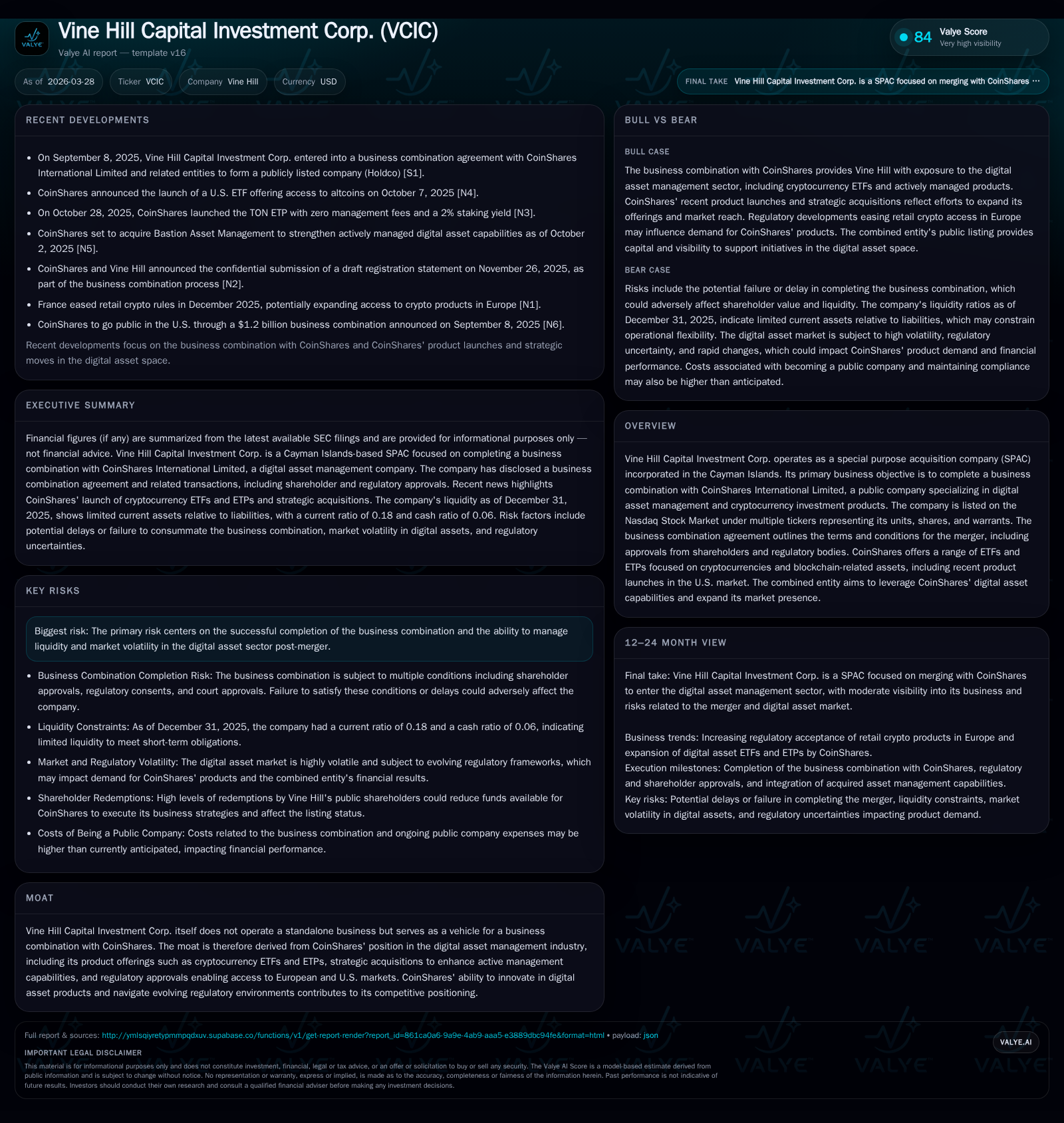
Vine Hill Capital Investment Corp., a Cayman Islands-incorporated SPAC, is executing a business combination with CoinShares International Limited, a public digital asset management firm. Historically, Vine Hill’s financials reflect typical SPAC characteristics including operating losses and minimal liquidity. The transaction entails complex regulatory and shareholder approvals with significant potential to leverage CoinShares' digital asset expertise via new cryptocurrency ETF and ETP offerings, particularly in the evolving U.S. market. Post-merger growth will depend heavily on managing market volatility, regulatory compliance, and shareholder redemptions, while capital deployment prior to closing conserves trust funds without dividends or buybacks.
From SPAC Vehicle to Digital Asset Manager: Vine Hill's Evolution
Vine Hill Capital Investment Corp., incorporated in the Cayman Islands, functions exclusively as a special purpose acquisition company (SPAC) [S1]. Its foundational purpose is to complete a business combination with an operating business—in this case, CoinShares International Limited—a digital asset management company focused on cryptocurrency ETFs and investment products [S14][S16][S17]. Prior to deal closure, Vine Hill itself does not generate operational revenue or have active commercial lines; instead, it holds capital primarily in trust accounts pending merger completion.
This reliance on future integration with CoinShares defines its valuation dynamics. Investors essentially assess the anticipated value creation based on CoinShares' digital asset platform rather than historical operating metrics attributable directly to Vine Hill [S1]. This transitional identity from blank check vehicle to an operational digital asset manager underscores all financial considerations.
Financial Performance Snapshot: Historical Metrics Highlighting Transition Flows
Vine Hill’s reported financial snapshot through FY2025 exhibits typical SPAC P&L behavior driven largely by trust fund accounting rather than core business activity [F1]. Operating income deteriorated from -$1.07 million in FY2024 to -$3.90 million in FY2025 (a -265.8% YoY decline), reflecting escalating expenses related primarily to transaction execution and administrative operations absent offsetting revenues [F1].
Interestingly, reported net income climbed from $2.28 million to $5.54 million over the same period (+142.8% YoY), largely attributed to non-operating gains typical of warrant revaluations or mark-to-market adjustments within the trust fund—a common distortion in this corporate form [F1]. Operating cash flow worsened by over 83%, declining from -$680K to -$1.25M as cash burn accelerated ahead of combination closing [F1].
Equity improved somewhat but remained negative at approximately -$3.43 million by end-2025 versus -$7.26 million at end-2024, indicative of net liabilities exceeding assets including accrued expenses tied to deal activities [F1]. The derived current ratio stands at a low 0.18 (current assets of $293K against liabilities of $1.63M), reinforcing constrained liquidity [F1].
Historical performance (annual)
| FY | Net ($mm) | CFO ($) | OpInc ($mm) | Net YoY |
|---|---|---|---|---|
| 2025 | 6 | -1246000 | -4 | +142.8% |
| 2024 | 2 | -680000 | -1 |
Source: SEC companyfacts cache [F1].
Capital returns and efficiency (annual)
| FY | ROE% |
|---|---|
| 2025 | -161.5 |
| 2024 | -31.4 |
Source: SEC companyfacts cache [F1].
Operating income reflects growing administrative costs and transaction-related expenses; net income benefits from accounting marks on warrants; liquidity remains limited.
The Business Combination Blueprint: Deal Structure and Strategic Rationale
On September 8, 2025, Vine Hill entered into a definitive Business Combination Agreement with CoinShares International Limited and Odysseus Holdings Limited—creating Holdco as the publicly listed parent upon closing [S14][S16][S17]. The merger contingency includes multiple approval hurdles:
- Shareholder approvals for both Vine Hill and CoinShares shareholders;
- Court-sanctioned acts by Jersey courts governing CoinShares’ scheme of arrangement;
- Regulatory clearances including Hart-Scott-Rodino expiration;
- Listing approval for Holdco securities on Nasdaq or other agreed US markets [S14][S17].
The transaction contemplates conversion of existing shares and warrants into Holdco ordinary shares at negotiated exchange ratios tied to an agreed equity valuation roughly $1.2 billion pre-merger considering fully diluted share counts [S16][S17]. The Sponsor Support Agreement ensures sponsor votes support closing conditions and enforces forfeiture of certain private placement warrants pre-close [S25].
Key operational risks encapsulated in filings highlight failure scenarios including inability to obtain required approvals or failure to maintain post-close listing status—any could impede or void consummation [S14][S29].
Harnessing CoinShares’ Moat: Product Innovations and Market Access Advantages
Post-merger, Vine Hill will gain direct access to CoinShares’ established position within digital asset management encompassing cryptocurrencies and blockchain-related investments [S14][S8]. CoinShares commands competitive differentiation via:
- A robust product suite of ETFs/ETPs that provide diversified exposure across Bitcoin-related products and altcoins;
- Strategic acquisitions enhancing active management capabilities beyond passive products;
- Regulatory approvals facilitating distribution both in Europe—an early adopter jurisdiction for crypto ETPs—and increasingly stringent U.S. markets;
- Recent launch of the U.S.-based Altcoins ETF expanding access to blockchain-themed assets that were previously restricted for many traditional investors [S8].
Digital asset funds face considerable listing thresholds set by exchanges involving custody risk mitigation standards and compliance mandates that CoinShares has navigated proficiently—a moat vital amid increasing market scrutiny.
Constraints Shaping Growth: Regulatory, Liquidity, and Market Volatility Risks
Despite significant opportunity potential framed by the business rationale above, growth is entwined tightly with persistent headwinds:
- Price volatility inherent in cryptocurrencies can strain portfolio performance stability impacting investor inflows.
- Regulatory uncertainty across U.S., European Union member states, and Jersey jurisdictions imposes compliance complexity with potential retroactive effects [S4][S5][S10][S11][S12].
- Redemption risk exists as public shareholders retain rights that could reduce available investable capital if large-scale redemptions occur—potentially jeopardizing exchange listing criteria due to diminished float or market capitalization post-close [S14][S29].
- Tracking errors may arise due to illiquid underlying assets or volatility disruptions affecting product appeal.
Risk disclosures emphasize execution uncertainty around these factors remains material until stable operational scale is attained post-merger.
Capital Deployment Patterns and Shareholder Returns: Examining Cash Flows and Equity Trends
Consistent with many SPACs prior to final business combination closing, Vine Hill has refrained from capital returns through dividends or share repurchases given its fiduciary responsibility toward preserving trust account cash for merger proceeds distribution [S7][S13][F1]. Negative equity positions approaching $3.43 million reflect accrued deal-related expenses exceeding assets once adjusted for certain liabilities such as deferred underwriting fees [F1].
Operating cash flow deficits widen reflecting increased preparatory outlay amid no substantive revenue streams pre-close [F1]. The calculated return on equity approximates -161.5%, which is distorted given equity negativity but echoes challenging capital efficiency during this transitional phase.
Liquidity pressures manifest clearly through current ratios significantly below one (0.18), highlighting tight short-term resource availability excluding trust-held funds earmarked pending closing transactions rather than general working capital use.
Investors should note that post-combination capital deployment will likely shift toward product development expenditure within CoinShares’ operations balanced against potential requirements for additional PIPE financing obligations committed pre-close totaling roughly $50 million invested at $10 per share as part of merger financing strategy [S16].[F1]
Key Upcoming Milestones and What to Monitor Post-Combination
Critical near-term milestones include the Extraordinary General Meeting scheduled for March 27, 2026—the decisive shareholder vote event on the proposed business combination proposal along with ancillary consent matters essential for advancing closing steps [S3][S14]. Monitoring continued receipt of:
- Necessary regulatory approvals including court acts from Jersey's Royal Court;
- Effective registration statement clearance by the SEC enabling Holdco’s issuance of securities;
- Confirmation of Nasdaq listing eligibility for Holdco ordinary shares post-closing,
- Realization of PIPE investment commitments securing enhancement of post-merger liquidity buffers.
Post-combination success indicators will revolve around seamless integration execution measured against retention of key personnel at CoinShares management level; efficient deployment into active product innovation pipelines; scaling investor inflows amid volatile crypto markets; and avoidance of excessive redemption outflows impacting trading liquidity.
Absent explicit forward guidance publicly released yet by Vine Hill or merged entity stakeholders as per latest filings [N/A], these remain focus areas for monitoring progress.
Disclaimer: This analysis is based exclusively on information contained within cited SEC filings ([S#]) and company data ([F1]) without conjecture beyond stated facts. It does not constitute investment advice.
Disclaimer: This is research-only, informational analysis and not investment advice. It may include AI-generated interpretation and general industry context. Always verify important details using primary sources.

Comments