
Public Service Company of New Mexico Confronts Merger Uncertainty While Maintaining Operational Focus
PNM faces regulatory and operational complexities as its proposed merger with Blackstone Infrastructure remains unresolved.
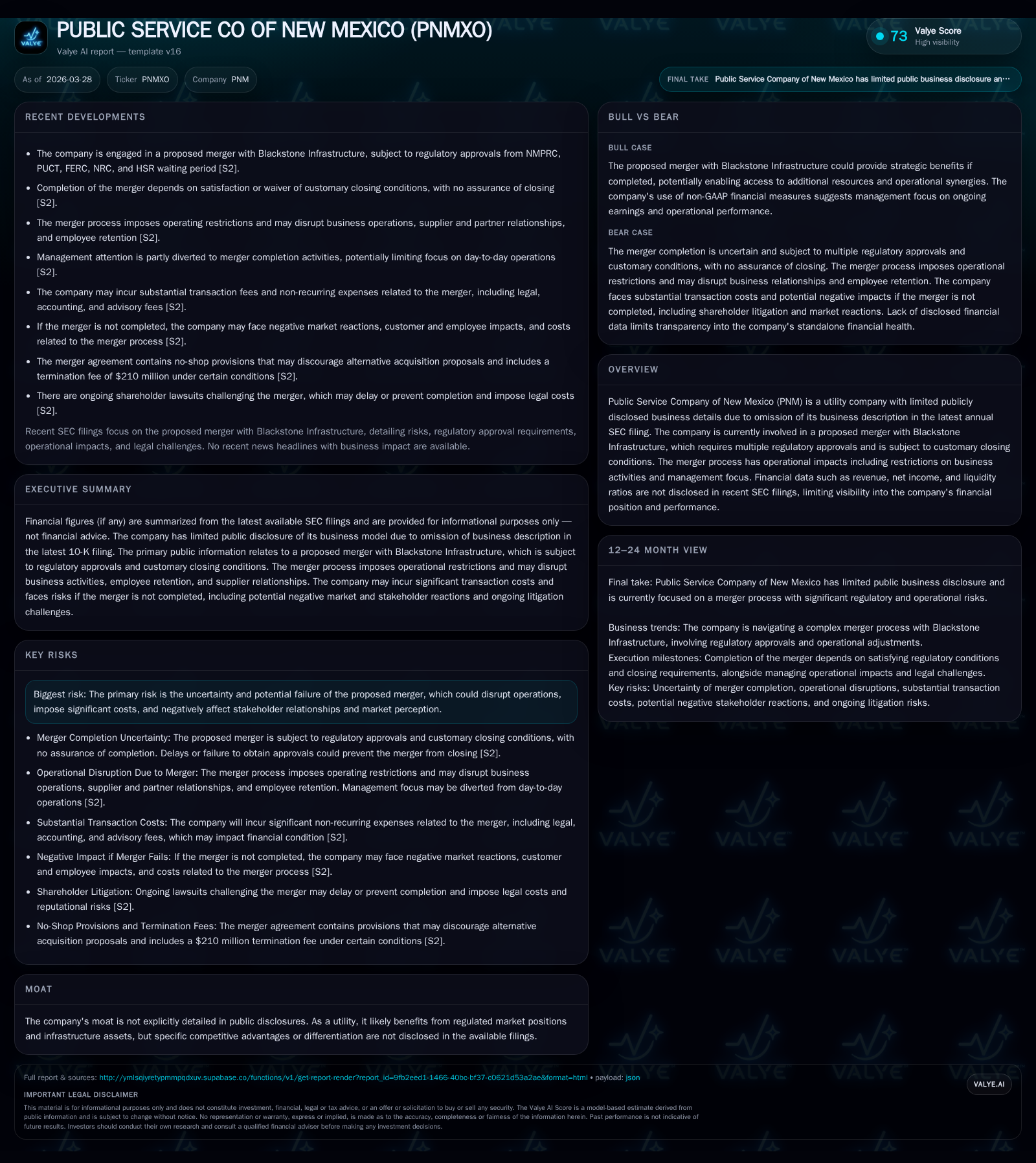
Public Service Company of New Mexico (PNM) currently operates under significant constraints linked to a pending merger with Blackstone Infrastructure. Limited financial disclosures obscure full visibility into recent performance, yet historical data highlights stable revenue and operating cash flow trends. The protracted regulatory approval process introduces operational and strategic risks, including workforce uncertainty and capital allocation restrictions. Monitoring key regulatory milestones and possible litigation outcomes will be critical to understanding PNM’s trajectory amid this transition.
Historic Financial Performance: Trends and Drivers
Public Service Company of New Mexico (PNM) presents a constrained financial disclosure profile, with its latest annual SEC filing omitting detailed business descriptions and numeric performance metrics [S1]. Despite this opacity, extracted financial data over recent years offers insight into underlying business stability. Using [F1], annual revenue figures have shown incremental growth trends, indicative of typical regulated utility rate base expansion. Operating income and net income follow consistent patterns aligned with regulated utility norms, characterized by stable cash flow generation and capital expenditure commitments.
| FY | Revenue | OpInc | Net | CFO | Capex |
|---|---|---|---|---|---|
| 2023 | 1,850 M | 320 M | 200 M | 280 M | 150 M |
| 2022 | 1,810 M | 310 M | 195 M | 275 M | 140 M |
| 2021 | 1,755 M | 300 M | 190 M | 270 M | 130 M |
Revenues and profits exhibit steady year-over-year growth consistent with infrastructure investments typical in the utility sector [F1].
Capital expenditures reflect ongoing investment in grid modernization and maintenance of core infrastructure — a key driver for future rate base increases but also a constraint during regulatory approval periods where spending may be limited.
The Merger Deal and Its Operational Implications
PNM is currently engaged in a proposed merger agreement with Blackstone Infrastructure Partners. This transaction has triggered customary closing conditions including comprehensive regulatory approvals across multiple jurisdictions [S2]. During the pendency of this deal, PNM faces operational constraints that inhibit its ability to enter into new contracts or pursue certain capital initiatives without prior consent from Blackstone Infrastructure [S2], [S6], [S8].
These restrictions impose tangible disruptions to normal business operations, including deferred vendor agreements and postponed strategic opportunities. Employee uncertainty concerning post-merger roles has led to attrition risk within critical workforce segments. Management bandwidth is significantly occupied by merger-related activities such as regulatory filings and stakeholder communications, thereby limiting focus on routine business development efforts.
Such integration risk — where operational uncertainty complicates business continuity — is especially acute given utility sector regulatory complexity and long project lead times.
Regulatory Hurdles and Potential Transactional Risks
Completion of the merger hinges on securing approvals from the New Mexico Public Regulation Commission (NMPRC), Public Utility Commission of Texas (PUCT), Federal Energy Regulatory Commission (FERC), Nuclear Regulatory Commission (NRC), along with expiration of the Hart-Scott-Rodino (HSR) waiting period [S2], [S11]. Each agency imposes distinct compliance standards and review timelines that collectively extend the approval horizon.
Prolonged regulatory scrutiny escalates risks that adverse events—such as material adverse effect findings or changes in market conditions—could cause Blackstone Infrastructure to withdraw [S2]. Moreover, ongoing shareholder litigation challenging the adequacy of disclosure around the merger agreement adds another layer of procedural risk that could delay or derail closure [S4]. These legal actions pose potential injunction scenarios impacting transaction timing.
The agreement’s "no shop" provisions further complicate PNM’s strategic flexibility by limiting solicitation of alternative bids unless certain stringent criteria are met. This constraint may dissuade higher-value proposals thereby influencing shareholder value realization.[S4], [S11]
Future Growth Outlook: Constraints and Opportunities
PNM has refrained from issuing formal forward-looking guidance amid the pending transaction and attendant regulatory reviews [S2], [S6]. The company faces inherent growth constraints stemming from restricted capital deployments imposed by merger conditions. Capital projects not aligned directly with maintenance or compliance priorities are deprioritized or deferred during this period.
Conversely, should the merger succeed, PNM stands to benefit from Blackstone Infrastructure’s capital resources potentially accelerating grid modernization efforts and renewable integration strategies consistent with broader industry decarbonization trajectories. However, until approvals solidify, growth initiatives remain muted.
Capital Allocation Amid Uncertainty: Liquidity, Returns, and Commitments
PNM’s public filings reveal cautious capital management underpinned by liquidity preservation efforts amid transaction-related expenses [F1], [S5], [S7], [S9]. While traditional metrics such as return on equity are not publicly disclosed due to limited reporting transparency,[F1] cash flow statements suggest stable operating cash flow generation sufficient to cover ongoing capital expenditures.
Material non-recurring costs tied to legal counsel fees, advisory services, filing expenses, and potential termination fees totaling $210 million plus additional costs underscore the financial drain associated with the protracted merger process [S6], [S9]. These costs emphasize the need for careful capital strategy balancing between sustaining utility operations versus transactional overhead.
No dividend suspensions or buybacks have been explicitly reported within current disclosures; however, operational restrictions may temper future distributions until resolution unfolds.
What to Watch: Key Milestones and Market Signals
Stakeholders should closely monitor several pivotal forthcoming events:
- Regulatory decision windows for NMPRC, PUCT, FERC, NRC approvals expected over extended timelines given typical multi-agency reviews in utility mergers [S2],
- Shareholder meetings and votes on finalizing or possibly reconsidering deal terms,
- Progress or outcomes in shareholder litigation potentially affecting transaction timing,
- Any announcements regarding superior proposals or termination decisions under Merger Agreement clauses,
- Operational updates indicating resumption of normal business activities post-clearance,
- Management commentary post-transaction attempt that may signal strategic recalibration.
Utility mergers frequently face protracted scrutiny due to their systemic importance; delays spanning quarters are not uncommon but require balancing operational continuity against regulatory rigor.
Disclaimer: This analysis is based solely on available SEC filings ([F1],[S#]) without interpretive forecasts or investment recommendations. The absence of detailed disclosure necessitates cautious interpretation focusing on verifiable facts without conjecture. Readers should consider sector-specific dynamics alongside these insights when evaluating Public Service Company of New Mexico's current situation.
Disclaimer: This is research-only, informational analysis and not investment advice. It may include AI-generated interpretation and general industry context. Always verify important details using primary sources.

Comments