
Senti Biosciences Advances Logic Gated CAR-NK Therapy Amid Continued Operating Losses
Clinical progress with SENTI-202 highlights innovative gene circuit platform, but substantial losses and regulatory risks persist.
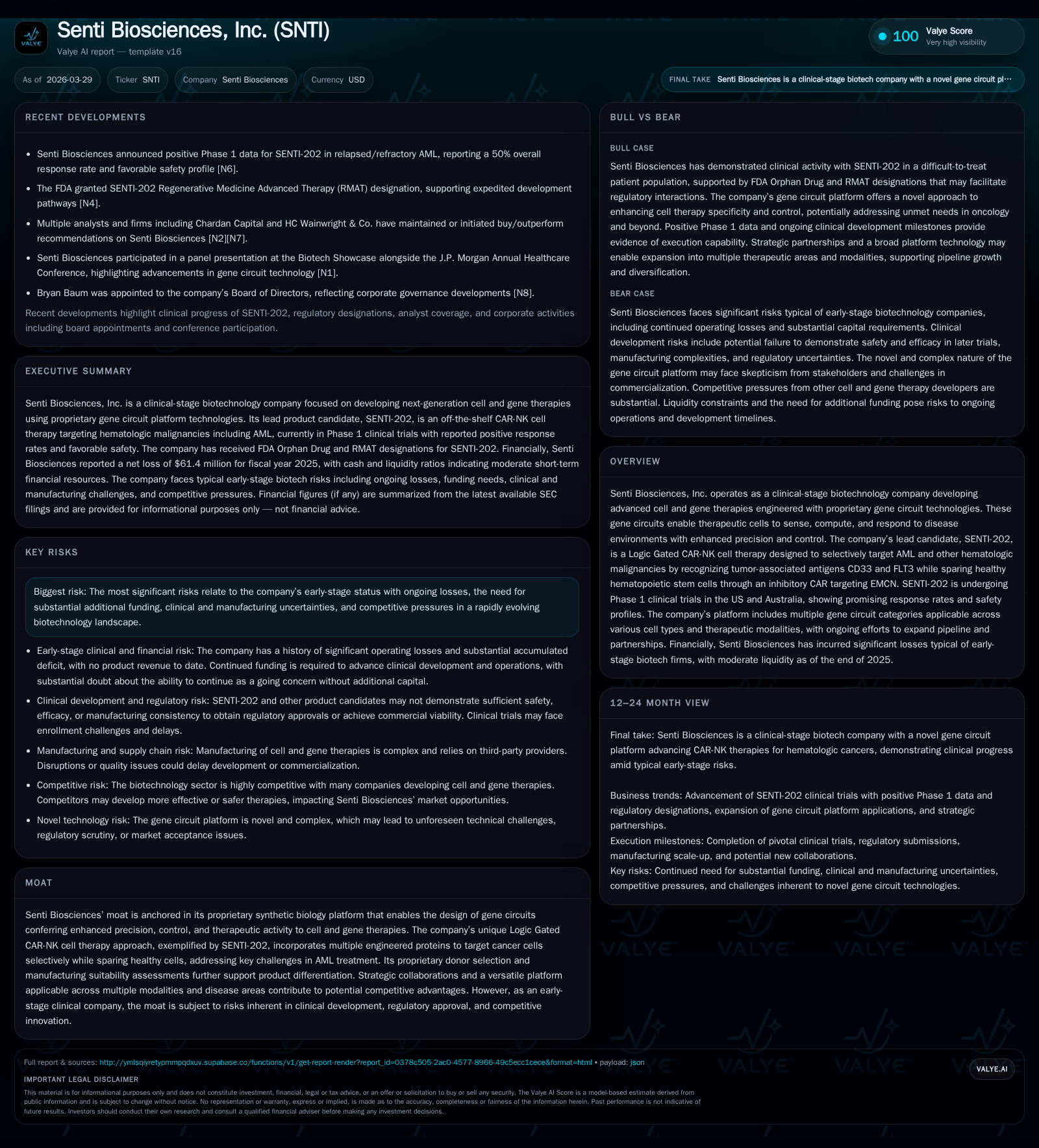
Senti Biosciences, Inc. is a clinical-stage biotech firm pioneering cell and gene therapies with proprietary gene circuits to improve precision and safety, exemplified by its lead candidate SENTI-202 for AML. Despite promising Phase 1 data in the US and Australia, the company remains unprofitable with consecutive annual net losses exceeding $50 million and no revenue in 2024. Its future growth depends on advancing clinical milestones and expanding its pipeline, while navigating significant risks from regulatory hurdles, funding needs, and competitive pressures inherent in early-stage biotech.
Company Overview and Business Model
Senti Biosciences, Inc. operates as an innovative clinical-stage biotechnology company focused on the development of cell and gene therapies leveraging proprietary synthetic biology and gene circuit technologies. Its unique approach programs therapeutic cells—primarily natural killer (NK) cells—with engineered biological logic circuits designed to sense disease environments precisely, compute responses internally, and modulate activity accordingly. This enables enhanced targeting specificity, improved safety profiles, and controlled expression of therapeutic agents post-administration.
The company's lead candidate, SENTI-202, embodies this new modality as a Logic Gated CAR-NK therapy for hematological malignancies like Acute Myeloid Leukemia (AML). By simultaneously recognizing multiple tumor-specific antigens (CD33 and FLT3) alongside an inhibitory receptor targeting EMCN to protect healthy hematopoietic stem cells, SENTI-202 aims to overcome key limitations common in conventional CAR therapies such as off-target toxicity.
Past Growth and Historical Financial Performance
As an early-stage clinical entity without approved products on the market yet, Senti Biosciences has generated modest revenues historically attributable largely to collaboration or licensing income which discontinued by FY2024:
Historical performance (annual)
| FY | Rev ($mm) | Net ($mm) | CFO ($mm) | OpInc ($mm) | Rev YoY | Net YoY |
|---|---|---|---|---|---|---|
| 2025 | -61 | -43 | -69 | -16.4% | ||
| 2024 | 0 | -53 | -41 | -61 | -100.0% | +25.7% |
| 2023 | 3 | -71 | -52 | -93 | -40.2% | -22.1% |
| 2022 | 4 | -58 | -35 | -71 |
Source: SEC companyfacts cache [F1].
Capital returns and efficiency (annual)
| FY | FCF ($mm) | ROE% |
|---|---|---|
| 2025 | -44 | -1099.3 |
| 2024 | -41 | -205.8 |
| 2023 | -64 | -106.2 |
| 2022 | -76 | -45.7 |
Source: SEC companyfacts cache [F1].
Revenues declined precipitously from $4.29 million in FY2022 to zero in FY2024–25 as early collaborations ended or were reprioritized. Meanwhile operating losses expanded initially in 2023 due to aggressive R&D scaling before moderating slightly thereafter but remain materially negative.
Persistent negative operating cash flow highlights ongoing burn primarily invested into advancing SENTI-202 through clinical phases alongside preclinical pipeline expansion efforts. Capital expenditure has contracted sharply after a peak in FY2022–23 consistent with infrastructure buildout completion.
Equity erosion has compounded over these years with shareholder equity declining from approximately $127 million at end-2022 to just $5.6 million at end-2025 [F1]. This reflects accumulated deficit absorption outweighing capital raises' net effect.
Future Growth Prospects
Senti’s near-term growth prospects hinge on the successful clinical progression of SENTI-202 through Phase 1 trials conducted across multiple sites in the US and Australia. Positive interim readouts published around late-2024/early-2025 demonstrated encouraging response rates coupled with an acceptable safety profile supportive of further development [S1][N#]. Upcoming milestones to monitor include:
- Dose escalation outcomes clarifying maximum tolerated dose parameters.
- Expansion cohorts assessing efficacy signals across broader AML patient subsets.
- Regulatory interactions shaping pivotal trial design requirements.
Beyond SENTI-202’s indication scope for AML and related hematological cancers where unmet medical needs are pronounced due to relapse/refractory patient populations overdue for novel therapies.
Additionally the company is exploring complementary solid tumor programs along with regenerative medicine projects collaboratively pursued with partners such as BlueRock Therapeutics [S1]. These endeavors seek to leverage the gene circuit platform versatility beyond hematology into broader indications opening avenues for pipeline diversification.
However,the pathway forward remains materially dependent on securing adequate capital against a backdrop of costly trials that may not yield commercial success promptly; manufacturing scalability concerns typical for engineered living medicines; evolving regulatory scrutiny especially concerning cellular treatment safety;and intensified competition from well-financed peers advancing CAR T/NK innovations alongside alternative modalities [S1].
Forecasts / Milestones / Expectations
While Senti has not disclosed formal revenue forecasts or detailed guidance within recent SEC filings or press releases by March 27th , 2026 [S3], it is prudent to watch forthcoming phase data disclosures throughout calendar year 2026 which will critically influence investor sentiment and strategic direction:
- Presentation of updated SENTI-202 clinical data endpoints.
- Announcement of next trial phases initiation timelines if supported.
- Potential new collaborations or licensing agreements leveraging technology platform.
The company’s rapid innovation approach combined with strategic partnerships might accelerate certain programs; however continuous evaluation of milestone achievements vs timeline slippages will be essential given the high attrition risks innate to cell therapy development.
Returns / Capital Allocation
Due to its nascent stage without commercial products generating income,Senti Biosciences exhibits no dividend payments nor share repurchase activities documented [F1]. Instead capital allocation focuses heavily on financing R&D operations:
- Operating cash flow remained negative at approximately $43 million outflow during FY2025 aligned closely with net losses.
- Minimal capital expenditures (~$196k in FY2025) indicate limited investment beyond core research activities currently.
- Shareholders’ equity deteriorated significantly reflecting cumulative net losses eroding book value; indicative of extensive dilution potential from past/future financings though specific equity issuance activity details are pending deeper review.
The company’s implied return on equity (ROE) calculated as net income divided by average equity approximates a steep negative magnitude around -1100%, underscoring ongoing value depletion during continued heavy investment cycles prior to revenue generation [F1].
Industry Context / Platform Differentiation Analysis
Senti's gene circuit platform epitomizes emerging synthetic biology trends enabling more sophisticated logic gating within cellular therapies — a notable advance beyond single antigen-targeted CARs — enhancing selective tumor cell recognition while mitigating damage to normal tissue. This approach aligns well with prevailing challenges experienced in AML therapeutics where the overlap of malignant and normal hematopoietic markers complicates safe targeting strategies.
Its off-the-shelf allogeneic NK-cell focus confers manufacturing advantages versus autologous CAR-T products commonly requiring individualized fabrication—a critical factor for scalability if SENTI-202 proves clinically efficacious.
Additionally,the inclusion of proprietary donor selection technology potentially improves reproducibility across batches,and partnerships aiming toward regenerative medicine expand technology application breadth [S1]. However,the competitive landscape includes numerous players developing next-gen CAR modalities including bispecific CARs,multi-antigen targeting constructs,and armored NK or T cells employing diverse genetic switches which collectively escalate innovation velocity pressures.
Risks Overview
Material risks primarily stem from:
- Clinical development uncertainty: Early-stage pipeline exposed to trial failure risk causing valuation impairment;
- Funding constraints: Continuing heavy cash burn necessitates frequent capital raises diluting existing holders;
- Regulatory environment complexity: Comprehensive FDA oversight entails costly compliance burdens plus labeling/promotion restrictions;
- Manufacturing scale-up: Dependence on third parties could delay or disrupt supply chain impacting trial continuity;
- Competitive threats: Rapid field advances may erode technological edge or market opportunity windows;
- Operational risks: Historical internal control weaknesses identified necessitate governance improvements [S2].
Furthermore,specialty drug pricing reforms could compress future reimbursement scenarios even if approval milestones are achieved adding commercial execution challenges.
Conclusion
Senti Biosciences represents a technically ambitious biotech player harnessing synthetic biology’s promise through advanced gene circuits embedded within CAR-NK therapies aimed at addressing acute unmet oncology needs such as AML. The encouraging preliminary clinical results for SENTI-202 affirm scientific validation of its platform concept.
Nevertheless,the company’s financial profile remains that of an early-stage developer characterized by zero product revenues currently paired with substantial operating losses and negative cash flows that drive the necessity for ongoing external funding infusions amid industry-wide uncertainties typical for novel biologic modalities.
Monitoring upcoming clinical trial data releases alongside business development activities will be crucial barometers for assessing Senti's runway toward product commercialization potential and long-term value creation prospects.
This report is intended solely for informational purposes summarizing publicly available data up to March 29th , 2026. It does not constitute investment advice or recommendations.
Disclaimer: This is research-only, informational analysis and not investment advice. It may include AI-generated interpretation and general industry context. Always verify important details using primary sources.

Comments