
STRATA Skin Sciences Shows Signs of Stabilization Amidst Lingering Losses and Market Challenges
STRATA’s patented excimer laser technology underscores its competitive position, though financial strain and regulatory complexities cloud near-term outlook.
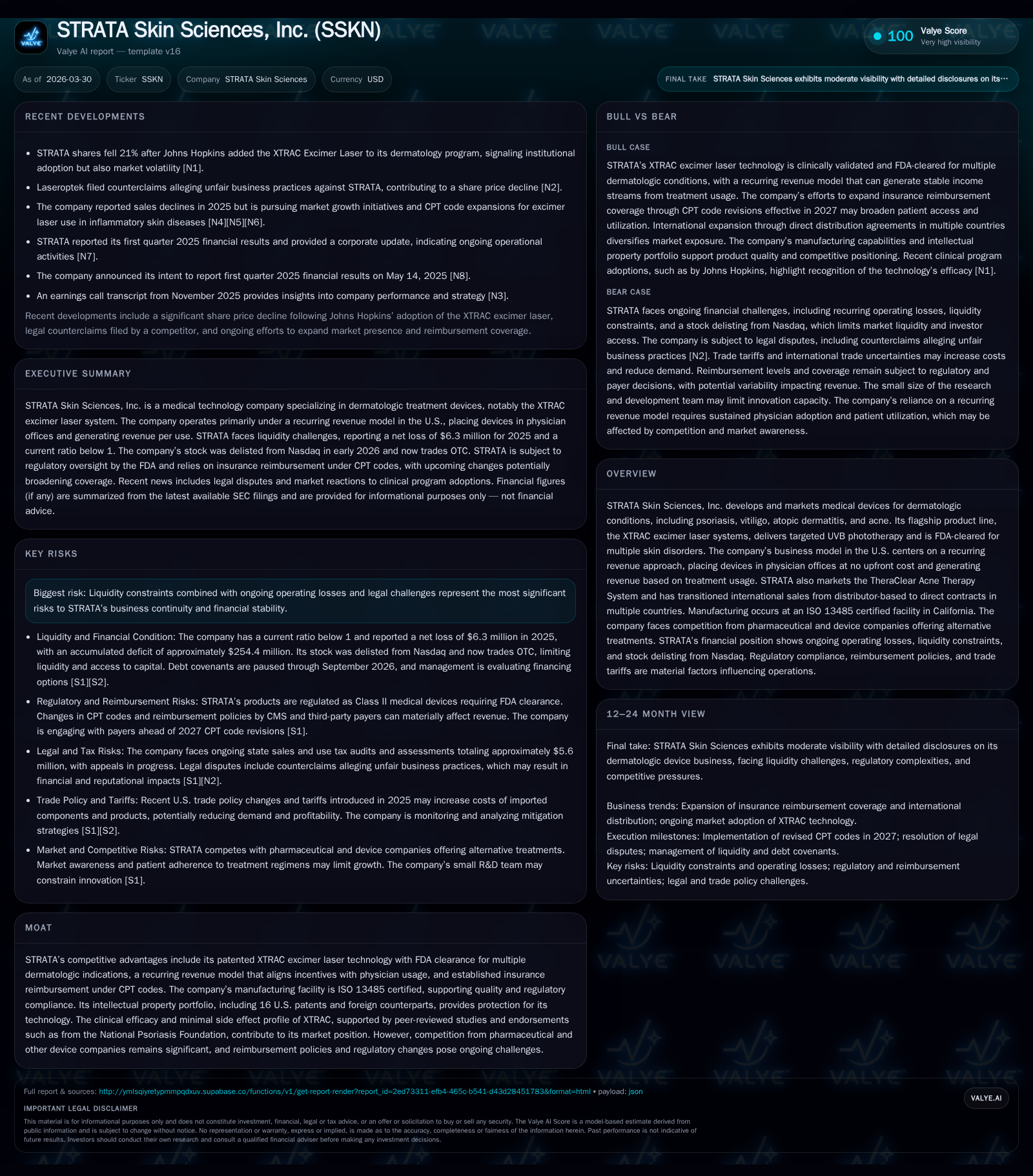
STRATA Skin Sciences, Inc. has established a unique market niche through its FDA-cleared XTRAC excimer laser systems targeting dermatologic disorders with a recurring revenue model that aligns with physician usage. Although operating losses have shown improvement in 2025, the company continues to face persistent liquidity constraints and legal challenges, including significant sales tax assessments and healthcare fraud scrutiny. Trade policy shifts add another layer of uncertainty for cost and demand dynamics. Moving forward, cash flow management and regulatory compliance will be critical as STRATA seeks to convert clinical validation into stronger commercial momentum amid competitive pressures.
Historical Financial Performance: Trends in Losses Amid Technology Adoption
STRATA Skin Sciences has faced persistent challenges converting innovative dermatology technologies into profitable operations. Latest SEC data show reported revenue approximately at $278K as of FY2012 with no recent updates indicating material growth in top-line [F1]. Operating losses have been sustained for years but improved materially from -$9.25M in FY2024 to -$4.7M in FY2025 — nearly halving the loss magnitude, which may reflect cost discipline or operational efficiencies.
Net income mirrored this improvement, narrowing from -$10.09M (FY2024) to -$6.26M (FY2025), yet continued negative earnings underscore ongoing unprofitability [F1]. Operating cash flow swung sharply negative at -$2.79M in FY2025 compared to modest positive inflows the prior year, highlighting liquidity stress likely tied to working capital dynamics.
Capital expenditures were reduced from peak levels ($5.02M in FY2023) to $1.47M in FY2025, suggesting a strategic shift towards maintenance rather than expansion investments [F1]. Equity contracted steeply from $21.8M at end-2022 down to $2.9M by end-2025, reflecting accumulated net losses and erosion of shareholder value.
Historical performance (annual)
| FY | Net ($mm) | CFO ($mm) | OpInc ($mm) | Capex ($mm) | Net YoY |
|---|---|---|---|---|---|
| 2025 | -6 | -3 | -5 | 1 | +37.9% |
| 2024 | -10 | 0 | -9 | 2 | +6.9% |
| 2023 | -11 | -1 | -9 | 5 | -95.2% |
| 2022 | -6 | -1 | -5 | 4 |
Source: SEC companyfacts cache [F1].
Capital returns and efficiency (annual)
| FY | FCF ($mm) | ROE% |
|---|---|---|
| 2025 | -4 | -215.3 |
| 2024 | -1 | -202.9 |
| 2023 | -6 | -85.4 |
| 2022 | -5 | -25.4 |
Source: SEC companyfacts cache [F1].
Note: Revenue YoY unavailable due to data gaps
These figures demonstrate partial stabilization in operating losses but highlight continued cash burn with free cash flow approximating negative $4.26 million in FY2025 when combining operating cash flow and capital expenditure outlays [F1]. This persistent negative cash flow accentuates liquidity risks against a backdrop of mounting liabilities.
The XTRAC Advantage: Patented Laser Technology and Clinical Endorsements
STRATA's core product offering centers on the XTRAC excimer laser systems delivering targeted UVB phototherapy primarily for autoimmune skin disorders such as psoriasis, vitiligo, atopic dermatitis, and eczema [S1]. This precision laser technology enables effective treatment with minimized side effects versus broader phototherapy approaches.
The company's intellectual property position is fortified by sixteen U.S. patents covering hardware components and treatment methods, providing a technological moat against competitors [S1]. Regulatory history includes FDA clearance since 2000 for the XTRAC system, underscoring longstanding approval status.
Clinical acceptance is supported by endorsements from entities such as the National Psoriasis Foundation alongside peer-reviewed studies validating efficacy, which enhances physician confidence and adoption potential despite competitive alternatives including pharmacologics and other phototherapy modalities.
Recurring Revenue Model and Insurance Reimbursement Dynamics
STRATA employs a recurring revenue model wherein devices are placed at no upfront cost within physician offices; revenues derive from treatment usage reimbursed under CPT codes by Medicare/Medicaid and private insurers [S1][S4]. This approach aligns STRATA’s incentives with physician utilization rates rather than one-time device sales.
While fostering recurring revenue streams that scale with treatment volumes, this model exposes the company to payer reimbursement risks including potential CPT code rate adjustments or fee schedule changes that could compress margins or reduce procedural volumes if providers alter treatment patterns [S25][S26]. Compliance burdens also arise from monitoring accurate coding practices amid evolving healthcare fraud regulations.
Legal and Regulatory Risks: Healthcare Fraud and State Tax Disputes
STRATA operates amid complex legal frameworks encompassing healthcare fraud laws such as the False Claims Act (FCA). Although it does not bill government payers directly, it faces risk if alleged improper coding or billing practices by providers are linked back to manufacturer influence or guidance [S4]. FCA penalties can be severe involving treble damages plus per-claim fines under qui tam whistleblower suits increasingly common across medical device firms.
Compounding challenges are ongoing state-level disputes regarding sales/use tax applicability on XTRAC treatment codes treated akin to tangible goods versus exempt medical services—resulting in over $5 million of assessed liabilities including penalties across New York and California jurisdictions with appeals pending [S23][S24]. These contingent liabilities add financial strain while increasing compliance complexity.
Anti-kickback statutes further heighten risk by prohibiting remuneration arrangements that could induce referrals or purchases, demanding rigorous adherence to avoid penalties including fines or exclusion from federal healthcare programs [S6][S7].
Trade Policy Impact: Tariffs Affecting Cost Structure
In 2025, newly enacted U.S. tariffs targeted imported components critical for manufacturing excimer lasers such as rare gases and optical parts used in XTRAC systems [S1][S2]. These tariffs raise procurement costs potentially compressing gross margins amid pricing pressures constrained by reimbursement ceilings.
Management is evaluating mitigation strategies including alternative sourcing or supplier diversification though effectiveness remains uncertain given trade policy volatility [S2]. Tariff-induced cost pressures compound existing financial vulnerabilities requiring vigilant margin management.
Liquidity Profile and Capital Allocation Constraints
Liquidity metrics reveal significant stress with a current ratio of approximately 0.58 reflecting current liabilities substantially exceeding current assets [$15.6M vs $26.7M] as of FY2025 year-end [F1]. The company’s long-term debt has been reclassified as current due to covenant breaches following Nasdaq delisting triggered defaults—an explicit going concern warning noted by management [S3][S12][S24].
Cash reserves stood near $7.9 million at FY-end but are insufficient relative to steep negative free cash flows approximating $4.26 million annually driven by operating deficits combined with necessary capital expenditures for production sustainment [F1]. No dividends or share repurchase programs have been declared consistent with a focus on preserving cash amid distressed financial conditions.
Market Developments: Clinical Adoption Efforts Amid Volatility
Notable recent developments include Johns Hopkins Health System integrating XTRAC excimer laser treatments into their dermatology program—signaling institutional validation of clinical utility—but coinciding with a more than 20% share price decline indicative of investor skepticism about near-term profitability prospects despite supportive meta-analyses published contemporaneously [N1][N2].
Strategically, STRATA is transitioning international markets away from third-party distributors toward direct sales channels aiming to enhance gross margin control albeit at the cost of increased fixed selling expenses requiring operational discipline for net benefit realization [S1].
Key upcoming indicators include resolution progress on sales tax litigation affecting contingent liability exposure; success mitigating tariff impacts sustaining margin integrity; physician adoption momentum supported by education initiatives overcoming clinical inertia; as well as refinancing or restructuring actions influencing liquidity outlook.
Disclaimer: This analysis synthesizes publicly available information up to March 30, 2026 without providing investment advice or price targets. All financial figures cited are sourced explicitly from SEC filings or official company disclosures referenced accordingly.
Disclaimer: This is research-only, informational analysis and not investment advice. It may include AI-generated interpretation and general industry context. Always verify important details using primary sources.

Comments