
Neumora’s CNS Drug Development Journey: Balancing Scientific Milestones and Capital Efficiency
Neumora Therapeutics advances its central nervous system pipeline with promising early clinical data while managing substantial operating losses through strategic capital maneuvers.
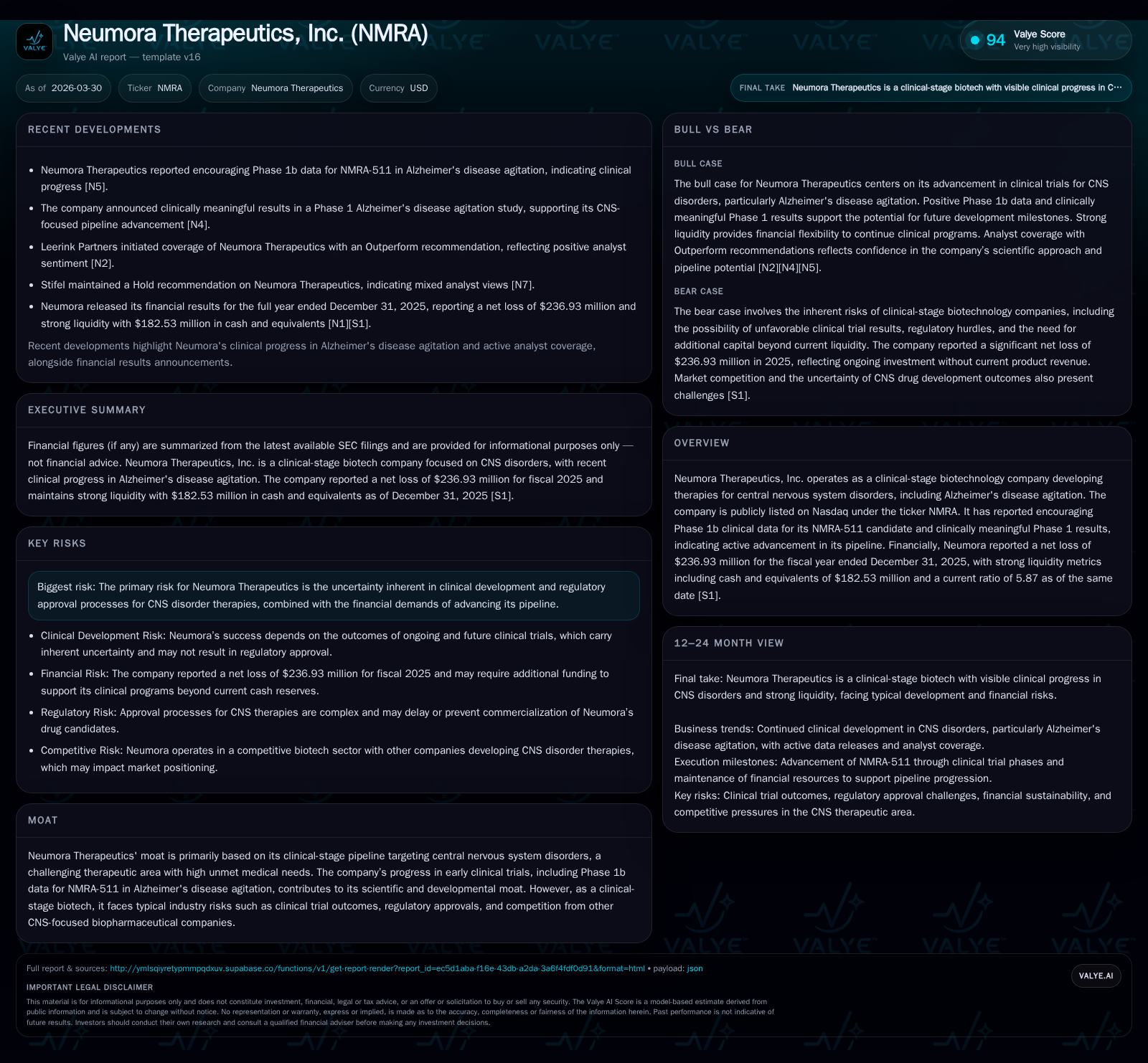
Neumora Therapeutics remains a clinical-stage biotech focused on central nervous system disorders, highlighted by encouraging Phase 1b results for NMRA-511 targeting Alzheimer's disease agitation. Despite ongoing steep net losses nearing $237 million in 2025, the company maintains a robust liquidity position with $183 million in cash and a strong current ratio of 5.87. Neumora's capital structure reflects active management efforts including convertible loan conversions into equity to sustain funding amid the costly clinical development cycle. Investors should closely monitor upcoming clinical readouts and cash runway dynamics given persistent sector risks and financial pressures.
2025 Financial Overview: High Operating Losses amid Strong Liquidity Buffer
Neumora Therapeutics operates as a classic clinical-stage biotechnology entity, reflected by its absence of commercial revenue and persistent operating deficits. For the fiscal year ended December 31, 2025, the company reported an operating loss approaching $241 million, marginally improved by approximately 8.5% compared to $263 million in 2024 and a slight decline from $252 million in 2023 [F1]. Net losses tracked similarly at $237 million in 2025 with a modest year-over-year reduction of about 2.8%. The company’s expenditures remain predominantly R&D driven as it progresses CNS disorder therapies.
Operating cash flow continued negative trends, declining by nearly 13% to -$206 million in FY2025 from -$183 million in FY2024, reflecting the intensifying costs associated with multiple clinical trials underway [F1]. Capital expenditures were nominal and consistent at roughly $117,000 annually given limited facility costs relative to operational scale.
Yet despite these headwinds, Neumora boasts strong liquidity metrics. Cash and equivalents totaled $182.5 million at year-end, buffering the firm against immediate funding gaps. The current ratio stands at an enviable 5.87 — current assets of about $190.5 million versus liabilities near $32.5 million — signaling ample short-term solvency [F1][S1]. This disparity highlights a prudent cash reserve strategy vital for sustaining prolonged CNS clinical programs marked by costly patient recruitment and biomarker analyses.
Historical performance (annual)
| FY | Net ($mm) | CFO ($mm) | OpInc ($mm) | Capex ($) | Net YoY |
|---|---|---|---|---|---|
| 2025 | -237 | -206 | -241 | +2.8% | |
| 2024 | -244 | -183 | -263 | 117000 | -3.3% |
| 2023 | -236 | -163 | -252 | 117000 |
Source: SEC companyfacts cache [F1].
Capital returns and efficiency (annual)
| FY | FCF ($mm) | ROE% |
|---|---|---|
| 2025 | -228.1 | |
| 2024 | -183 | -84.9 |
| 2023 | -163 | -50.3 |
Source: SEC companyfacts cache [F1].
All figures are in millions USD unless noted; Capex is in thousands [F1]
Clinical Pipeline Momentum: NMRA-511 and Early Phase Successes
Neumora’s core scientific moat rests on its focus within the central nervous system (CNS) space—long regarded as one of the most challenging therapeutic arenas due to complex pathologies and historically low success rates for novel therapies.
The company’s lead candidate, NMRA-511, targets agitation associated with Alzheimer’s disease—a condition with high unmet medical need given limited approved treatment options that effectively address neuropsychiatric symptoms without compromising safety.
In January 2026 disclosures, Neumora announced encouraging Phase 1b signal-seeking results indicating NMRA-511's safety profile was acceptable with preliminary evidence suggesting potential efficacy signals in affected patients [S16]. These early-stage findings represent meaningful de-risking steps pivotal before advancing into larger-scale efficacy studies.
Additionally, Neumora is progressing other pipeline candidates addressing different CNS disorders though details remain sparse pending trial readiness or regulatory approvals [S7]. Notably, Phase 1 results broadly support continued investments into this pipeline.
Given the notorious difficulty in CNS drug discovery—often characterized by translational gaps between animal models and human pathology—the successful demonstration of tolerability and pharmacodynamic activity in initial studies marks critical milestones for Neumora.
Sector Challenges: CNS Drug Development Risks and Regulatory Hurdles
Regulating its forward trajectory are inherent risks endemic to CNS biopharma ventures. Clinical trial failure rates remain elevated due to heterogeneous patient populations and elusive biomarkers complicating endpoint validation [S4][S6]. Regulatory review timelines are typically protracted as agencies demand rigorous demonstration of both safety and clinically meaningful benefits due to vulnerable patient sets.
Neumora openly acknowledges these risks including potential litigation or unforeseen adverse events impacting trials [S11]. Competition from both established pharma giants and nimble biotech startups racing to capture portions of the CNS market also applies pressure.
Moreover, CNS programs usually require extensive patient enrollment across multiple geographies alongside innovative trial designs incorporating neuropsychological endpoints — all factors driving up R&D costs and operational complexity.
Consequently, while scientific advances underpin promise, these sector-specific impediments cautious any expansive optimism until late-phase confirmatory data emerges.
Capital Structure, Cash Flow Trends, and Equity Adjustments
Reflecting its stage and financial demands, Neumora’s capital structure has evolved via a mixture of equity financing supplemented by structured debt facilities featuring convertible features.
Year-end balance sheet snapshots show total equity contracted noticeably from approximately $287 million at end-2024 to just under $104 million after net losses significantly eroded book value [F1], illustrating dilution effects from financing transactions plus accumulated deficits.
Total debt details are fragmented but focus heavily on term loans arranged mid-2025 with embedded lender rights allowing conversion into common stock under defined terms [S14][S15][S17]. This approach mitigates immediate cash interest burdens albeit dilutes existing shareholders — typical for pre-revenue biotechs prioritizing capital preservation over cost efficiency.
Operating cash flow burn remains substantial reflective of active trial expenditure; however, robust cash reserves offer a measured runway extension while awaiting value-inflecting pipeline outcomes.
| Metric | Amount ($M) |
|---|---|
| Cash & Equivalents | 182.53 |
| Current Assets | 190.54 |
| Current Liabilities | 32.45 |
| Current Ratio | 5.87 |
| Shareholders’ Equity | 103.87 |
Figures as of December 31, 2025 unless noted [F1]
Capital Allocation Strategies: Debt Conversions and Share Issuances
Neumora employs creative structuring via its loan agreements with K2 HealthVentures LLC allowing lenders to convert up to $12.5 million principal into common stock at pre-agreed conversion prices near $0.88 per share unveiled publicly mid-to-late last year [S14][S15].
In November 2025 alone, K2HV converted about $2.5 million principal resulting in issuance of ~2.85 million shares—transactions exempted from registration under Section 4(a)(2), indicating private placement mechanics designed to limit transaction friction [S14].
Such convertible mechanisms preserve crucial liquidity by offsetting imminent debt repayments while increasing equity base—a double-edged sword common among biotechs striving for extended development runways without immediate revenue inflows.
Significantly though, there were no distributions paid out as dividends nor programs initiated for repurchasing shares during this period aligning with norms where free cash flow remains restrained by intensive R&D spending requirements [S8][S9][S10].
These steps underscore an emphasis on maintaining operational continuity over capital return policies until positive commercialization prospects materialize downstream.
Outlook and Investor Watchpoints: Upcoming Clinical Milestones and Funding Needs
Looking ahead through calendar year 2026, investor focus should sharpen primarily on key developmental milestones such as expanded Phase 2 readiness or initial proof-of-concept signals from ongoing trials including NMRA-511 follow-ups [N1][N2]. Successful progression through CNS-specific endpoints will represent validation points that could modulate risk perceptions substantially.
Moreover, close attention toward cash burn rates paired with any announced capital raises or further loan-to-equity conversions will illuminate sustainability amidst the inevitable volatility standard to pre-revenue biotechnology companies.
Given no explicit forward-looking guidance furnished beyond general event timing disclosures currently available [N1], stakeholders must remain vigilant for subsequent filings such as quarterly Form 10-Qs or special Form 8-Ks containing critical pipeline updates or financing activities that may recalibrate valuation outlooks.
This analysis compiles reported financial disclosures and recent market communications concerning Neumora Therapeutics as of March 30, 2026 without offering buy/sell recommendations or price forecasts. It endeavors to provide a detailed view of core scientific progress alongside financial structuring decisions pertinent to understanding this CNS-focused biotech’s position within its sector’s distinctive challenges.
Disclaimer: This is research-only, informational analysis and not investment advice. It may include AI-generated interpretation and general industry context. Always verify important details using primary sources.

Comments