
KRAKacquisition Corp's Strategic Deployment in Bridging DeFi and TradFi
KRAKacquisition Corp, a newly public Cayman Islands SPAC with $345 million in trust, focuses on digital asset mergers bridging decentralized and traditional finance.
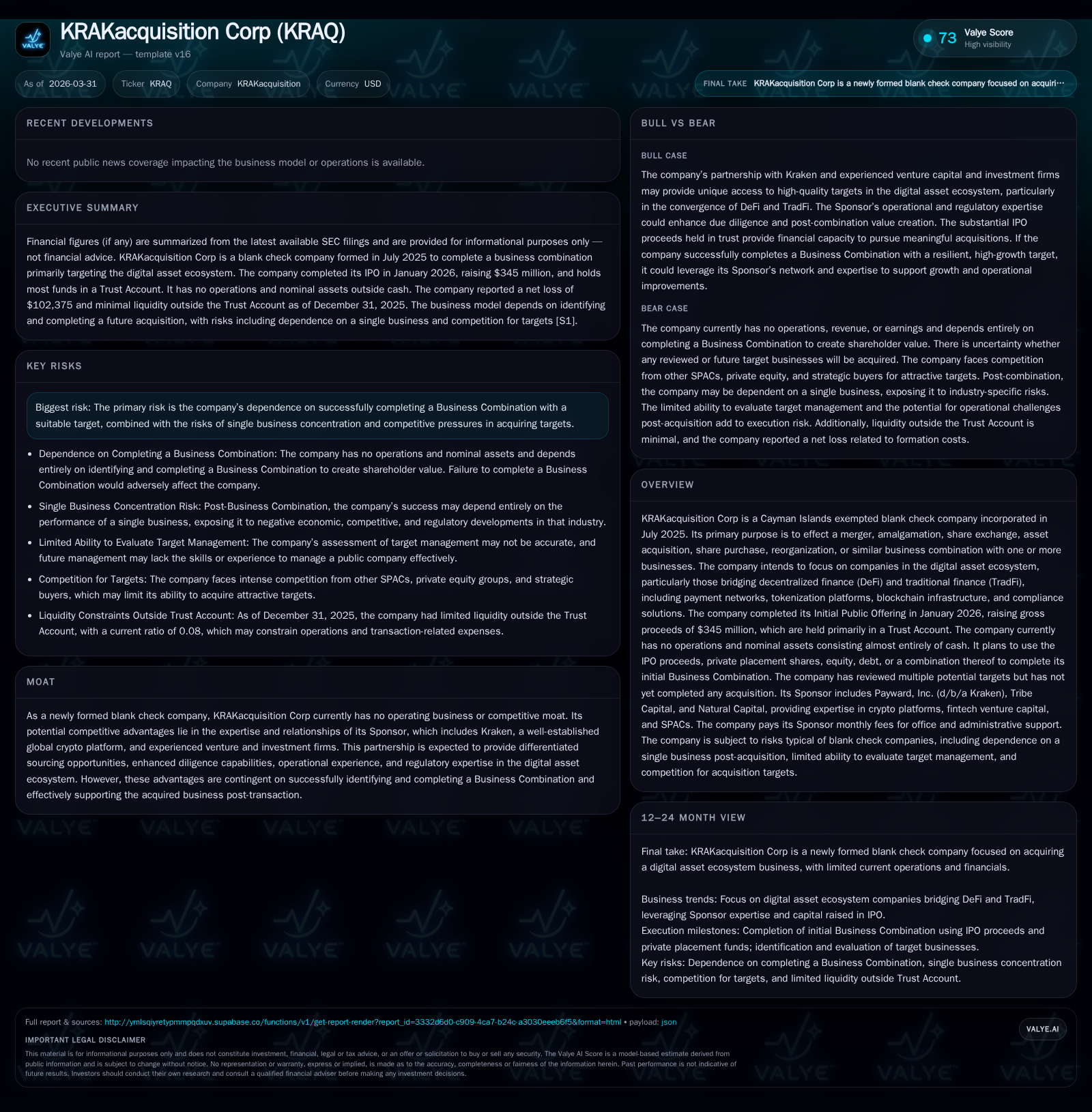
Incorporated in July 2025 and IPO completed January 2026, KRAKacquisition Corp (KRAQ) is a blank check company targeting the digital asset ecosystem, specifically the intersection of decentralized finance (DeFi) and traditional finance (TradFi). It raised $345 million placed in a Trust Account for future business combinations. The sponsor group includes Kraken and venture investors, providing operational insight into crypto fintech. Founder shares hold significant voting power, potentially enabling deal approval despite public shareholder opposition. The company faces execution risks common to SPACs and regulatory uncertainty in crypto markets. Success depends on identifying and closing a transformative business combination within two years.
Genesis of KRAKacquisition Corp and IPO Milestone
KRAKacquisition Corp was incorporated on July 28, 2025 as a Cayman Islands exempted company formed to effectuate mergers or similar business combinations [S1]. It operates as a special purpose acquisition company (SPAC) aiming at companies bridging decentralized finance (DeFi) with traditional finance (TradFi), focusing on sectors such as payment networks, tokenization platforms, blockchain infrastructure providers, and compliance technologies.
The company completed its Initial Public Offering on January 29, 2026, issuing 34.5 million units at $10 each including full exercise of the over-allotment option, generating gross proceeds of approximately $345 million [S1],[S6]. These funds were placed in a Trust Account dedicated to financing future Business Combinations or redeeming public shareholders. Concurrently, private placement warrants were sold to sponsors for $2.25 million. Founder shares totaling approximately 8.6 million were issued pre-IPO for nominal consideration consistent with typical SPAC structures [S1],[S6].
The sponsor group comprises Payward Inc., operating as Kraken—a leading global crypto platform—alongside venture capital firm Tribe Capital and investment platform Natural Capital.
Financial Snapshot: Capital Raised, Assets, and Operating Status
As a blank check company without operations or revenues to date, KRAQ reported a net loss of $102,375 for the fiscal year ending December 31, 2025 primarily due to administrative expenses [F1]. The balance sheet reflects nearly all assets held in cash equivalents: approximately $44 thousand outside the Trust Account with about $345 million secured within it per offering documents [F1],[S6]. Current liabilities are minimal relative to total funds raised at roughly $557 thousand [F1], resulting in a current ratio of approximately 0.08 which is not indicative given the non-operating nature.
Historical performance (annual)
| FY |
|---|
| 2025 |
Source: SEC companyfacts cache [F1].
Sponsor Profile and Sector Expertise as Strategic Advantage
KRAQ’s sponsor consortium blends operational expertise from Kraken with venture capital insights from Tribe Capital and investment acumen from Natural Capital [S1],[F1]. Kraken brings over a decade of experience building a global digital asset exchange platform including technology development, risk management, compliance navigation, and ecosystem relationships. This operational knowledge offers differentiated access to potential targets beyond typical financial sponsors.
This strategic advantage positions KRAQ to identify high-growth opportunities where DeFi solutions intersect with established TradFi infrastructures. The sponsor's combined expertise supports deeper due diligence and value creation potential post-Business Combination.
Governance Structure and Shareholder Voting Dynamics
Founder shares represent roughly 20% of total equity immediately post-IPO and carry substantial voting power that may enable Business Combination approval even if most public shareholders oppose it [S1,S4,S8]. Key points include:
- Shareholder votes for Business Combinations may be held when legally or strategically required,
- Sponsors have agreed contractually to vote their Founder Shares plus any Public Shares they own in favor of such transactions,
- Only about 37.5% affirmative votes from public shareholders participating are needed alongside Founder Shares for approval,
- Under Cayman Islands law quorum assumptions at one-third attendance may mean no additional public votes beyond Founder Shares are required.
While this enhances deal certainty vital for SPAC timelines, it limits public shareholder influence relative to sponsors.
Risk Landscape: Execution Challenges and Regulatory Considerations
KRAQ faces risks typical for SPACs plus sector-specific regulatory complexities:
- Must complete Business Combination within two years or liquidate returning Trust Account proceeds to public shareholders [S1,S7,S26], risking total loss of upside if unsuccessful.
- Competition for attractive digital asset ecosystem targets blending DeFi-TradFi elements is intense amid active funding environments.
- Regulatory frameworks governing crypto assets remain evolving globally; compliance uncertainties exist especially around payments networks and tokenization platforms targeted by KRAQ [S28].
- Concentration risk arises from dependence on a single post-combination entity without diversification.
- Sponsor indemnity agreements limit redemption obligations if Business Combination fails but introduce counterparty risk affecting liquidity [S10,S16,S22].
No material litigation or regulatory actions against management have been disclosed [S7].
Capital Allocation Policy: Cash Management and Shareholder Rights
IPO proceeds plus private placement funds totaling about $347.25 million remain primarily invested in the Trust Account earning interest but restricted for use solely toward Business Combinations or redemptions except limited permitted withdrawals capped at five percent of interest accrued for working capital or tax purposes [S4,S8–S12].
Current policies include:
- No dividends declared or share repurchases conducted;
- Sponsor waivers prevent redemption rights on Founder Shares enhancing capital stability;
- Public shareholders can redeem their shares upon completion of any Business Combination at pro rata amounts approximating $10 per share based on Trust Account balances regardless of voting preferences;
- Decisions between tender offers or proxy solicitations for redemptions are at KRAQ’s discretion subject to SEC rules including insider purchase restrictions under Rule 14e-5 [S8,S21,S23,S27].
This conservative cash stewardship protects principal while maintaining optionality.
Outlook: Target Sectors within DeFi-TradFi Convergence (Analytical)
Though no specific acquisition targets have been publicly announced or term sheets disclosed by KRAQ’s management or sponsors thus far, sector analysis suggests likely candidates include:
- Payment networks integrating blockchain technology with traditional banking systems facilitating cross-border remittances;
- Tokenization platforms enabling digitization of real-world assets unlocking TradFi liquidity through DeFi protocols;
- Blockchain infrastructure providers offering scalable solutions addressing latency and security critical for financial applications;
- Compliance technology firms specializing in automated AML/KYC/tax reporting tailored for emerging digital asset markets bridging regulated TradFi environments.
Regulatory developments—especially US SEC guidance on crypto custody and stablecoins—will influence valuations and integration feasibility.
KRAQ’s strategic focus aligns well with industry trends emphasizing DeFi adoption supported by TradFi harmonization creating consolidation opportunities via Business Combinations.
Key Milestones: Timeline, Approvals, Transaction Terms (Analytical)
Investors should monitor:
- Announcements regarding identified target(s), letters of intent or exclusivity agreements indicating due diligence progress;
- Filing dates for proxy statements or tender offer materials detailing transaction terms informing shareholder decisions;
- Choice between shareholder vote versus tender offer impacting control dynamics and redemption logistics;
- Redemption election deadlines with electronic delivery requirements necessitating timely shareholder action;
- Regulatory review periods pertinent if targets hold licensed financial activities under US/state/federal laws;
- Compliance with the strict two-year deadline from IPO close requiring either consummation or orderly wind-down preserving investor capital protection rights.
These milestones influence deal execution likelihood and integration complexity shaping long-term value creation.
This report integrates disclosures from KRAKacquisition Corp’s SEC filings ([S1]-[S29]) and financial facts ([F1]) providing an evidence-based overview without speculative projections beyond official information. Analytical sections reflect sector expertise rather than new company-specific announcements. Readers should track ongoing regulatory updates and transaction developments as key data points evolve.
No investment advice is offered herein; information is provided solely for research purposes consistent with internal editorial standards.
Disclaimer: This is research-only, informational analysis and not investment advice. It may include AI-generated interpretation and general industry context. Always verify important details using primary sources.

Comments