
American Rebel Holdings Faces Uphill Battle With Financial Strains and Brand Expansion
The company pursues a multi-category lifestyle brand rooted in patriotism but contends with mounting losses and liquidity constraints.
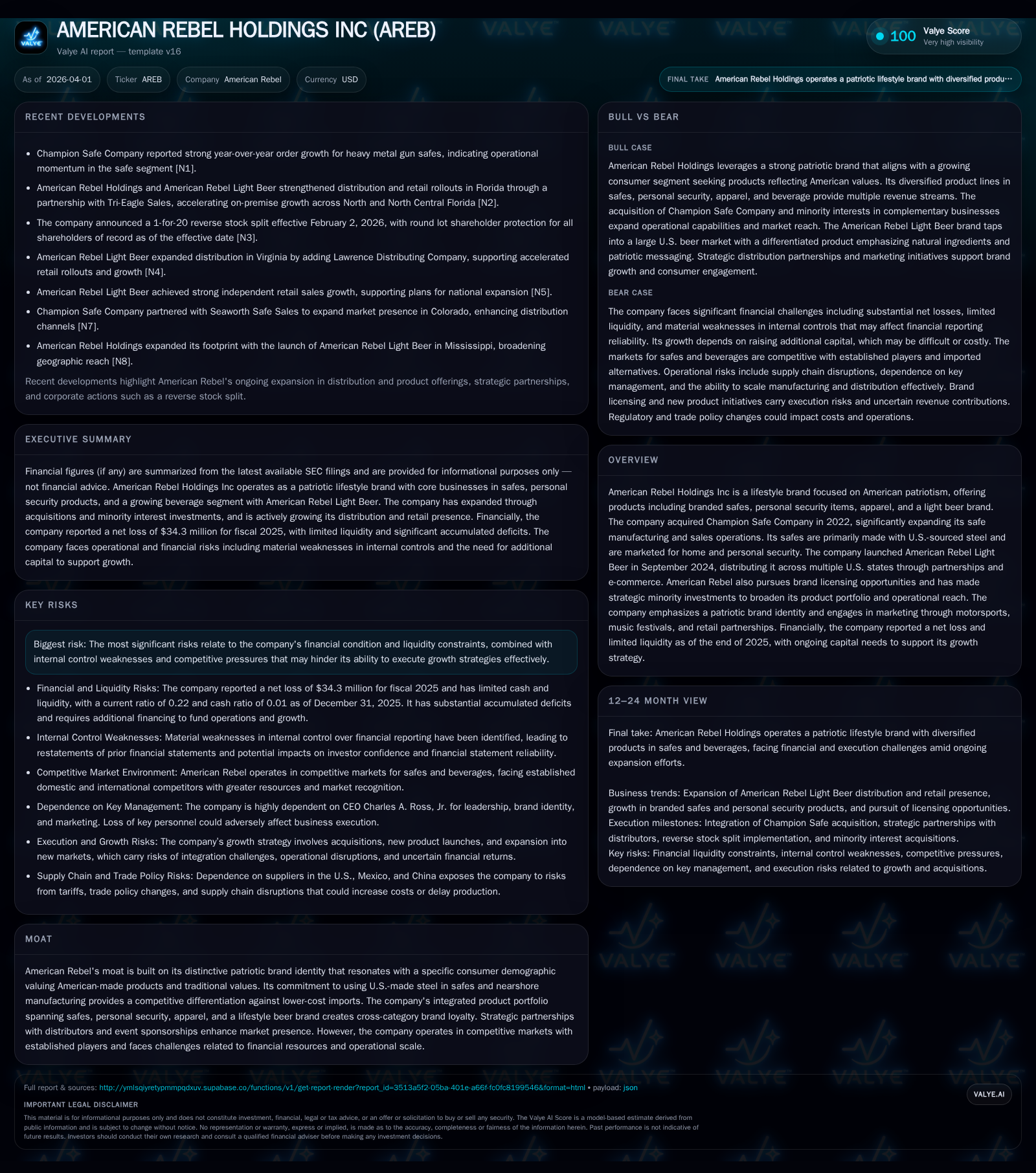
American Rebel Holdings has developed a distinctive patriotic lifestyle brand portfolio encompassing safes, personal security items, apparel, and a light beer launched in 2024. The acquisition of Champion Safe Company in 2022 expanded its manufacturing footprint, particularly with U.S.-sourced steel products. Despite these strategic expansions, the company's financial performance has deteriorated sharply through 2025, with continued top-line contraction and deepening operating losses. Liquidity remains stressed as operating cash flow stays deeply negative and current liabilities substantially outweigh current assets. Future growth depends on scaling new product lines and expanding distribution, but capital limitations and intense competition from well-funded incumbents pose significant obstacles.
American Rebel’s Revenue and Profit Trajectory: A Summary of Recent Years
American Rebel Holdings, Inc., has shown a clear yet troubling trajectory over the past several years marked by incremental revenue growth followed by sharp contraction amid increasing costs. Revenue reached $986,826 in fiscal year 2021 after rising from just $131,274 in 2018. However, the latest full-year data from FY2025 reveals a -21.4% year-over-year decrease relative to the prior period (approximate prior revenues implied by this reduction) indicating challenges in sustaining sales volume as the company expands its brand portfolio.[F1]
Operating income figures reveal mounting pressure on profitability with losses deepening every year: -$5.1 million in FY2022 escalated to nearly -$15 million in FY2025, with a -20.8% worsening trend in operating income from FY2024 to FY2025 alone.[F1] Net income mirrors this deterioration sharply—the firm swung from -$7.1 million net loss in FY2022 to an eye-watering -$34.3 million net loss by FY2025, a near doubling of losses within one year.[F1]
Cash flow from operations remains negative consistently—FY2025 saw operating cash outflows of about $7.2 million—and combined with modest capital expenditures ($329K in FY2025), free cash flow remains deeply negative. This suggests the company is heavily reliant on external financing or asset sales to cover cash burn.[F1]
Historical performance (annual)
| FY | Net ($mm) | CFO ($mm) | OpInc ($mm) | Capex ($) | Net YoY |
|---|---|---|---|---|---|
| 2025 | -34 | -7 | -15 | 329435 | -95.0% |
| 2024 | -18 | -7 | -12 | 3090 | -80.9% |
| 2023 | -10 | -7 | -9 | 6300 | -36.2% |
| 2022 | -7 | -7 | -5 | 20888 |
Source: SEC companyfacts cache [F1].
Capital returns and efficiency (annual)
| FY | FCF ($mm) | ROE% |
|---|---|---|
| 2025 | -8 | -783.4 |
| 2024 | -7 | 230.7 |
| 2023 | -7 | -238.9 |
| 2022 | -7 | -62.9 |
Source: SEC companyfacts cache [F1].
Revenue figures prior to FY21 omitted due to less relevance for recent trends.
The cumulative effect is a deeply negative ROE estimated at approximately -783%, indicative of severe capital erosion given large net losses against shareholders' equity of roughly $4.38 million at the end of FY2025.[F1]
Key Growth Drivers Behind the Company’s Brand Expansion
American Rebel’s growth strategy leverages its distinctive patriotic brand identity that resonates strongly within niche American audiences emphasizing values such as constitutional rights and national pride.[S6][S17] The acquisition of Champion Safe Company in 2022 significantly bolstered manufacturing capacity and product breadth in the secure storage space.
Champion Safe's safes benefit from the use of American-made steel components—largely produced at the Provo Utah facility—and assembly through nearshore operations in Mexico under Maquiladora protocols which mitigate tariff exposure.[S20] This approach delivers a competitive narrative contrasting sharply against imported Chinese safes facing tariffs amid shifting US trade policies.[S20]
Beyond safes and personal security products (including branded apparel), American Rebel has begun diversifying its lifestyle offering by launching its own light beer called American Rebel Light Beer in September 2024.[S1] This product encapsulates both clean ingredient formulation—eschewing common mass-market additives—and patriotic messaging boldly displayed on packaging.[S17]
Such branding efforts are supported by sponsorships across motorsports events and music festivals aiming to embed American Rebel within culturally relevant high-impact channels.[S17]
New Product and Market Initiatives: Beer Launch and Strategic Minority Interests
The light beer initiative extends American Rebel’s reach into the highly competitive alcoholic beverages sector where it seeks to capture consumers motivated by both taste preferences for all-natural formulations as well as alignment with patriotic values not typically emphasized by mainstream competitors.[S7]
Distribution as of early 2026 encompasses eleven U.S. states through independent distributors while direct-to-consumer e-commerce supports online sales across roughly forty states.[S7] However, establishing reliable national distribution footprints remains challenging given entrenched relationships between retailers and major brewers like AB InBev or Molson Coors who command extensive shelf presence.[S6][S11]
In parallel with beverage expansion, American Rebel made strategic minority investments during fiscal year ending Dec 31, 2025: acquiring approximately a 19% stake in Sydona Enterprises (d/b/a Schmitty’s), a player in smokeless tobacco products—a $10 billion category—aimed at retail extension under the Company's patriotic licensing umbrella; as well as acquiring minority interests progressively totaling over three percent ownership in RAEK Data LLC which enhances operational influence.[S14]
These moves signal an effort toward brand licensing diversification beyond core product lines while leveraging adjacent customer segments attuned to similar values.
Competitive Landscape and Differentiation: The Patriotism Edge Against Bigger Players
American Rebel competes against industry giants possessing vastly superior financial resources and vertically integrated distribution networks—for instance AB InBev and Molson Coors dominate beer categories including legacy ales as well as expanding hard seltzer markets.[S6][S10][S11] Imported brands such as Corona® or Heineken® retain significant market share alongside regional craft brewers.
Premium safes also face robust competition from established safe manufacturers including Liberty Safe—which litigated against American Rebel's subsidiary Champion Safe regarding alleged trademark issues resolved late-2025—and other specialized domestic manufacturers that benefit from either legacy brand recognition or economies of scale.[S10][S20][S22]
Tariff dynamics create complex sourcing considerations: while some competitors rely on Chinese imports subject to renewed political scrutiny under President Trump’s administration (re-elected as cited), American Rebel’s nearshore Mexican assembly coupled with mandatory use of American steel offers differentiation but suffers cost disadvantages relative to fully offshore low-cost producers.[S20]
Industry consolidation trends further concentrate bargaining power among distributors who often prioritize larger brewers' portfolios presenting ongoing risks for independent brand penetration into retail cold box space or tap placements essential for beverage growth.[S7][S15]
Financial Headwinds: Liquidity, Operating Losses, and Cash Flow Trends
Liquidity pressures plague American Rebel Holdings emphatically. At December 31, 2025 balance sheet levels show current assets totaling about $5.6 million sharply dwarfed by current liabilities exceeding $25.9 million resulting in an unsustainable current ratio near 0.22—a critical solvency warning sign pointing toward potential working capital insolvency absent successful recapitalization or asset monetization efforts.[F1][S18][S23]
Negative operating cash flow persisted at around -$7.2 million in FY2025 contributing alongside capex (modest at $329K) to free cash flow deficits exceeding $7.55 million indicative of a recurring need for external financing support or cost restructuring.[F1]
Notably debt restructuring included repayment of Bank of America line-of-credit claims resolving litigation filed but cleared by September 15, 2025 ensuring no outstanding obligations remain with that creditor.[S22]
Recent multiple reverse stock splits culminating a cumulative ratio near one-for-90 thousand shares have led Nasdaq to determine non-compliance with continued listing standards related to minimum bid price mandates resulting in pending delisting actions effective February 13, 2026 unless successfully appealed – marking material market access limitations that could hinder equity financing options significantly.[S21]
Capital Allocation Overview: Investments, Debt Management, and Shareholder Returns
Notwithstanding constrained liquidity conditions, American Rebel strategically invested over $3 million via issuance of preferred stock shares toward minority acquisitions including stakes in Schmitty’s ($1.99 million valuation transaction) and RAEK Data ($1.5 million initial plus subsequent $1 million option exercise).[S14]
In commercial real estate dealings related to acquisition attempts for retail property at Nashville’s "218 Third Avenue" site valued at $14.1 million structured payments commenced though some agreements required renegotiations evidencing active asset portfolio expansion efforts even amid financial strain.[S12]
No dividends were declared or paid during reported periods consistent with management's emphasis on internal reinvestment over shareholder returns judging from disclosures indicating no expectation for cash dividends foreseeable given ongoing losses and cash needs.[F1][S16]
Buyback programs are non-existent reflecting conservatism due to limited free cash flow preventing capital returns despite dilution from preferred stock issuances which carry conversion rights potentially dilutive upon exercise affecting common shareholders' equity stakes notably next few years depending on recapitalization outcomes.[F1][S12]
Risk Factors Impacting Growth Prospects: Regulation, Competition, and Internal Controls
Risks articulated comprehensively encompass material financial condition fragility—including possible inability to meet working capital requirements without further capital injections—combined with intense competition from dominant rivals capable of aggressive pricing, product innovation acceleration and broader geographic reach impacting realistic gains domestically.
Legal disputes linger although resolved litigation includes Liberty Safe trademark issues settled December 2025 while fresh complaints relate to lease payment arrears resolved March 23rd also highlight operational expense risk spots requiring close monitoring.[S10][S13][S22]
Supply chain exposures stem notably from reliance on Mexican assembly sites for safes plus overseas factories producing backpacks/apparel subject to complex tariff regimes that could materially escalate costs should political winds intensify protectionism measures or border taxes reemerge unexpectedly impeding gross margin recovery potential without swift alternative supplier sourcing which remains non-trivial given scale requirements posed versus available U.S. makers unwilling/unable presently to meet cost/volume thresholds.[S4][S9]
Potential additional regulation affecting concealed carry accessories or shifts in firearm policy legislations could unpredictably alter demand patterns impacting core safe products' sales trajectories amid fluctuating governmental approaches around firearm access rights target customer segments identify closely with safety/legal compliance but remain sensitive to legislative climates changes regularly debated federally/states likewise e-commerce expansion introduces competitive digital marketing complexities intensified price discounting pressures conflicting with physical store partner relationships complicating omnichannel strategies implementation effectively sans dilutive promotions or margin erosions.,,,,
What to Watch: Operational Milestones and Distribution Expansion in 2026
While explicit forward-looking guidance is absent within available filings,[N/A analysis] key milestones will revolve around:
- Expanding the footprint of American Rebel Light Lager beyond initial eleven states via additional distributor agreements crucially broadening retail shelf presence;
- Strengthening e-commerce platform capabilities aimed at capturing direct consumer traffic offsetting distributor dependence;
- Progressing incremental minority interest integrations especially synergistic partnerships leveraging "America's Patriotic Brand" licensing;
- Managing legal fallout resolutions maintaining reputational integrity critical for sustained consumer confidence;
- Navigating potential recapitalization moves or strategic partnerships alleviating liquidity constraints vital for ongoing operations continuity;
- Adjusting supply chain resilience plans especially apparel/backpacks sourcing aligned with tariff risk mitigation strategies. These factors collectively will be defining barometers shaping whether bold brand ambitions can translate into sustainable financial turnaround versus prolonged distress.
This analysis is based solely on publicly filed documents including annual reports (10-K), current reports (8-K), proprietary financial data sets consolidated under company facts snapshot (F1), alongside third party narrative summaries provided through Valye Report excerpts without making any investment recommendations.
Disclaimer: This is research-only, informational analysis and not investment advice. It may include AI-generated interpretation and general industry context. Always verify important details using primary sources.

Comments