
Amaze Holdings Faces Significant Profitability Pressure Despite Platform Growth
The company’s transition to a creator-focused commerce platform drives top-line growth but challenges remain in achieving sustainable profitability.
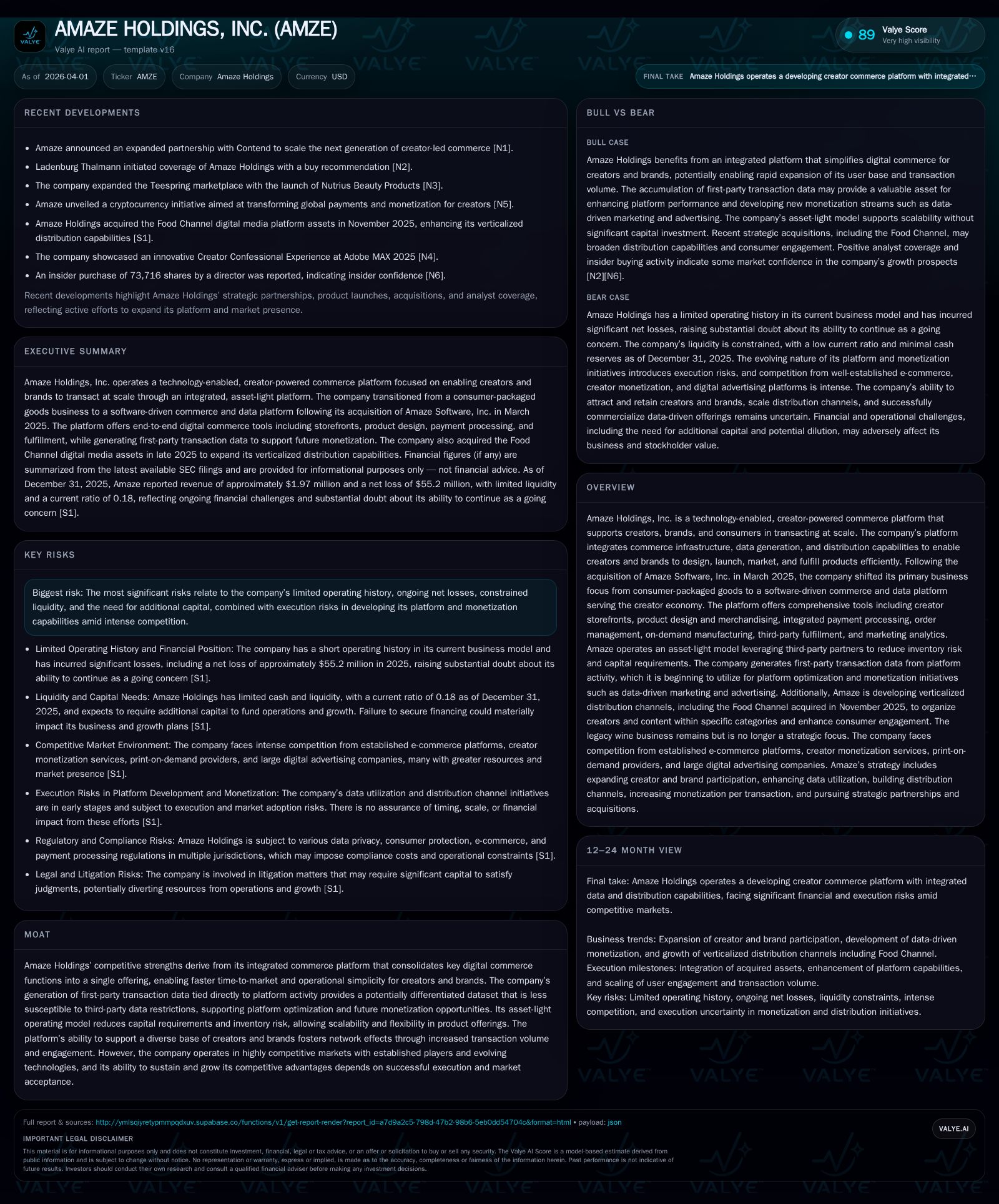
Amaze Holdings, Inc. transformed in 2025 from a consumer-packaged goods firm into an integrated, technology-enabled commerce platform serving the creator economy. This pivot, anchored by acquiring Amaze Software, Inc., has fueled substantial revenue growth but also significantly wider operating losses and negative cash flows. The asset-light model leverages third-party manufacturing and fulfillment to reduce capital intensity, while first-party transaction data offers potential future monetization avenues. However, the company’s limited operating history, heavy indebtedness, ongoing legal disputes, and early-stage monetization efforts underscore execution risks. Monitoring progress on scaling active creators, expanding distribution initiatives like the Food Channel, and development of data-driven monetization will be critical milestones.
Company Overview and Transformation
Amaze Holdings, Inc. (AMZE) underwent a fundamental transformation starting in March 2025 when it acquired Amaze Software, Inc., shifting its business focus from producing consumer-packaged goods—specifically low-carb premium wines—to becoming a technology-enabled, creator-powered commerce platform. This repositioning targets creators and brands seeking an end-to-end solution for digital commerce operations ranging from storefront setup through product design, merchandising, payment processing, order management, to fulfillment coordination (largely outsourced to third parties) [S1,S4,S23].
The company now provides an integrated commerce infrastructure designed to streamline operational complexity for creators and brands while generating valuable first-party transaction data tied directly to platform activity. This data is fundamental to Amaze’s evolving strategy for optimizing platform performance and unlocking new monetization opportunities via improved targeting and personalization features [S4,S16,S18].
Historical Financial Performance
Since the company’s pivot completion in early 2025, revenue has exhibited sharp acceleration but profitability remains elusive. Revenue grew from $299K in FY2024 (mostly legacy operations) to roughly $2 million in FY2025—an increase of approximately 558% year-over-year. Despite this surge in top-line sales underpinning nascent market acceptance of the platform offering, operating income plunged from a loss of about $3.1 million in FY2024 to a much larger operating loss of approximately $54.4 million in FY2025.
Net losses mirrored this pattern severe deepening from $2.5 million loss in FY2024 to over $55 million loss in FY2025. Operating cash flows remain deeply negative at -$17.5 million for FY2025 after deteriorating steadily since inception. The balance sheet shows strained liquidity conditions with current assets at around $4.39 million against current liabilities of approximately $24.4 million as of December 31, 2025 — yielding a stressed current ratio near 0.18 that signals short-term liquidity stress [F1].
Equity was positive at nearly $9.8 million end-2025 versus roughly $1.5 million in prior year; however this reflects capital raises as well as recognition of goodwill which itself suffered a substantial impairment charge of $34.3 million in 2025 impacting reported profitability unfavorably [F1,S21].
Historical performance (annual)
| FY | Rev ($mm) | Net ($mm) | CFO ($mm) | OpInc ($mm) | Rev YoY | Net YoY |
|---|---|---|---|---|---|---|
| 2025 | 2 | -55 | -18 | -54 | +557.8% | -2090.0% |
| 2024 | 0 | -3 | -2 | -3 | -83.6% | +76.3% |
| 2023 | 2 | -11 | -5 | -11 | -36.1% | +30.2% |
| 2022 | 3 | -15 | -14 | -15 |
Source: SEC companyfacts cache [F1].
Capital returns and efficiency (annual)
| FY | ROE% |
|---|---|
| 2025 | -564.7 |
| 2024 | -170.3 |
| 2023 | 1279.7 |
| 2022 | -270.8 |
Source: SEC companyfacts cache [F1].
Table: Amaze Holdings Annual Financial Summary ([F1])
Business Model and Platform Capabilities
Amaze operates an asset-light model leveraging third-party manufacturers, logistics providers, and payment processors rather than owning inventory or production assets directly [S4]. This approach minimizes upfront capital expenditures and inventory risk while enabling rapid scaling across diverse creator-driven product offerings.
The platform encompasses comprehensive tools essential for creators: branded storefronts; product design interfaces; merchandising management; payment processing tightly integrated with order management systems; on-demand manufacturing coordination; third-party fulfillment relationships; plus marketing analytics aimed at optimizing engagement and conversion rates [S4,S11,S27]. This breadth reduces friction associated with running direct-to-consumer digital commerce businesses.
Crucially, Amaze captures first-party transaction data intrinsically tied to every phase of the commerce lifecycle — covering consumer behavior metrics such as purchase preferences, geographic demographics, creator-audience interactions — a dataset less vulnerable than third-party cookies or trackers given increasing privacy regulations worldwide ([S16],[S17],[S18]). The company is developing data utilization capabilities including tailored marketing solutions designed to boost conversion efficiency for creators but remains early in commercialization efforts [S16,S18].
Recent Strategic Developments
Following the core pivot via acquisition of Amaze Software during Q1-2025, Amaze Holdings completed an additional relevant acquisition in November 2025 purchasing substantially all assets of Foodchannel.com LLC ("Food Channel") including digital media assets and customer relationships through its subsidiary Food Channel Amaze Company LLC [S4,S11].
This move aligns with the company's strategic vision of building verticalized distribution channels — niche marketplaces organizing creators by themes or content categories — aimed at augmenting visibility for creator offerings beyond the standalone storefront experience [S11,S18]. The success factors for these initiatives include effective content development, user acquisition within target segments (e.g., food/lifestyle creators), and seamless integration of distribution with core commerce infrastructure.
Market Context and Competition
Amaze faces competition on several fronts: established e-commerce platforms like Shopify or WooCommerce provide robust storefront infrastructure albeit less focused on creator-specific needs; creator monetization services such as Patreon offer audience subscription models; print-on-demand providers compete on manufacturing/fulfillment dimensions; while large tech firms dominate digital advertising ecosystems targeting creators’ audiences [S19].
The company attempts differentiation by integrating multiple functional layers—from product creation tools through payment processing to fulfillment—within one end-to-end platform coupled with proprietary transaction data generation driving iterative optimization potential at scale under an asset-light framework that boosts flexibility [S19].
Risks and Challenges
Despite promising prospects, Amaze Holdings carries significant risks primarily stemming from its limited history as a technology-driven commerce platform post-pivot (less than two years), ongoing substantial net losses indicating scalability challenges, constrained liquidity worsened by a poor current ratio (~0.18), reliance on external capital markets for cash infusion amid volatile market conditions, and high leverage (approximately $7.1 million debt notes payable as of Dec-2025) restricting operational flexibility [F1,S1,S5].
Several legal proceedings further complicate the outlook including rulings against the company totaling judgments exceeding $600K plus pending cases related to vendor disputes potentially accruing damages near six figures in sum—all imposing financial drains and managerial distraction risks [S26]. Additionally, goodwill impairments outsize reported revenues limiting earnings quality [F1,S21].
Regulatory headwinds include evolving global privacy regimes (e.g., GDPR variants worldwide) imposing complex compliance costs around data handling integral to their core business model which relies heavily on first-party transactional datasets for marketing efficacy improvements—failure or perceived failures could impair brand trust or invite fines/litigation [S6–S9,S13–S17]. Payment system disruptions or fee hikes pose additional operational risks given dependence on third-party processors for seamless consumer transactions [S9].
Growth Prospects and What To Watch
Moving forward, key growth drivers hinge upon successfully increasing active creator participation and retention on the platform via continued product innovation enhancing usability across storefront creation, product merchandising tools, and seamless fulfillment integration supporting diverse verticals including emerging niches fostered by acquired distribution assets like Food Channel [S16,S22]. Executing on rollout of advanced data-driven functionality intended to improve monetization per transaction through personalized marketing enhancement remains critical but uncertain given developmental stage [S16–S18].
Monitoring trends around transaction volume growth metrics relative to creator cohort expansions will be essential alongside assessing any advances toward positive unit economics given steep historical losses/negative cash flows . Progression toward operational efficiency improvements such as supplier cost optimization or fulfillment speed enhancements may alleviate margin pressures over time but depend heavily on execution capabilities within competitive markets dominated by financially stronger incumbents.
Potential future capital raises—equity or debt—and any strategic partnerships or acquisitions enhancing technological capabilities or distribution reach will materially impact sustainability prospects under capital constraints noted previously [S12,S21]. Delays or failure here would constrain growth investments.
Returns & Capital Allocation
The company has no evidence of sustained profitability or positive free cash flow generation; instead it posted widening net income deficits (approximately -$55 million in FY25) alongside deteriorating operating cash flows (-$17.5 million). Return on equity is deeply negative at roughly -565% reflecting losses disproportionate to modest equity base as per FY-end figures [F1]. No dividends have been declared or paid given loss position; nor are there indications of share repurchase programs amidst liquidity pressures noted [F1].
Capital allocation priorities currently center around funding operations via external capital injections rather than returning value to shareholders given developmental stage cited extensively in risk disclosures around capital needs and going concern doubts absent sufficient financing access [S1,S12]. Management acknowledges significant expense increases related to R&D investments focused on expanding marketplace functionality as well as compliance costs relevant for a recent public entity growing its structure set-up capability.[S1]
Conclusion
Amaze Holdings embodies a bold transition into the burgeoning yet competitive space combining creator economy commerce enablement with advanced data utilization ambitions under an asset-light model designed for scalability potential amid capital constraints.The rapid expansion in revenue post-pivot signals traction whereas concomitant surge in net losses highlights significant scaling challenges requiring execution finesse.
Key focus areas shaping future prospects include successful onboarding/growth of active creators along with commercializing first-party data insights for monetization upliftand maturing nascent distribution channel efforts represented by recent acquisitions like Food Channel.The balance sheet condition notably indicative of liquidity stress compounded by material litigation exposures stresses importanceof prudent capital strategy execution.
Investors should closely monitor quarterly metrics detailing creator engagement/transaction volumes,milestones tiedto commercializationof analytics capabilities,and updates regarding potential refinancingsor settlements that impactfinancial health.Limited operating historyinthis evolved form injectshigh uncertaintyunderscoring risk profile despite thematic alignmentwith fast growing digital economy segments.
Disclaimer: This report is for informational purposes only and does not constitute investment advice or recommendations.
Disclaimer: This is research-only, informational analysis and not investment advice. It may include AI-generated interpretation and general industry context. Always verify important details using primary sources.

Comments