
Super League Enterprise's Growth Turnaround and Strategic Expansion in Gaming Advertising
Super League Enterprise pursues profitability through scalable platform innovation and strategic acquisitions amid a competitive gaming advertising market.
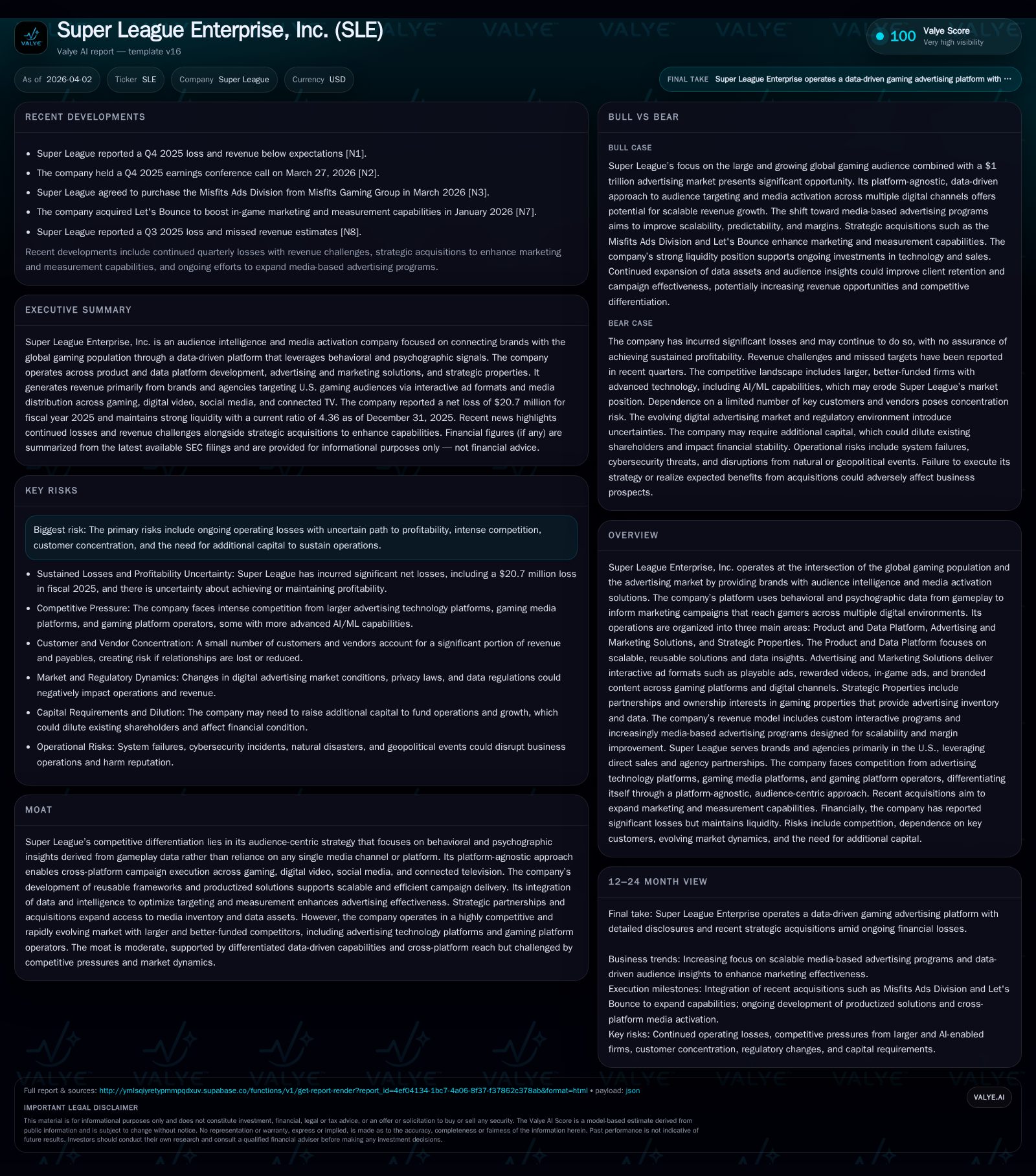
Super League Enterprise, Inc. operates at the junction of a vast global gaming audience and the expansive digital advertising market by offering advanced audience intelligence and interactive ad solutions. The company has recorded accelerating revenue growth since 2019 but continues to grapple with significant operating losses, which have shown improvement yet remain substantial. Its platform-agnostic use of behavioral and psychographic gameplay data powers multi-channel campaigns across gaming ecosystems and digital environments. Strategic acquisitions, notably the Misfits Ads division, aim to broaden media inventory and data assets to support scale. However, intense competition and capital requirements pose ongoing challenges that will test its path to sustainable profitability.
From Modest Beginnings: Historical Revenue and Operating Loss Trajectory
Super League Enterprise emerged in a niche crossroads — targeting one of the largest global audiences (3.3 billion gamers) while tapping into a colossal $1 trillion advertising ecosystem [S1]. Despite these impressive market foundations, its financial journey reflects substantial operating challenges.
The company’s revenue nearly doubled from $1.08 million in fiscal year (FY) 2019 to $2.06 million in FY 2020 [F1]. This rapid top-line acceleration coincided with persistently heavy operating losses that peaked dramatically at -$84.96 million in FY 2022 but then improved gradually to reach -$13.05 million by FY 2025 [F1]. This trajectory indicates operational leverage beginning to play out as revenues grow but also underscores the magnitude of investments required in technology development, partnerships, and market expansion.
Net income follows a similar pattern moving from heavy losses of -$85.45 million (FY 2022) narrowing to -$20.72 million (FY 2025), illustrating some gains on cost control alongside continued reinvestment [F1].
Historical performance (annual)
| FY | Net ($mm) | CFO ($mm) | OpInc ($mm) | Capex ($) | Net YoY |
|---|---|---|---|---|---|
| 2025 | -21 | -11 | -13 | 0 | -24.5% |
| 2024 | -17 | -11 | -17 | 23000 | +45.2% |
| 2023 | -30 | -15 | -33 | 8000 | +64.5% |
| 2022 | -85 | -20 | -85 | 149000 |
Source: SEC companyfacts cache [F1].
Capital returns and efficiency (annual)
| FY | FCF ($mm) | ROE% |
|---|---|---|
| 2025 | -11 | -118.2 |
| 2024 | -11 | -9785.3 |
| 2023 | -15 | -303.6 |
| 2022 | -20 | -445.0 |
Source: SEC companyfacts cache [F1].
Table summarizes Super League’s revenue acceleration alongside persistent but improving operating losses and cash flows.
Behavioral Data as Brewing Competitive Advantage: Platform and Product Drivers
At its core, Super League differentiates itself not merely by being present in gaming advertising but by how it captures audience intelligence through an intricate understanding of gamer behavior and psychology derived from gameplay data [S1]. Unlike many competitors tied rigidly to specific channels or platforms, Super League’s product strategy is platform-agnostic — enabling it to deploy campaigns integrating playable ads, rewarded video ads, immersive mini-games, interactive characters, branded content sponsorships, and more across gaming titles such as Roblox, Minecraft, Fortnite along with digital video, social media, and connected TV channels.
These capabilities hinge on proprietary reusable frameworks forming a data platform that seeks to unlock granular insights about gamer preferences and motivations — critical for psychographic audience targeting that transcends traditional demographic segmentation [S1][N1]. The interactivity of their ad formats — for instance rewarded videos where gamers opt-in for incentives or playable ads that offer hands-on brand engagement — aligns well with gamer behavior patterns fostering higher engagement rates compared to passive static ads.
This multifaceted approach enables multi-channel campaign execution that can flex dynamically between gaming ecosystems and broader digital environments — an increasingly important feature given advertisers’ push for seamless audience reach regardless of device or channel fragmentation.
Strategic Acquisitions Fueling Media Inventory and Audience Reach
Super League bolstered its strategic position with the March 2026 acquisition of the Misfits Ads division from Misfits Gaming Group [N6][S3]. This asset purchase agreement adds valuable advertising inventory sourced directly from an established esports organization and network.
This move not only amplifies the company’s access to proprietary game-related media inventories but also enriches its data assets underpinning audience intelligence efforts crucial for campaign optimization.
Operational synergies anticipated include enhanced scale for ad delivery leveraging Misfits' existing platforms combined with Super League’s data-driven activation technology — effectively broadening the addressable market while deepening engagement with esports-oriented audiences known for high-value advertiser appeal.
Confronting Market Headwinds: Competition and Capital Needs
Super League articulates significant risk factors explicitly acknowledging its history of substantial operating losses coupled with intense competition from larger well-funded entities including established advertising technology firms and gaming platform operators [S1][S2]. The company's reliance on a concentrated customer base intensifies vulnerability to client activity fluctuations.
Capital requirements remain prominent due to technology investments required for platform enhancements plus media inventory acquisitions like Misfits.[S1] Management notes an "uncertain path to profitability" coupled with dependency on maintaining an effective revenue model amid evolving industry dynamics.
These challenges underscore strategic importance of disciplined capital allocation balanced against aggressive scale-up initiatives while safeguarding brand reputation within a fast-moving digital marketing landscape.
Operational Metrics and Financial Health Snapshot
At fiscal year-end 2025, Super League held robust liquidity indicated by overall current assets of approximately $18.21 million against current liabilities near $4.18 million yielding a healthy current ratio around 4.36 [F1]. Cash & equivalents stood at about $14.39 million providing sufficient short-term runway.
However, despite this liquidity cushion operations continue consuming cash: operating cash flow was negative $10.67 million in FY2025 though representing a moderate improvement relative to prior years [F1]. Capital expenditures were minimal or zero ($0k in FY2025), reflecting conservative investment or shift toward software/IP capitalization rather than heavy hardware spend.
Working capital management appears conservative but must be balanced against growth aspirations that likely require ongoing deployment until breakeven scaling is achieved.
Looking Ahead: Growth Focus Areas and Milestones
While no formal forward-looking financial guidance has been published recently [N1], key indicators will come under scrutiny by observers monitoring Super League’s execution trajectory:
- New client acquisitions signaling expansion beyond existing base.
- Campaign scalability evaluation leveraging reusable productized solutions enabling efficient cross-platform executions.
- Integration effectiveness following the Misfits Ads division acquisition involving seamless combination of media inventories and data resources.[N6]
- Profitability milestones reflective of narrowing operating loss trends toward breakeven levels.
- Progress across emerging verticals such as connected TV branded gaming applications that diversify revenue streams.[S1]
Tracking these operational markers during earnings calls or corporate updates will be pivotal in assessing if Super League translates its compelling value proposition into commercial sustainability.
Capital Deployment Priorities Reflect Growth Focus Over Returns
Capital allocation choices at this stage prioritize reinvestment over distributions; no dividends or share repurchases have been reported indicating focus remains on growth capital deployment [F1].
Return on equity stands deeply negative at approximately -118%, driven by persistent net losses relative to shareholder equity of about $17.53 million at FY-end 2025 [F1].
Operating cash flow deficits (-$10.67M in FY2025), unmitigated by capex spending, suggest continuing working capital use supporting operations rather than asset-driven expansion—typical for a high-growth yet unprofitable tech enterprise aspiring for scale benefits before profitability [F1].
Successful transition toward positive cash flows coupled with ROE improvement depends critically on ramping revenue coverage over fixed costs plus generating sufficient incremental margin from enriched media inventory usage enabled through acquisitions.[S1][N6]
Disclaimer: This analysis is based solely on publicly available information up to April 2nd, 2026 inclusive of SEC filings and Nasdaq news reports cited herein; no forward-looking statements should be construed as investment advice or recommendations.
Disclaimer: This is research-only, informational analysis and not investment advice. It may include AI-generated interpretation and general industry context. Always verify important details using primary sources.

Comments