
Brainstorm Cell Therapeutics’ Path from Trial Losses to Regulatory Hurdles
This report examines Brainstorm Cell Therapeutics Inc.’s clinical development of NurOwn®, financial trends, litigation risks, and liquidity challenges shaping its growth outlook.
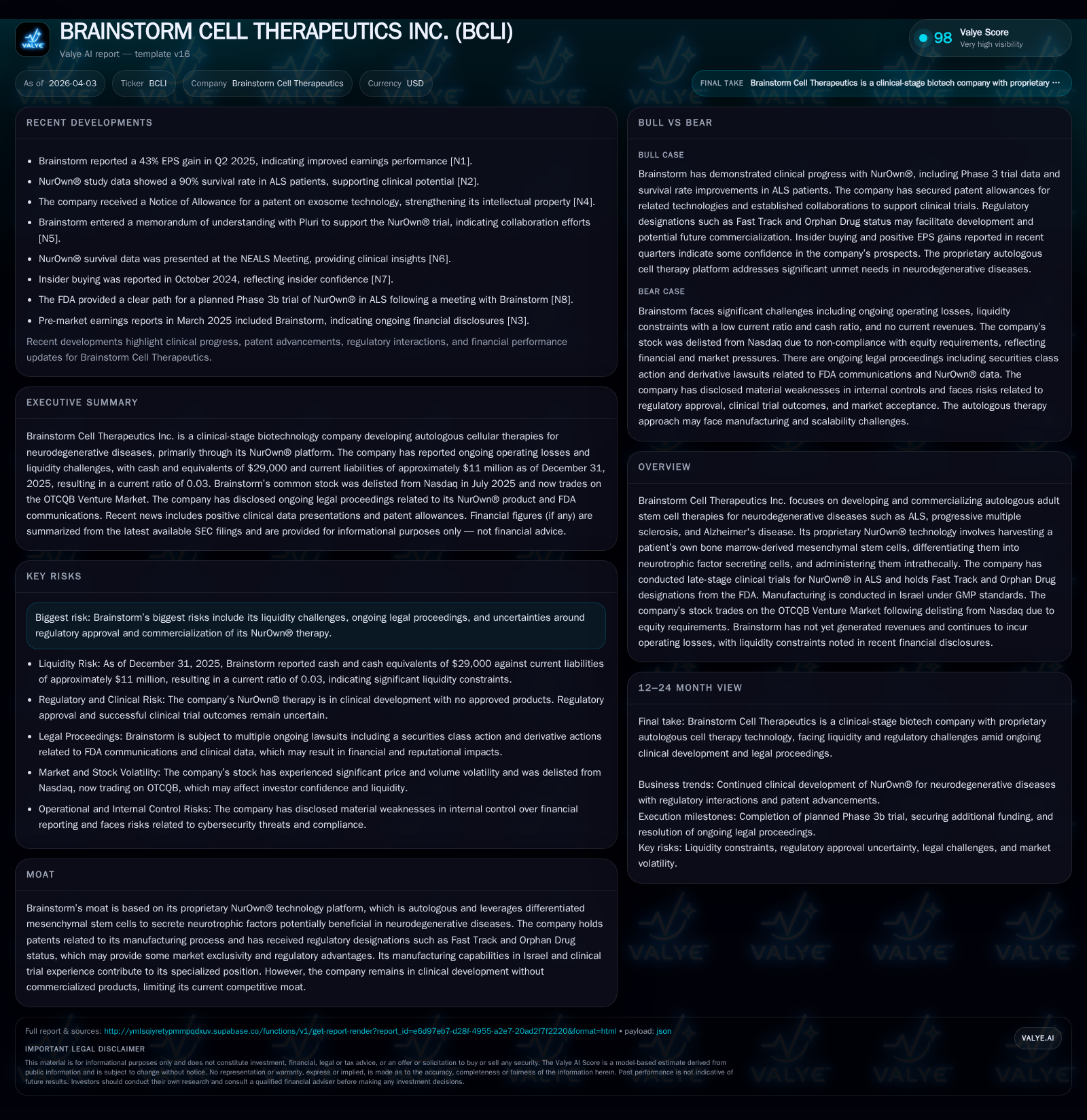
Brainstorm Cell Therapeutics focuses on developing NurOwn®, an autologous stem cell therapy targeting neurodegenerative diseases, particularly ALS. Despite regulatory designations like Fast Track and Orphan Drug status, the company faces significant hurdles from trial setbacks, ongoing securities litigation, and severe liquidity constraints. Operating losses narrowed somewhat by 2025 but remain high, while a critical gap between current liabilities and assets raises questions about funding sustainability. Continued clinical progress and resolution of legal matters are pivotal near-term milestones for Brainstorm’s prospects.
NurOwn® Technology and Industry Position
Brainstorm Cell Therapeutics Inc. focuses on NurOwn®, a proprietary autologous adult stem cell therapy platform designed for neurodegenerative diseases including amyotrophic lateral sclerosis (ALS), progressive multiple sclerosis (PMS), and Alzheimer's disease (AD). The treatment involves harvesting mesenchymal stem cells from patients' bone marrow, differentiating them ex vivo into neurotrophic factor secreting cells, and administering them via intrathecal injection to potentially bypass the blood–brain barrier challenges faced by systemic therapies.
The platform leverages these cells' secretion of growth factors aimed at slowing neuronal degeneration or promoting repair. Manufacturing processes are conducted under Good Manufacturing Practice (GMP) standards at Brainstorm's Israeli subsidiary facilities, providing technical specialization crucial for quality assurance in cell therapy.
Brainstorm has secured FDA Fast Track and Orphan Drug designations for NurOwn® in ALS treatment, intended to expedite development and confer market exclusivity incentives. However, approval remains pending due to ongoing debates regarding late-stage trial data interpretation and clinical endpoints.
This positioning places Brainstorm within a specialized segment pursuing innovative biologics for challenging neurodegenerative conditions with limited therapeutic alternatives.
Recent Financial Trends and Operating Performance
As a clinical-stage biotech without commercial products, Brainstorm continues to incur operating losses but has shown some improvement. Operating income losses decreased approximately 15% from negative $11.7 million in fiscal year 2024 to negative $10.0 million in fiscal year 2025 [F1]. Net income losses similarly narrowed from about $11.6 million negative in 2024 to over $10.3 million negative in 2025 [F1].
Operating cash flow remained deeply negative at nearly -$7.0 million in 2025 while capital expenditures were minimal, around $18 thousand in prior years [F1].
Liquidity remains a critical concern: as of December 31, 2025, current assets were approximately $307 thousand against current liabilities exceeding $11 million—a current ratio near 0.03—highlighting significant short-term funding pressures [F1].
Historical performance (annual)
| FY | Net ($mm) | CFO ($mm) | OpInc ($mm) | Capex ($) | Net YoY |
|---|---|---|---|---|---|
| 2025 | -10 | -7 | -10 | +11.3% | |
| 2024 | -12 | -9 | -12 | +32.4% | |
| 2023 | -17 | -20 | -21 | 18000 | +29.2% |
| 2022 | -24 | -19 | -25 | 29000 |
Source: SEC companyfacts cache [F1].
Capital returns and efficiency (annual)
| FY | FCF ($mm) | ROE% |
|---|---|---|
| 2025 | 103.2 | |
| 2024 | 149.7 | |
| 2023 | -20 | 353.9 |
| 2022 | -19 | 805.2 |
Source: SEC companyfacts cache [F1].
Operating income and net losses have improved but remain significantly negative; cash flows continue to reflect heavy consumption.
Clinical Development Progress and Regulatory Outlook
Brainstorm is engaged in late-stage clinical trials for NurOwn® targeting ALS under FDA oversight with Fast Track and Orphan Drug designations supporting accelerated review pathways.
Recent filings reveal contentious issues surrounding subgroup analyses within pivotal trials—specifically whether certain subpopulations were prespecified—and safety profile interpretations by regulators [S5][S6][S7]. These regulatory uncertainties have delayed potential approvals.
Discussions with the FDA include clarifications on statistical considerations such as "floor effects," which impact endpoint sensitivity and significance necessary for labeling decisions.
While continuing dialogue aims at resolving these regulatory concerns favorably for approval prospects, ongoing securities litigation related to these clinical disclosures adds complexity.
Ongoing Litigation and Legal Risks
Brainstorm faces multiple securities class-action lawsuits alleging fraud based on statements about NurOwn® trials and FDA communications between early 2020 and late 2023 [S5]. Certain claims tied to biomarker data or insider trading were dismissed; however, key allegations concerning statements about FDA views on trial design features remain active [S5].
Additionally, consolidated derivative lawsuits accuse officers and directors of fiduciary breaches related to internal control deficiencies affecting disclosure accuracy during this period [S6][S7]. These legal proceedings impose financial costs through defense expenses and distract management from operational priorities.
Liquidity Status and Capital Structure Dynamics
At year-end 2025, Brainstorm held roughly $29 thousand in cash against over $11 million in current liabilities—a highly strained liquidity position with a current ratio near 0.03 [F1].
Capital raising efforts include at-the-market (ATM) equity offerings authorized since mid-2021 with aggregate capacity up to $100 million; actual proceeds have been modest amid delisting from Nasdaq to OTCQB Venture Market trading [S4][S19].
In early 2026 the company issued convertible promissory notes aggregating over $200 million principal with original issue discounts and high interest charges (10–12%) reflecting distressed capital conditions [S20]. These notes include conversion rights at steep discounts subject to ownership limits.
Further complicating financing are contractual equity participation rights held by ACCBT Corp., controlled by CEO Chaim Lebovits. ACCBT can maintain its pro-rata ownership during new financings and appoints up to 30% of the Board [S14]. These rights limit external investor access without ACCBT involvement.
This complex capital structure combined with minimal liquid resources underscores refinancing risks absent near-term clinical or strategic breakthroughs.
Capital Allocation Decisions and Shareholder Returns
Consistent with biotech norms at this stage, Brainstorm has not declared dividends or conducted share repurchases recently or planned any given ongoing cash burn [F1][S4][S8].
The company recently expanded its stock option plans substantially—tripling available shares—to align employee incentives amid intensified R&D efforts without immediate shareholder cash returns [S8]. This reflects prioritization of talent retention over buybacks or dividends while awaiting regulatory clarity.
Forward-Looking Considerations and Key Milestones
While explicit guidance is limited due to unsettled regulatory pathways compounded by litigation, the company’s key near-term milestones include readouts from ongoing ALS trials expected later this year or early next alongside potential FDA advisory actions.
Resolution progress on securities litigations will influence investor confidence as well as financial outlays impacting operational runway.
Successful incremental financing—whether via equity offerings navigating ACCBT participation or alternative debt instruments—would ease liquidity constraints markedly.
Strategically, successful navigation through these challenges could enable transition toward commercialization within a competitive neurotherapeutics landscape; failure or delay may necessitate restructuring or partnerships.
Disclaimer: This report is based solely on publicly available filings as referenced ([F1], [S4], [S5], [S6], [S7], [S8], [S14], [S15], [S19], [S20]). It does not constitute investment advice.
Disclaimer: This is research-only, informational analysis and not investment advice. It may include AI-generated interpretation and general industry context. Always verify important details using primary sources.

Comments