
New Concept Energy’s Asset-Backed Model Faces Growth Limitations and Persistent Net Losses
The company’s strategic shift to leasing and advisory services secures steady revenue but struggles against rising operational costs and net losses.
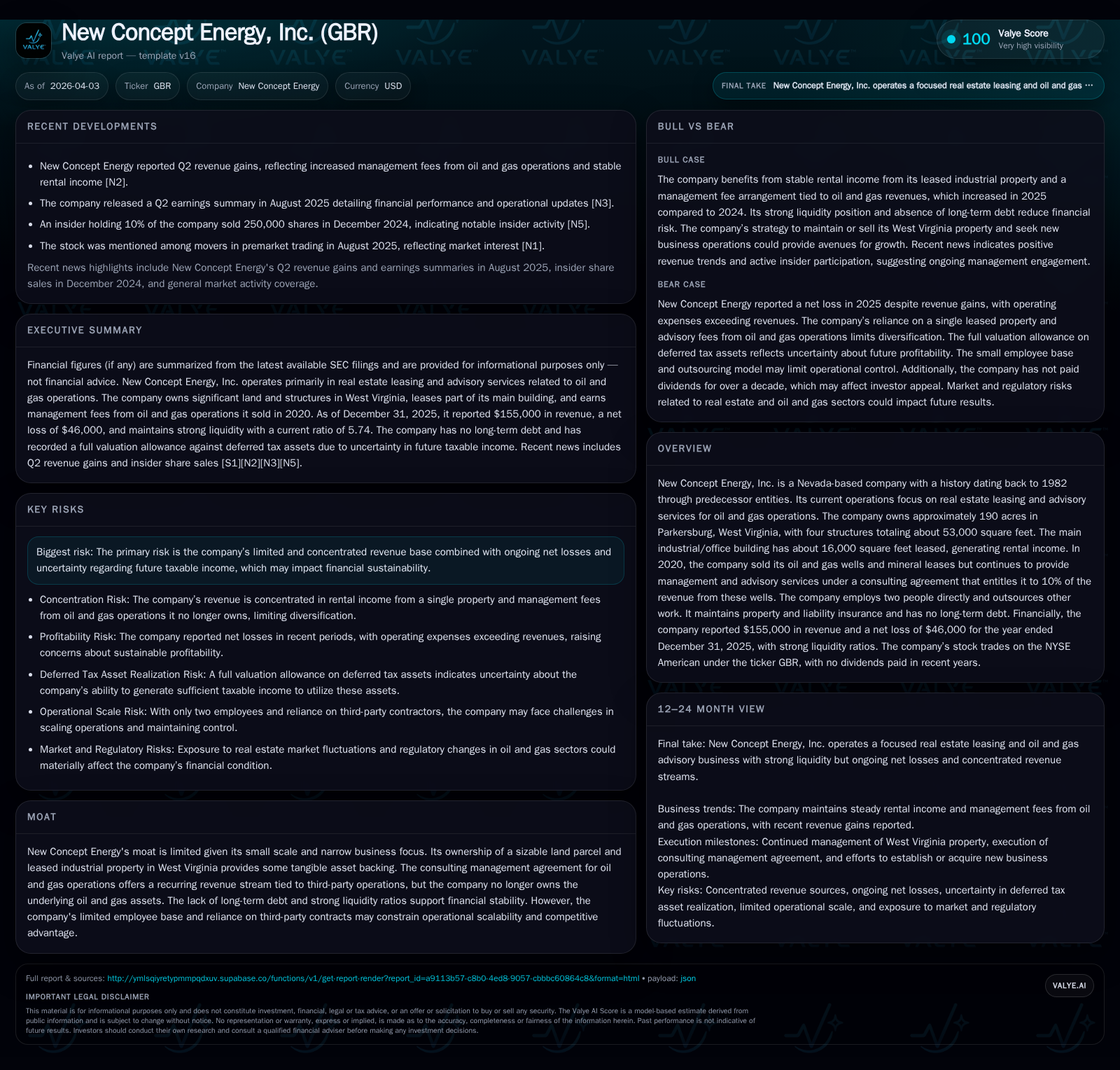
New Concept Energy, Inc. has transitioned from direct oil and gas ownership to a focus on real estate leasing and advisory services, leveraging its sizable West Virginia land assets and management agreement for modest recurring income. Despite stable revenue growth of 6.2% in 2025, operating losses widened due to increasing general administrative expenses, reflecting scalability constraints from its small operational footprint. With no long-term debt, robust liquidity, and a conservative capital structure, the company prioritizes financial stability over dividends or buybacks, yet its narrow business base and reliance on third parties cap growth potential.
From Oil & Gas Ownership to Advisory Services: A Historical Overview
New Concept Energy’s evolution reflects a strategic recalibration catalyzed in August 2020 when it divested its oil and gas wells and mineral leases located in Ohio and West Virginia [S1]. Transitioning away from direct asset ownership, the Company shifted its emphasis toward real estate leasing and advisory services. It retains about 190 acres in Parkersburg, West Virginia encompassing four structures totaling roughly 53,000 square feet. The core industrial/office facility houses approximately 24,800 square feet; as of late 2025 around 16,000 square feet was leased, generating annual rental revenue near $103,000 [S1][F1].
Complementing property leasing is a Consulting Management Agreement established January 1, 2022 with the current operator of the formerly owned oil and gas wells. Under this contract, New Concept receives a fee equating to 10% of gross revenues derived from these wells in exchange for advisory, accounting, and management services [S1][S8]. This arrangement maintains operational involvement without asset ownership but includes a termination clause mandating a 60-day notice period by either party [S1]. The company also actively explores options to either continue operating or sell its West Virginia property while seeking new business ventures [S1].
Revenue Trends: Assessing Stability and Erosion in Core Income Streams
Since the pivot to service-based income streams, New Concept Energy’s overall revenue profile has remained relatively stable but constrained in scale. Annual revenue totaled $155,000 in fiscal year (FY) 2025 representing a 6.2% increase over $146,000 recorded in FY2024 [F1]. This uptick reflects moderate growth primarily attributable to rising management fees linked to increased oil and gas sales under the consulting agreement alongside steady lease payments [S20].
Rental income contributed approximately $103,000 during FY2025 compared with prior periods as reported [S1][F1]. Meanwhile, interest income—a supplemental cash flow source mostly derived from notes receivable—declined due to prevailing lower interest rates with $169,000 earned in FY2025 versus prior comparable periods [S20]. Quarterly breakdowns illustrate rental revenues holding consistent around $26K per quarter while management fees showed incremental quarterly gains [S2]. Thus, while the core streams display resilience without dramatic volatility or erosion post-asset sale, their modest size restricts material expansion.
Analyzing Operational Expenses and Persistent Negative Operating Income
Operating profitability remains elusive for New Concept Energy as escalating expenses outpace its incremental revenue gains. For FY2025 total operating expenses stood at approximately $406,000—up from around $370,000 in FY2024—with general & administrative costs constituting the bulk at $364,000 [F1][S20]. Despite employing just two direct staff members as of December 31, 2025—the remaining functions are outsourced—these overheads highlight inherent fixed costs that challenge scalability within such a compact organizational framework [S1].
Depreciation expenses associated with property assets were reported at $14,000 during FY2025 compared with about $13,000 for FY2024 [S12]. This incremental increase aligns with steady asset base utilization rather than new capital investment. Corporate-level expenditures such as insurance procurement through affiliated entities also contribute to costs without clear offsetting revenue synergies [S15][S26]. The resulting operating loss widened from -$237,000 in FY2024 to -$265,000 in FY2025—a deterioration signaling persistent structural challenges suppressing earnings despite stable top-line performance [F1][S10].
Historical Financial Performance
Historical performance (annual)
| FY | Rev ($) | Net ($) | CFO ($) | OpInc ($) | Rev YoY | Net YoY |
|---|---|---|---|---|---|---|
| 2025 | 155000 | -46000 | 20000 | -265000 | +6.2% | -155.6% |
| 2024 | 146000 | -18000 | -64000 | -237000 | -3.9% | +14.3% |
| 2023 | 152000 | -21000 | 22000 | -243000 | -28.3% | -111.6% |
| 2022 | 212000 | 181000 | 184000 | -162000 |
Source: SEC companyfacts cache [F1].
Capital returns and efficiency (annual)
| FY | FCF ($) | ROE% |
|---|---|---|
| 2025 | -1.0 | |
| 2024 | -75000 | -0.4 |
| 2023 | 11000 | -0.5 |
| 2022 | 4.0 |
Source: SEC companyfacts cache [F1]. *Note: Positive net income in FY2022 preceded divestiture of oil & gas assets [F1].
Capital Structure and Liquidity Position
New Concept Energy maintains a conservative financial profile characterized by no significant long-term debt obligations. As of December 31, 2025 cash and cash equivalents totaled approximately $383,000 supported by current assets near $396,000 against current liabilities around $69,000 yielding a strong current ratio near 5.74 [F1][S21]. This liquidity buffer supports operational flexibility without reliance on external borrowings.
The company's equity stands at roughly $4.49 million as of year-end 2025 with minimal changes from prior years reflecting stable capital structure [F1]. Capital expenditures remain modest at approximately $11,000 annually based on recent disclosures [F1][S23], indicating restrained reinvestment primarily focused on maintenance rather than expansion.
The note receivable balance remains substantial at about $3.54 million bearing interest tied to Secured Overnight Financing Rate benchmarks but does not currently translate into full earnings stability given valuation allowances noted by management [S16][S21].
Dividend Policy and Capital Allocation Strategy
Consistent with the firm’s modest size and earnings profile is a longstanding policy eschewing dividend distributions. No cash dividends have been paid on common stock for more than ten fiscal years through FY2025 [S3][S4]. The Board’s stated rationale centers on retaining earnings internally for debt reduction where applicable or funding potential future developments rather than returning capital directly to shareholders.
Historically minor share repurchases have been executed only sporadically to minimize transactional costs but are not an active component of capital return strategy [S3]. Consequently investors should interpret capital allocation efforts as conservative with priority given to sustaining financial stability.
Key Risks: Concentrated Revenue Base & Scalability Constraints
A material risk facing New Concept Energy lies in its tightly concentrated revenue composition derived principally from leasing activities on legacy land holdings plus fees from one advisory contract linked to third-party-operated oil wells [S24][S1]. Such concentration limits diversification benefits typically protective against sectoral downturns or client attrition.
Furthermore operating leverage is constrained by fixed cost pressures despite minimal direct employee count—the reliance on outsourced service providers constrains agility and ability to scale operations efficiently as volumes fluctuate. Governance provisions encode anti-takeover measures including stringent voting thresholds (80%) impacting bylaws amendments which could impede strategic alternatives such as mergers or acquisitions potentially needed for transformative growth paths [S24].
Outlook: Monitoring Milestones for Growth or Strategic Shifts
Stakeholders should monitor key indicators including lease occupancy rates within West Virginia portfolio properties since sustained vacancies would pressure rental revenue streams. Equally important is renewal status or changes surrounding the consulting management agreement underpinning advisory fee income due to its terminable nature with short notice clauses.
Operational expense trends will also be telling — particularly whether cost controls can arrest recent upward trajectories supporting narrowing losses or eventually positive operating leverage.
Additionally salient would be any announcement signaling new acquisitions or diversification efforts which could broaden the operational footprint beyond legacy assets.
This analysis synthesizes available regulatory filings up to April 3rd, 2026 without conjecture beyond disclosed data points. Figures are drawn exclusively from validated SEC reports and company disclosures [F1],[S#], with no investment advice intended.
Disclaimer: This is research-only, informational analysis and not investment advice. It may include AI-generated interpretation and general industry context. Always verify important details using primary sources.

Comments