
Aptose Biosciences’ Clinical Progress and Hanmi Acquisition Hinge on Tuspetinib’s Frontline AML Data and Capital Constraints
Clinical-stage biotech Aptose focuses on precision oncology with its oral kinase inhibitor tuspetinib amid financial pressures and pending acquisition by Hanmi Pharmaceutical.
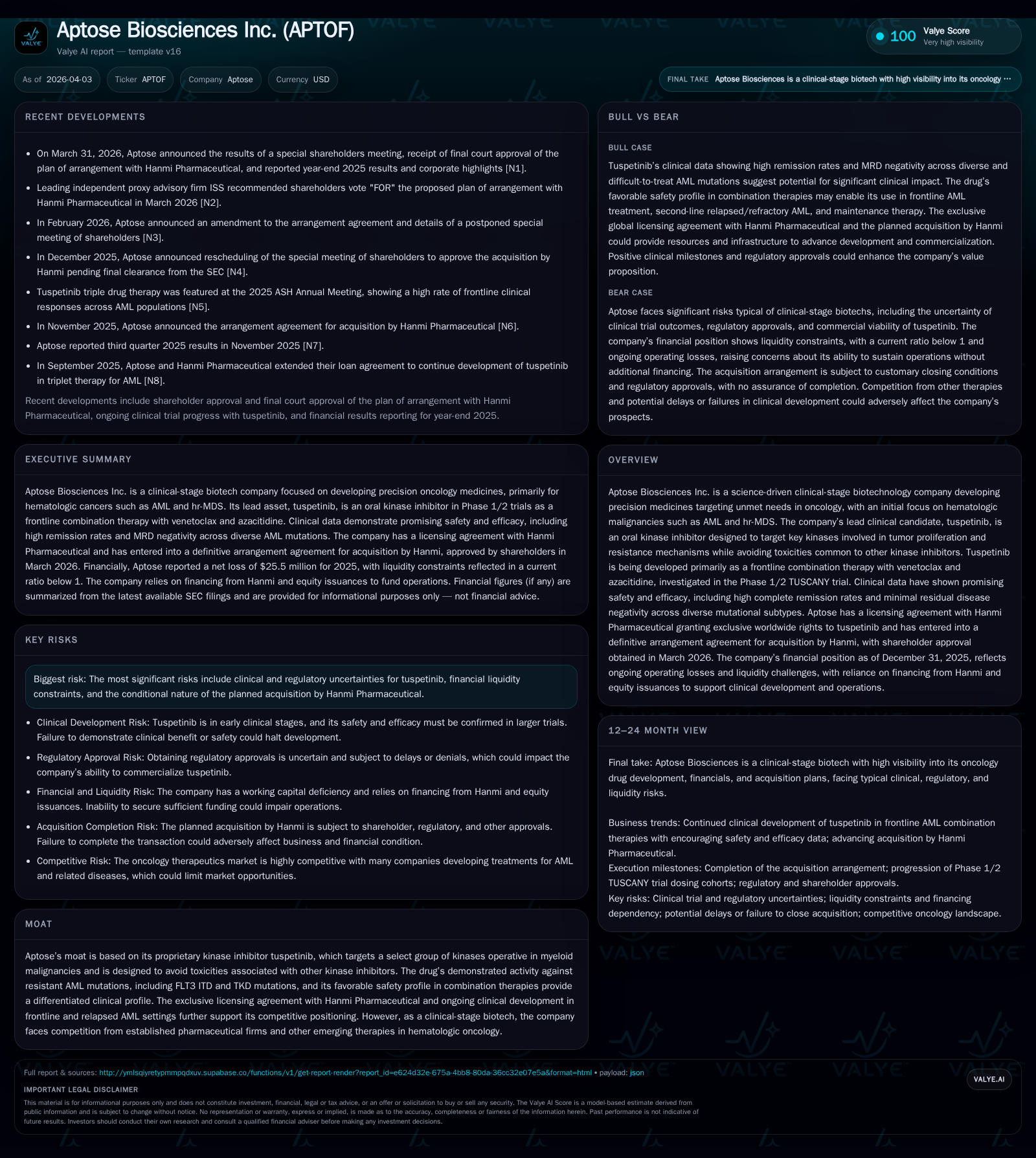
Aptose Biosciences is advancing its lead asset, tuspetinib, an oral kinase inhibitor targeting resistant hematologic malignancies such as AML and hr-MDS. Clinical results from the Phase 1/2 TUSCANY trial suggest meaningful remission rates and a safety profile that could differentiate tuspetinib in frontline combination therapies. However, the company faces ongoing liquidity challenges, with limited cash reserves and significant annual operating losses exceeding $25 million. A pending acquisition by Hanmi Pharmaceutical offers potential operational support but remains conditional on regulatory approvals. Investors should monitor clinical milestone readouts, regulatory progress for the Hanmi deal, and Aptose's capital access to sustain development activities.
Company Overview
Aptose Biosciences Inc., a clinical-stage biotechnology company headquartered in San Diego (executive offices) and Toronto (headquarters), concentrates on developing precision medicines addressing unmet oncology needs—primarily hematologic cancers such as acute myeloid leukemia (AML) and higher-risk myelodysplastic syndromes (hr-MDS) [S1]. Its lead candidate, tuspetinib, is an orally administered kinase inhibitor designed to target critical proliferation and resistance pathways involved in myeloid malignancies while minimizing toxicities that commonly burden other kinase inhibitors.
Historical Performance: Financials Reflect Heavy Development Costs
The company's financial track record through 2025 reveals sustained net losses driven primarily by research and development expenditures supporting its early-stage pipeline. Net losses were approximately $25.5 million in both FY2024 and FY2025—a relatively flat trajectory indicating stabilized but ongoing burn rates in the absence of revenue generation (see Table below) [F1]. Operating cash flow improved from a negative $35.98 million in 2024 to roughly negative $21.99 million in 2025 but remains substantially negative reflecting continued investment without product commercialization.
Historical performance (annual)
| FY | Net ($mm) | CFO ($mm) | Capex ($) | Net YoY |
|---|---|---|---|---|
| 2025 | -25 | -22 | 0 | -0.1% |
| 2024 | -25 | -36 | 5000 | -112.7% |
| 2023 | -12 | -45 | 29000 | -19.6% |
| 2022 | -10 | -32 | 24000 |
Source: SEC companyfacts cache [F1].
Capital returns and efficiency (annual)
| FY | FCF ($mm) | ROE% |
|---|---|---|
| 2025 | -22 | 93.7 |
| 2024 | -36 | 559.8 |
| 2023 | -45 | 412.1 |
| 2022 | -32 | -26.5 |
Source: SEC companyfacts cache [F1].
Negative working capital (-$2.86 million at end-2025) highlights ongoing liquidity challenges amid ballooning current liabilities relative to current assets [F1]. The sharp decline in cash reserves over the same period underscores mounting funding pressures.
Tuspetinib: Differentiated Clinical Profile Drives Future Growth
Tuspetinib's promise lies in its targeted mechanism addressing kinases pivotal to tumor proliferation pathways in AML patients resistant to existing therapies due to mutations like FLT3 ITD/TKD—critical drivers of poor prognosis . The Phase 1/2 TUSCANY trial investigates combinations of tuspetinib with venetoclax plus azacitidine for frontline treatment.
Published data presented by investigator Dr. Daver highlight encouraging complete remission rates coupled with minimal residual disease negativity across genetically heterogeneous patient pools, including subsets refractory to prior venetoclax regimens [N28]. Safety profiles demonstrate reduced off-target toxicities relative to non-selective kinase inhibitors—a potential differentiator that could translate into broader clinical adoption.
Despite these promising signals, Tuspetinib remains investigational with regulatory clearance pending. Pertinent risks include standard biopharma clinical development hurdles: enrollment rates, evolving trial endpoints, demonstration of statistically significant efficacy/safety versus standard-of-care comparators, and potential post-marketing commitments [S12], [S18], .
Capital Allocation & Liquidity Constraints
Aptose operates under significant financial constraints restricting agility in scaling development activities or pursuing additional pipeline projects absent successful capital raises or strategic partnerships [S5], [F1]. The company had zero capital expenditures recorded for FY2025—likely reflecting prioritization of clinical spend amid tight budgetary conditions.
Loan facilities extended by Hanmi Pharmaceutical play a critical role in bridging liquidity gaps; however, these advances under the Second Amended Facility Agreement remain uncommitted and can be canceled unilaterally by Hanmi without notice [S14]. This fragility creates operational risk if access is curtailed suddenly.
With reported shareholders' deficit expanding sharply due to accumulated losses and liabilities exceeding assets at $27 million deficit year-end 2025 ([F1]), Aptose’s balance sheet signals untenable independence absent external capital inflows.
Pending Acquisition by Hanmi Pharmaceutical: Conditional Strategic Inflection Point
In November 2025, Aptose entered into a definitive arrangement agreement whereby Hanmi Pharmaceutical will acquire all outstanding common shares not already owned through a plan of arrangement valued at C$2.41 per share for cash consideration [S1]. This deal aims to provide greater financial support and operational scale necessary for bringing tuspetinib to market.
Several conditions must be satisfied including shareholder approval, regulatory consents, absence of legal impediments, and final court approval—all introducing timing uncertainty and deal execution risk [S1], [N1]. Post-announcement endorsements from proxy advisory firms ISS and Glass Lewis have supported the transaction thereby reducing some governance risk hurdles [N2], [N3].
Failure or delay in closing could trigger deleterious impacts on Aptose’s share price valuation and restrict management flexibility due to interim covenants limiting business alterations outside ordinary course transactions [S23]. Potential lawsuits or claims surrounding the transaction further add complexity.
Industry Context & Competitive Positioning
AML remains a fiercely competitive therapeutic area marked by rapid innovation cycles from biotech startups alongside major pharmaceutical incumbents deploying multi-mechanistic agents targeting mutational subsets like FLT3 or IDH1/2 mutations. Aptose's ability to carve out market share hinges on demonstrating superior efficacy/safety profiles especially after prior failure of other targeted agents.
Tuspetinib's mechanism may address resistant patient populations inadequately treated today—potentially filling severe unmet medical needs while avoiding toxicities common with broad-spectrum kinase inhibitors []. However, market acceptance will depend heavily on demonstration of durable remissions translating into survival benefits alongside payer coverage decisions subjected to pressure from government healthcare agencies impacting pricing strategies especially in North America [[S17]].
Key Risks Summary
- Clinical & Regulatory Uncertainty: Success depends on late-stage clinical trial results which are inherently unpredictable; delays or data setbacks could materially impair value creation.
- Liquidity & Capital Access: Negative working capital position coupled with negligible free cash flow generates going concern doubts; dependency on Hanmi’s funding exposes Aptose to unilateral withdrawal risk.
- Deal Execution Risk: Completion of Hanmi’s acquisition contingent upon multiple approvals; failure would leave Aptose exposed financially and operationally.
- Intellectual Property: Patent strength around tuspetinib is crucial given biotech patent complexities; infringement disputes or licensed tech loss could derail product development.[S13], [S25]
- Competition & Market Dynamics: Evolving therapeutic landscape imposes continuous competitive pressure necessitating effective differentiation.
What To Watch Forward (Analysis)
Absent explicit financial guidance post-transaction announcement, monitoring several milestones is critical:
- Completion status of Hanmi acquisition deal including final regulatory/governance clearances.
- Clinical data updates from TUSCANY trial assessing response durability across mutational spectrums.
- Licensing developments or strategic collaborations broadening portfolio reach.
- Financing initiatives supplementing current cash burn requirements should deal falter or be delayed.
- Regulatory interactions shaping pathways for U.S./Canada/EU submissions.
Given fluctuating funding dynamics typical at this stage for biotech firms without marketed products, sustaining adequate runway remains paramount before potential commercialization inflection points arrive.
Conclusion
Aptose Biosciences stands at a crossroads defined by advancing a clinically promising but still investigational oncology therapy alongside critical funding constraints characteristic of small biotechs moving through registration stages. The company’s lead asset – tuspetinib – exhibits compelling early clinical evidence supporting differentiation within difficult-to-treat AML populations when deployed as combination regimens.
Nonetheless, material execution risks remain tied to both biological outcomes and the successful navigation of financing complexities exemplified by the conditional arrangement with Hanmi Pharmaceutical—whose consummation carries consequential impact on Aptose's operational viability going forward.
Investors tracking Aptose should prioritize near-term clinical data readouts aligned with regulatory milestones while weighing inherent uncertainties related to capital structure deleveraging options awaiting transactional closure or alternative financing arrangements ensuring continuity through pivotal development phases.
This analysis leverages publicly available SEC filings ([F1],[S#]) and recent news releases ([N#]). It does not provide investment advice but aims to inform on corporate developments and sector context based on verifiable data.
Disclaimer: This is research-only, informational analysis and not investment advice. It may include AI-generated interpretation and general industry context. Always verify important details using primary sources.

Comments