
SKINVISIBLE, INC.’s Licensing Model Confronts Financial Strains and Development Milestones
Skinvisible advances its patented Invisicare® polymer delivery system amid modest revenues and capital challenges.
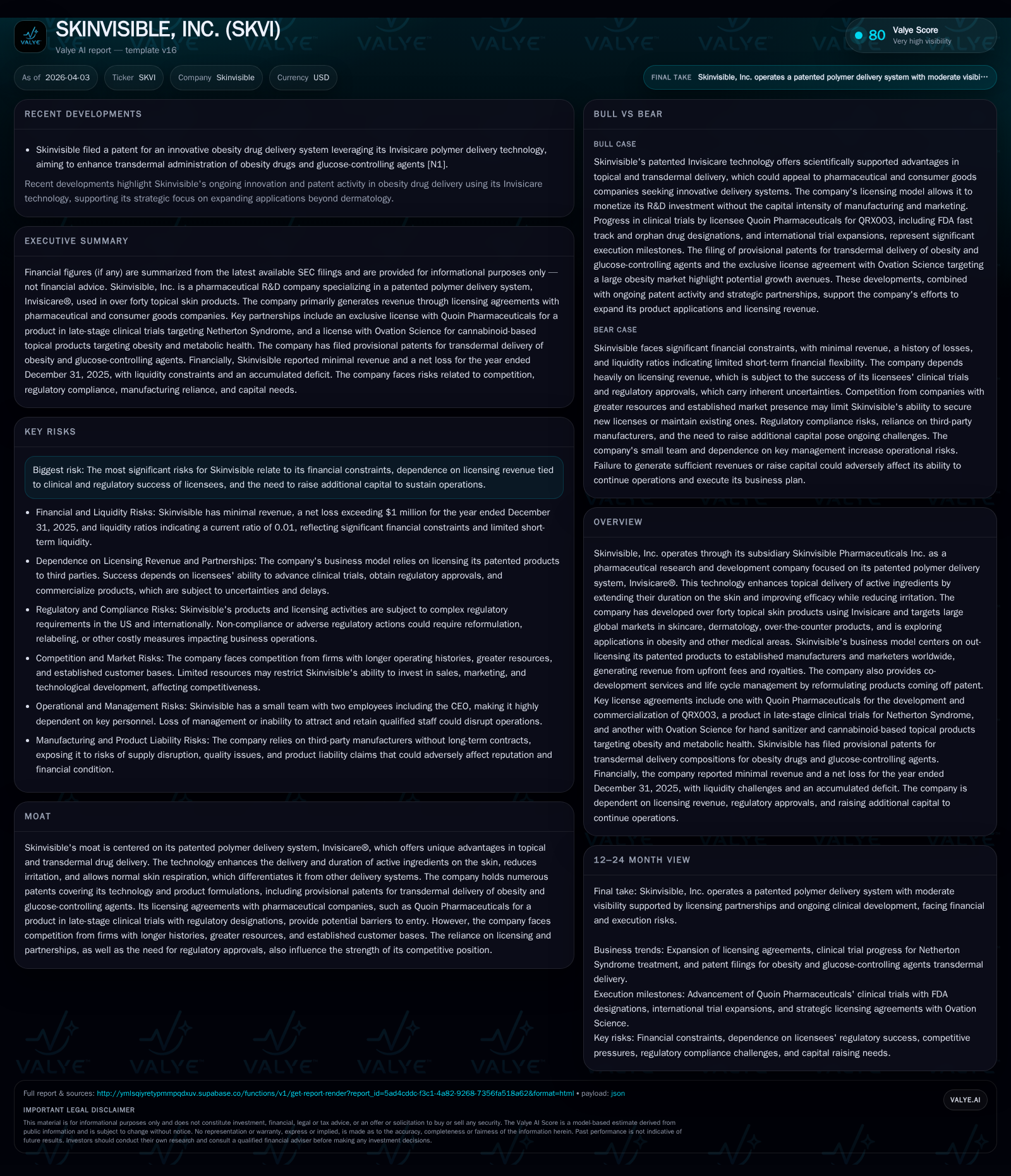
Skinvisible, Inc. operates via a patented polymer technology aimed at enhancing topical drug delivery, licensing its formulations globally to pharmaceutical and consumer companies. Despite completing R&D on over forty products and securing multiple patents, the company has yet to generate significant revenues, posting consistent losses and a substantial accumulated deficit. Future growth hinges on clinical progress by licensees such as Quoin Pharmaceuticals along with successful capital raises to sustain operations. The firm faces risks from its limited resources, dependency on license-generated income, regulatory complexities, and competitive dynamics in the skincare and pharmaceutical arenas.
Company Overview and Core Technology
Founded in 1998, Skinvisible, Inc., through its subsidiary Skinvisible Pharmaceuticals Inc., has developed an innovative polymer delivery system called Invisicare®. This proprietary technology facilitates enhanced topical delivery of active ingredients by forming a protective bond on the skin's surface that persists for hours. Unlike many current solutions relying on organic solvents such as alcohol or silicones, Invisicare® carriers water-insoluble or cationic actives in water-based formulas without these solvents. Its non-occlusive nature allows normal skin respiration while maintaining moisture. This unique formulation extends the duration of actives' effectiveness, improves efficacy, lessens irritation potential, and reduces dosage requirements.
To date, Skinvisible has formulated over forty unique skin products harnessing Invisicare® technology covering prescription dermatology and over-the-counter applications. Its research portfolio further includes disclosed provisional patents addressing transdermal delivery for obesity management agents (CB-1 receptor antagonists) and glucose-controlling compounds relevant for diabetes therapy [S15][S26].
Historical Financial Performance
The company’s revenue profile remains minimal considering its long operational history—annual top-line figures have been flat at approximately $20,000 from 2023 through 2025 after a prior higher figure of approximately $279k in 2022. Operating losses have persisted with net income recorded at -$1.06 million in FY2025 compared to -$566k in FY2024 but showing some improvement from larger losses in FY2023 [F1]. This results in a cumulative deficit exceeding $41 million.
Cash flows from operations are negative; FY2025 saw an operating cash outflow of about $38k after prior years similarly reflecting operating inefficiencies. Liquidity is notably strained as the company reports current liabilities ($5 million) drastically exceeding current assets ($27k), producing a critically low current ratio near 0.01 [F1]. This mismatch underscores significant short-term solvency concerns requiring urgent capital infusion.
Historical performance (annual)
| FY | Rev ($) | Net ($mm) | CFO ($) | OpInc ($) | Rev YoY | Net YoY |
|---|---|---|---|---|---|---|
| 2025 | 20000 | -1 | -38410 | -496315 | 0.0% | -88.1% |
| 2024 | 20000 | -1 | -69834 | -589589 | 0.0% | +76.3% |
| 2023 | 20000 | -2 | -77157 | -490375 | -92.8% | -94.5% |
| 2022 | 279296 | -1 | 45170 | -238432 |
Source: SEC companyfacts cache [F1].
Capital returns and efficiency (annual)
| FY | ROE% |
|---|---|
| 2025 | 10.4 |
| 2024 | 6.1 |
| 2023 | 26.4 |
| 2022 | 18.4 |
Source: SEC companyfacts cache [F1].
(Figures in USD)
Business Model and Revenue Streams
Skinvisible’s strategy centers on monetizing its R&D investment primarily through licensing its patented products featuring Invisicare® to pharmaceutical manufacturers globally. Licensing arrangements generate upfront fees alongside ongoing royalties based on net sales. The firm also offers co-development services assisting clients in optimizing formulations prior to clinical trials and provides life-cycle management by reformulating drugs approaching patent expiration — thus supporting clients’ revenue retention strategies [S14][S16][S25].
Notably, Skinvisible entered an exclusive license agreement with Quoin Pharmaceuticals granting rights to certain patents underpinning developmental products such as QRX003, which has reached late-stage clinical trials under FDA regulatory oversight with special designations for rare skin disorders like Netherton Syndrome. Quoin paid a $1 million upfront fee with promised milestone payments totaling $5 million contingent upon FDA/EMA approvals plus royalty streams thereafter from product sales or sublicensing income shared with Skinvisible [S14][S26].
Additionally, Skinvisible’s ongoing innovation includes patent filings for transdermal obesity therapies utilizing cannabinoids (THC-V) targeting multi-billion-dollar markets — highlighting strategic moves beyond dermatological niches into systemic disease management via topical routes [S15][S26].
Growth Prospects and Challenges
While Invisicare® showcases compelling scientific attributes facilitating longer-lasting topical effects with reduced irritation potential, financial returns remain nascent. Revenue growth critically depends on:
- Successful clinical progression and regulatory approvals of licensed products like Quoin’s QRX003.
- Expansion of licensing deals across pharmaceutical companies increasingly reliant on external R&D.
- Commercialization execution by partners converting formulations into branded products.
- Exploiting provisional patents toward first-in-class transdermal obesity/glucose control therapies offering differentiated modalities.
Conversely, growth could be constrained by significant capital needs impacting operational scalability; regulatory complexities regarding product categorization between cosmetics versus drugs affecting marketing pathways; competition from more established pharma firms; manufacturing dependencies handled through third parties without binding contracts; and uncertain market acceptance compounded by limited brand recognition given the company's small size and early commercial status [S1][S4][S7][S9][S13].
Capital Structure and Allocation
Skinvisible does not pay dividends or conduct share buybacks; scarce capital is directed toward sustaining development efforts. Return metrics are currently negative due to ongoing losses; reported equity is deeply negative reflecting accumulated deficits [F1]. Operating cash flow remains negative indicating ongoing funding needs.
The company explicitly states reliance on future equity or debt raises to continue operations over the next twelve months with no assurance of success — highlighting material going concern risks flagged by auditors [S1][S13]. Given current balance sheet pressures plus limited cash reserves reported two years prior (~$66k), shareholder dilution via future offerings appears likely absent profitable commercialization milestones.
Regulatory Environment and Legal Risks
Products marketed straddle cosmetic versus therapeutic classifications subject to FDA oversight under different statutes including FDCA and FTC regulations governing labeling claims and ingredient safety. Misclassification could lead to enforcement actions ranging from warning letters through injunctions or product seizures materially impacting revenues [S4][S5].
Global distribution introduces jurisdictional challenges requiring compliance with diverse regulations potentially restricting market entry or demanding costly registrations. Product liability exposure inherent in skincare/pharmaceutical sectors adds risk especially if adverse reactions occur despite rigorous testing protocols [S6][S8]. Intellectual property enforcement is critical given potential patent infringement suits affecting freedom-to-operate [S24].[F1]
Competition and Operational Dependencies
While Invisicare®’s technology addresses specific gaps in topical delivery performance with claimed prolonged action times up to four hours or more without occlusion or irritation typical of existing systems, rivals include companies with deeper resources investing heavily into novel polymer chemistries or transdermal platforms possessing stronger market footholds.
Skinvisible outsources manufacturing entirely to third-party contractors who operate on purchase order terms without binding agreements—adding risk of supply chain disruptions impacting product availability or quality control concerns impacting brand trustworthiness [S7]. Customer acquisition remains dependent on establishing effective sales channels through partners rather than direct consumer penetration given very limited staff (two employees including CEO) constraining internal capabilities [S10][S27].
Outlook Considerations
- Clinical trial updates—especially Phase III enrollment progress for Quoin’s product targeting rare dermatological disorders—will be pivotal milestones driving milestone payments.
- Expanding licensing agreements beyond existing deals could improve revenue visibility.
- Successful capital raises will be critical amid persistent cash burn.
- Regulatory clarifications around approval pathways for transdermal obesity/glucose controlling agents may unlock new markets.
- Resolution of any identified material weaknesses in financial controls would enhance investor confidence.
- Competitive developments or patent litigation outcomes could materially affect industry positioning.
Conclusion
Skinvisible is an early-stage R&D-oriented company leveraging proprietary delivery technology promising improved topical treatment performance across multiple therapeutic areas including dermatology and metabolic diseases. Despite decades-long development culminating in a broad patent portfolio and initial licensing deals delivering nominal revenues thus far, it faces substantial financial challenges reflected by recurring net losses, limited liquidity, operational constraints, regulatory hurdles, and intense competition.
Long-term value creation depends heavily on licensed partners’ success advancing products through clinical pipelines toward commercial launches coupled with Skinvisible’s ability to secure needed capital injections enabling organizational expansion amid this demanding environment.
This analysis aims solely to provide an informed overview based on public filings and does not constitute investment advice.
Disclaimer: This is research-only, informational analysis and not investment advice. It may include AI-generated interpretation and general industry context. Always verify important details using primary sources.

Comments