
American Clean Resources Group Faces Capital and Execution Challenges Before Toll Milling Operations Begin
Exploration-stage company ACRG aims to establish a permitted custom processing toll milling facility but wrestles with financial strain and regulatory hurdles.
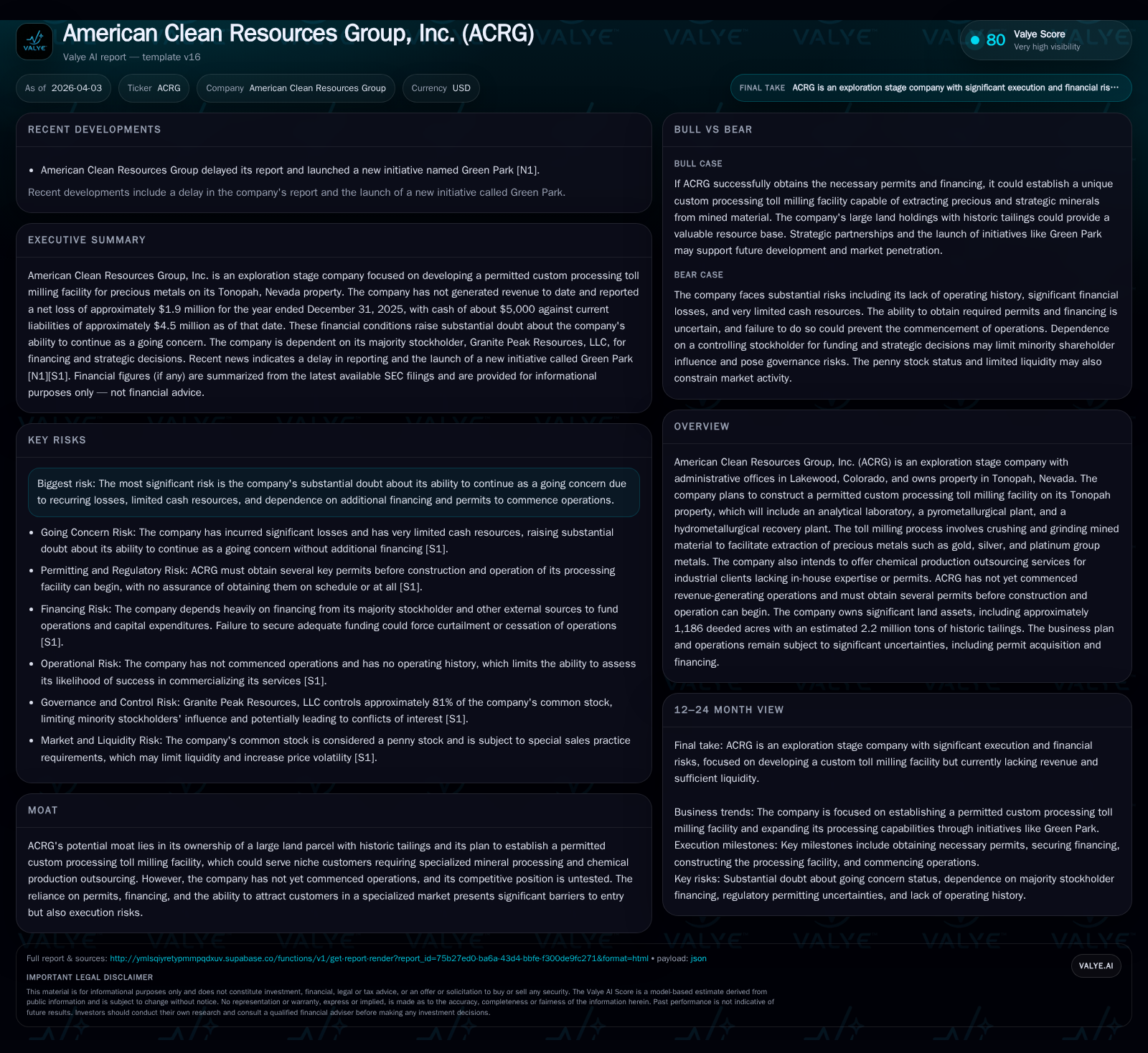
American Clean Resources Group, Inc. (ACRG) operates as an exploration-stage enterprise focused on constructing a toll milling facility in Tonopah, Nevada, to process precious metals. Despite substantial land holdings and a plan targeting niche processing services, the company has yet to generate any revenue and faces significant risks related to financing, permitting, and execution. Its financials reveal persistent losses and a precarious liquidity position dependent largely on its majority stockholder's support. Future growth hinges critically on successfully navigating permit acquisition, securing capital, and attracting clients in a specialized market.
Company Overview
American Clean Resources Group, Inc. (ACRG) is positioned at the early stage of developing a custom processing toll milling operation in Tonopah, Nevada, encompassing roughly 1,186 acres of deeded land. The company’s administrative headquarters are located in Lakewood, Colorado. Its core strategy targets building a mineral processing facility equipped with an analytical laboratory, pyrometallurgical plant, and hydrometallurgical recovery plant intended for extracting precious metals — gold, silver, platinum group metals — from mined ore.
The unique aspect of ACRG's property is the presence of large historic tailings deposits such as the Millers Tailings (about 2.2 million tons), sourced from earlier gold rush activity. These tailings represent both an opportunity and challenge for processing due to their pre-existing material concentration.
Historical Performance
ACRG has not reported any revenues since inception. The business remains in an exploration stage without commercial toll milling operations commenced or revenues recognized [F1][S1]. Its operating losses have worsened over recent years:
Historical performance (annual)
| FY | Net ($mm) | CFO ($) | OpInc ($mm) | Net YoY |
|---|---|---|---|---|
| 2025 | -2 | -1150681 | -1 | +67.6% |
| 2024 | -6 | -112786 | -6 | -360.0% |
| 2023 | -1 | 35003 | -1 | -22.5% |
| 2022 | -1 | -1112 | 0 |
Source: SEC companyfacts cache [F1].
Capital returns and efficiency (annual)
| FY | ROE% |
|---|---|
| 2025 | 18.3 |
| 2024 | 57.3 |
| 2023 | 30.4 |
| 2022 | 5.7 |
Source: SEC companyfacts cache [F1].
Notably, while net losses appear to have improved from the deep loss in 2024 to 2025 (net loss decreased by ~67%), operational cash flows remain negative and capex spending halted after peaking years ago — indicative of stalled project implementation [F1].
Capital Structure and Liquidity
A critical constraint facing ACRG is its fragile liquidity situation. At fiscal year-end 2025 the company had only $5,000 in cash against current liabilities approximating $4.46 million resulting in a current ratio near 0.01 [F1]. This extremely tight liquidity raises serious going concern questions that management freely acknowledges [S1][S6][S10][S12].
Historically reliant on financing from its majority stockholder Granite Peak Resources LLC (GPR), which owns roughly 81% of ACRG’s common stock and exercises substantial governance control [S1][S9][S19], the company has converted significant debt under lines of credit held by GPR into equity throughout recent years [S4][S5][S9]. While this reduces debt burden nominally on paper, it dilutes shareholder value and perpetuates dependence on GPR for cash injections required to fund ongoing development [S6][S10].
Business Model and Industry Context
Toll milling involves crushing and grinding ore delivered by other mining companies so they can maximize precious metal extraction downstream; this service requires specialized infrastructure and regulatory approvals given environmental sensitivities including emissions controls and waste handling [S11][S18][S19].
ACRG plans to offer not only precious metal extraction but also chemical production outsourcing services for industrial customers lacking internal capacity or permits [S16]. This diversification could provide some resilience if executed effectively.
However, barriers to entry include complex permitting regimes tied to environmental compliance as well as capital costs associated with facility construction — factors that impose lengthy timelines before revenue generation can commence [S15][S18]. The company must continuously navigate these hurdles while managing costs.
Risks and Uncertainties
Risk factors dominate ACRG's narrative:
- Going concern: Substantial doubt expressed by auditors regarding sustainability due to insufficient funds and ongoing losses [S1][S6].
- Funding dependency: Reliance on majority stockholder GPR for capital undermines financial independence; failure to raise additional funds would jeopardize operations [S10][S19].
- Permitting risk: Necessary permits needed before construction remain unapproved; delays could materially affect timeline and costs [S16][S18].
- Operational execution: Management's limited experience in custom toll milling heightens execution uncertainty in establishing competitive presence [S15][S20].
- Commodity price volatility: Profitability highly sensitive to fluctuating precious metals market prices impacting client demand for toll milling services [S19].
- Environmental liabilities: Potential liabilities relating to historical contamination under CERCLA regime add another layer of regulatory risk with costly remediation possible [S11].
- Governance concentration: With GPR controlling ~81% stock voting power there is limited minority influence on corporate decisions which could lead to misaligned interests [S1][S17][S21].
Future Growth Prospects
Growth hinges primarily on:
- Successfully obtaining key permits enabling construction commencement at Tonopah property.
- Raising substantial capital beyond limited existing cash resources (~$5K as of end Q1 2025) necessary for building facilities including labs and plants.
- Establishing relationships with mining operators or others supplying mineral feedstock for processing contracts.
- Efficiently executing pilot testing phases mentioned in recent announcements prior to scaled commercial rollout [N1][S22].
- Potentially deploying chemical outsourcing services leveraging market gaps among industrial clients without internal capabilities.
Given operational startup has yet to begin amidst persistent working capital deficits and delayed projects historically stretching back several years without revenue realization [F1], growth relies on multiple interdependent milestones being achieved methodically.
Forecasts / Milestones / Expectations
No explicit quantitative guidance exists as ACRG remains pre-revenue and subject to significant uncertainties around permitting timelines and financing outcomes [N1][S22]. Key milestones likely include:
- Obtaining all required environmental and operational permits.
- Completing construction of initial milling facility components.
- Securing initial tolling contracts or customer agreements.
- Commencing first batches of ore processing refining precious metals recovery outputs. These events will be pivotal measures signaling advancement towards commercial viability but currently remain prospective.
Returns and Capital Allocation
Given zero revenues generated historically coupled with substantial net losses [F1], traditional return metrics such as profitability ratios or ROE carry limited immediate relevance beyond highlighting distress— notably approximate ROE calculated from recent data superficially shows positive ratio owing mainly to negative equity balances caused by accumulated deficits rather than profitable earnings generation [F1].
Free cash flow remains deeply negative reflective of persistent operating cash burn without offsetting investing inflows post prior periods of capital expenditure spend aimed at asset base expansion that has since decelerated sharply:
- FY2025 CFO: -$1.15 million vs Capex: $0 indicates no active major asset investments but continued operational cash drain [F1]
Dividend policy states no planned payments foreseeable given reinvestment needs and financial constraints; no buybacks either amid liquidity strain noted across recent disclosures [S7][S11]. Financial discipline appears focused on survival through financing rounds rather than capital returns.
Strategic Considerations & Sector Nuances (Analysis)
The toll milling sector requires specialized expertise not only in mineral processing technology but also delicate stakeholder relations managing ore suppliers’ expectations about recovery grades—a nuanced facet evident across similar legacy mill facilities repurposed elsewhere where conflicts over grade reconciliation sometimes stall throughput volumes. Additionally environmental compliance imposes long lead times on ramping capacity usage patterns since tailings reprocessing carries distinct risks versus primary mining operations common in other precious metal enterprises—requiring careful layering of processing technology known within metallurgy circles but seldom deployed commercially at scale without proven workflows. ACRG’s niche targeting included strategic pivot into chemical production outsourcing aligns with industry trends toward integrated value chains but demands dual competencies rarely combined successfully at new entrants’ scale—underscoring complexity underlying turn-key project delivery timeline forecasts.
Conclusion
American Clean Resources Group presents an intriguing albeit highly speculative prospect centered around reviving historic mineral assets through a novel custom toll milling facility. While ownership of sizable land with known tailings offers foundational value propositions for mineral reclamation services targeting precious metals extraction complemented by chemical service offerings, the absence of revenue generation combined with pressing liquidity deficits underscore profound execution challenges ahead. Ultimate success rests heavily on securing requisite permits quickly, tapping sufficient investor or related-party capital efficiently, and rapidly proving concept viability via pilot programs preceding sustainable operations initiation. Investors must weigh these multiple contingent factors alongside concentrated ownership dynamics limiting external governance checks when considering the company’s trajectory.
This report summarizes publicly available data as of April 2026 and does not constitute investment advice. Valye News provides analysis solely for informational purposes based on cited official filings and news disclosures.
Disclaimer: This is research-only, informational analysis and not investment advice. It may include AI-generated interpretation and general industry context. Always verify important details using primary sources.

Comments