
Alaunos Therapeutics Advances Preclinical Obesity Program Amid Financial Constraints
Strategic shift to obesity therapeutics highlights early preclinical progress and capital challenges.
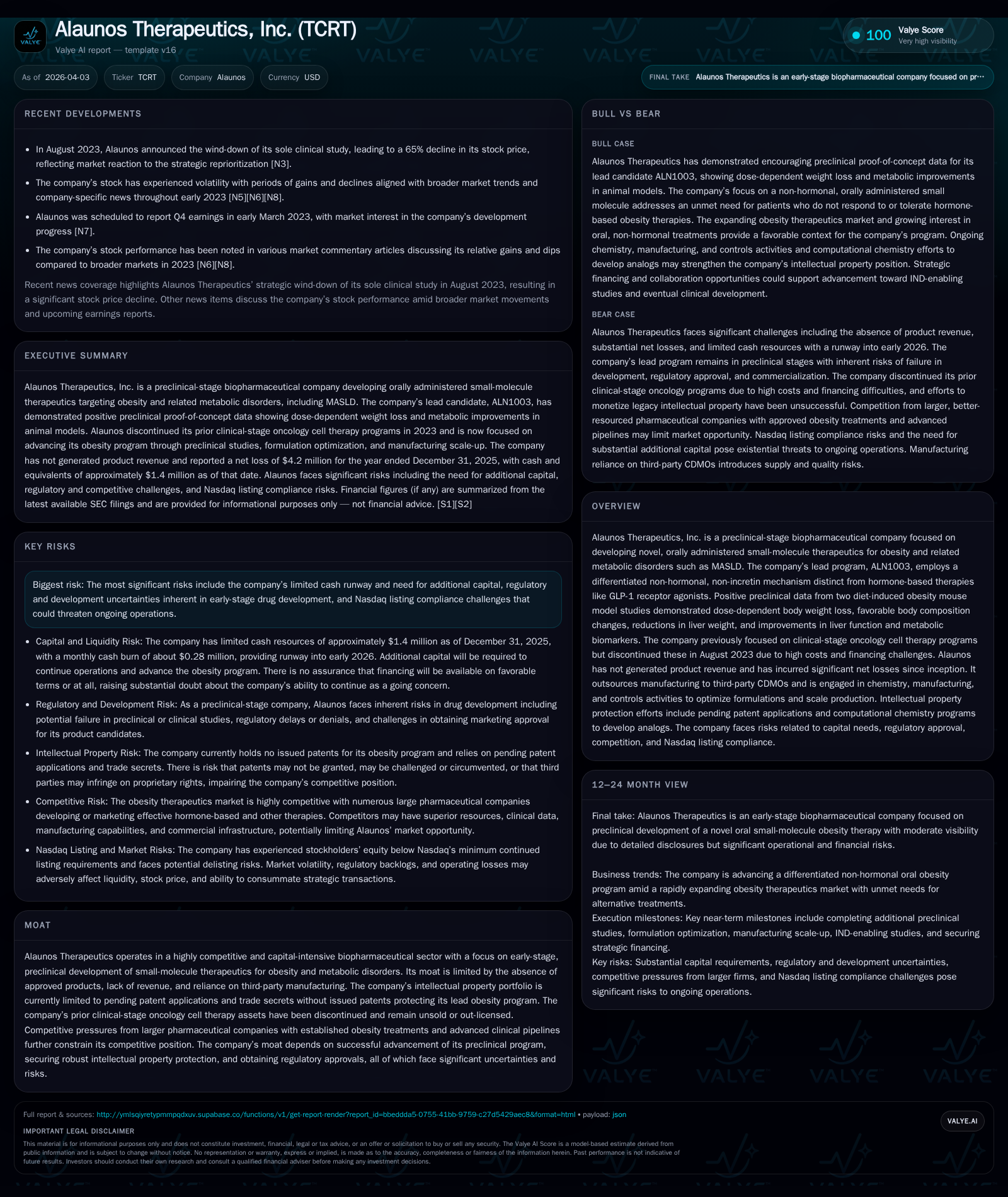
Alaunos Therapeutics, Inc. has transitioned from oncology-focused cell therapies to developing a novel oral small-molecule candidate for obesity and related metabolic disorders. Its lead compound ALN1003 demonstrated encouraging preclinical efficacy in diet-induced obesity mouse models, including dose-dependent reductions in body weight and improvements in metabolic biomarkers. Despite positive early data, the company faces ongoing financial challenges with a net loss of $4.18 million in 2025, limited cash reserves sufficient only through Q2 2026, and no committed capital. Alaunos operates with a minimal workforce and outsources manufacturing, navigating a competitive landscape dominated by established hormone-based obesity therapies while preparing for IND-enabling studies contingent on additional funding.
Company Background and Strategic Shift
Founded in 2003, Alaunos Therapeutics originally focused on adoptive TCR-T cell therapies in oncology but underwent a strategic reprioritization announced in August 2023 [S1]. This shift discontinued clinical oncology trials and reduced the workforce by about 95%, leaving one full-time employee supported by external consultants as of March 2026 [S12]. The company now concentrates solely on a preclinical-stage oral small-molecule program addressing obesity and related metabolic disorders [S1][S12].
Historical Financial Performance
Alaunos has not generated product revenue from commercialization; historical revenues relate to legacy licensing activities with reported figures of $15.9 million from prior years but none recently [F1]. The company reported a net loss of approximately $4.18 million for fiscal year 2025, narrowing from prior years but contributing to an accumulated deficit of about $924.6 million as of December 31, 2025 [F1][S1]. Operating cash flow remained negative at roughly -$2.87 million in 2025 despite stringent cost controls [F1]. Equity declined significantly over recent years to $2.15 million at year-end 2025 [F1]. The following table summarizes key financial metrics:
Historical performance (annual)
| FY | Net ($mm) | CFO ($mm) | OpInc ($mm) | Capex ($) | Net YoY |
|---|---|---|---|---|---|
| 2025 | -4 | -3 | -4 | 98000 | +10.8% |
| 2024 | -5 | -5 | -5 | 0 | +86.7% |
| 2023 | -35 | -30 | -34 | 197000 | +6.9% |
| 2022 | -38 | -29 | -35 | 216000 |
Source: SEC companyfacts cache [F1].
Capital returns and efficiency (annual)
| FY | Buybacks ($) | FCF ($mm) | ROE% |
|---|---|---|---|
| 2025 | -3 | -194.0 | |
| 2024 | -5 | -226.8 | |
| 2023 | 0 | -30 | -557.2 |
| 2022 | 45000 | -29 | -97.9 |
Source: SEC companyfacts cache [F1].
Source: SEC filings and company financial data [F1]
Lead Program ALN1003: Preclinical Evidence
Alaunos' lead asset ALN1003 is an orally administered small molecule targeting obesity through a non-hormonal mechanism distinct from hormone-based treatments like GLP-1 receptor agonists [S1][S12]. Two independent non-GLP diet-induced obesity (DIO) mouse studies conducted in late 2025 demonstrated dose-dependent body weight reductions reaching peak losses near 13% relative to controls, preservation of lean mass alongside fat reduction, decreased liver weight, improved liver function biomarkers, and favorable metabolic biomarker shifts [S1][S3]. These findings support ongoing formulation optimization and planned IND-enabling studies.
Manufacturing and Intellectual Property
The company outsources manufacturing entirely to third-party CDMOs specializing in small-molecule APIs [S13][S23]. While this model reduces fixed costs, it presents risks related to supply chain continuity, quality control, and regulatory compliance common among emerging biopharmaceutical firms.
Regarding intellectual property, Alaunos holds primarily pending patent applications and trade secrets for its obesity program; legacy patents related to TCR-T oncology programs remain but are not actively pursued commercially [S11][S23]. The competitive patent landscape in obesity therapeutics is crowded with established pharmaceutical companies holding robust portfolios, posing challenges to securing exclusive rights [S15]. Potential patent infringement claims could result in costly litigation or licensing requirements.
Regulatory Status and Development Outlook
As of early 2026, Alaunos has not submitted an Investigational New Drug application (IND) for ALN1003; current efforts focus on completing IND-enabling toxicology studies, chemistry-manufacturing-controls validation, formulation refinement, and scale-up assessments [S7][S1]. FDA approval will require successful completion of clinical trials following IND clearance.
Pricing and reimbursement uncertainties exist due to growing scrutiny by payors regarding new obesity treatments’ cost-effectiveness compared to established hormone-based therapies [S7]. Market access may be constrained even if regulatory approval is achieved.
Financial Position and Capital Allocation
With approximately $1.39 million in cash as of December 31, 2025, Alaunos projects sufficient liquidity into Q2 2026 absent additional financing [F1][S16]. No committed capital sources exist beyond current reserves; therefore, substantial equity or debt financing or strategic partnerships are needed to fund continued research activities advancing ALN1003 toward clinical development [S16].
The company terminated its engagement with Cantor Fitzgerald as strategic advisor effective January 8, 2026 after unsuccessful attempts to monetize legacy assets or execute alternative transactions [S1][S18]. No dividends or share repurchases have been made recently given persistent losses and capital constraints [F1][S18]. Return on equity remains deeply negative at approximately -194% for FY25 reflecting ongoing investment losses rather than profit generation [F1].
Competitive Landscape
Obesity pharmacotherapy is dominated by large pharmaceutical companies such as Novo Nordisk and Eli Lilly with multiple approved hormone-based agents including GLP-1 receptor agonists widely adopted globally [S12]. These incumbents benefit from extensive resources enabling rapid development timelines, broad geographic reach, payer engagement expertise, manufacturing scale capacity, and strong commercial infrastructure.
Alaunos’ non-hormonal approach seeks differentiation potentially improving tolerability or addressing limitations of hormone therapies but faces significant hurdles for market penetration without demonstrating superior safety or efficacy profiles [S12]. Numerous other biotechs exploring alternative mechanisms further intensify competition.
Key Risks Identified
- Capital Constraints: Limited cash runway without committed financing heightens risk of operational disruption beyond mid-2026 absent successful fundraising or partnerships [S16].
- Regulatory Development Risk: Preclinical stage entails inherent uncertainties including potential failure during clinical development delaying or preventing approvals [S7][S17].
- Intellectual Property Challenges: Pending patents amid a crowded field raise risk of infringement disputes requiring costly defense or licensing agreements [S11][S15].
- Nasdaq Compliance Risk: Ongoing U.S. government shutdown impacts SEC review processes risking filing delays that may imperil exchange listing status if unresolved promptly [S2].
- Competitive Pressure: Established market leaders outspend Alaunos substantially; failure to demonstrate meaningful differentiation may limit strategic partnerships or commercial viability [S12].
- Operational Limitations: Minimal internal staff increases reliance on third-party vendors whose performance affects development timelines and costs [S12].
Milestones To Watch
Investors should monitor:
- Completion of IND-enabling toxicology studies;
- Filing and acceptance of IND application;
- Updates on additional preclinical efficacy and safety data;
- Strategic partnership or financing announcements extending runway;
- Timely SEC filings preserving Nasdaq listing eligibility;
- Market developments within non-hormonal obesity therapeutic space.
Conclusion
Alaunos Therapeutics is navigating a challenging transition from costly clinical immuno-oncology programs toward an early-stage preclinical opportunity targeting obesity with differentiated non-hormonal mechanisms. While promising animal data validate initial pharmacological activity of ALN1003, substantial scientific risk remains before clinical proof-of-concept can be established. The company’s limited financial resources impose pressing capital requirements with a runway into mid-2026 absent new funding sources. Its minimal internal infrastructure combined with reliance on external manufacturing partners underscores operational vulnerabilities amid intense competition from well-resourced incumbents dominating the obesity treatment market. Prospective investors should weigh these factors carefully alongside upcoming developmental milestones.
This report synthesizes publicly available information from SEC filings as of April 2026 ([S1], [S2], [S3], etc.) and company financial data snapshots ([F1]). It does not constitute investment advice.
Disclaimer: This is research-only, informational analysis and not investment advice. It may include AI-generated interpretation and general industry context. Always verify important details using primary sources.

Comments