
New Providence Acquisition Corp. III: Early SPAC Performance and the Road to its Abra Merger
NPAC’s strong IPO capital raise and experienced management underpin its strategic pursuit of a business combination with Abra, amid inherent SPAC risks.
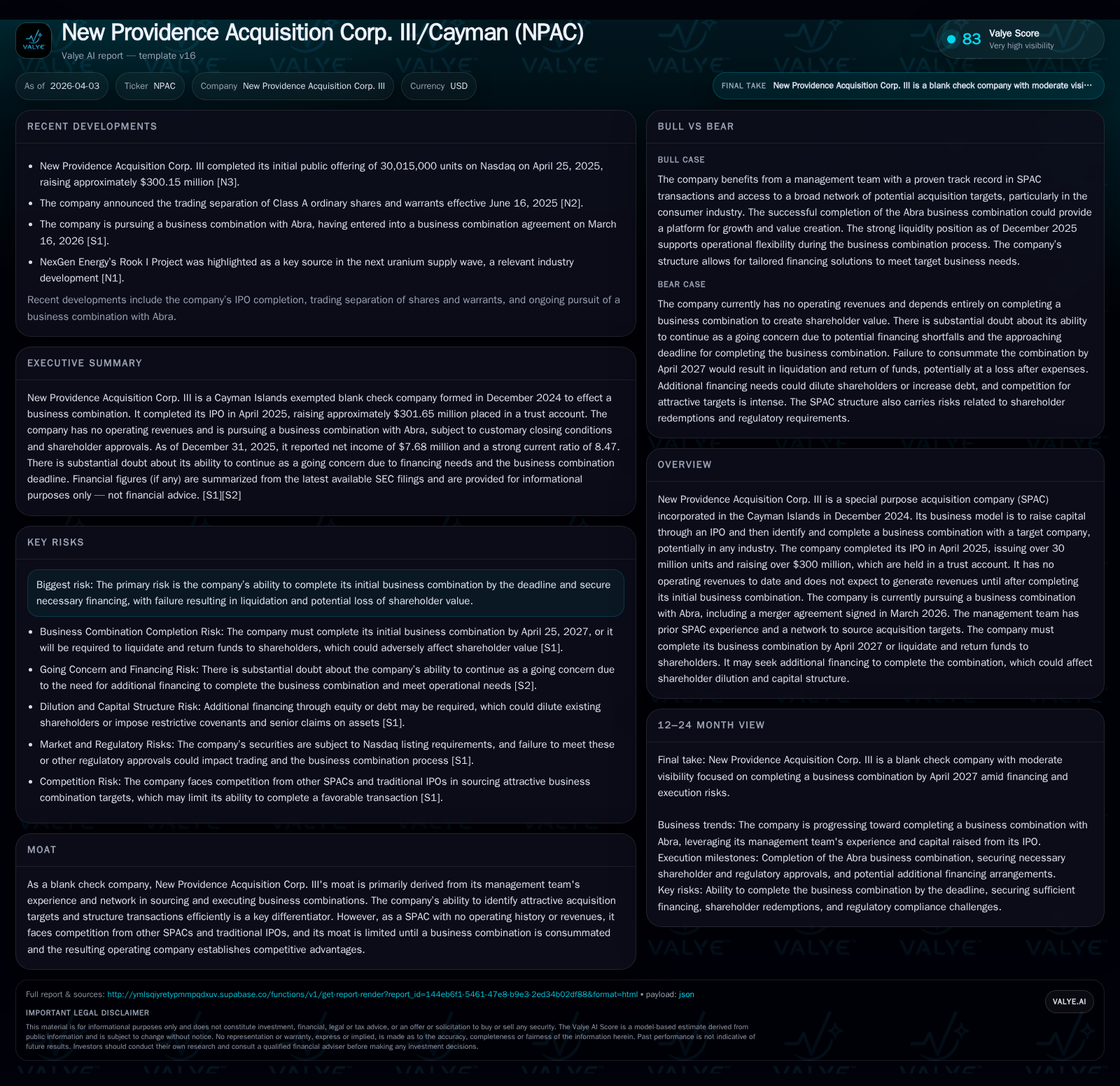
New Providence Acquisition Corp. III (NPAC), a Cayman Islands-incorporated SPAC, completed a successful IPO in April 2025, raising over $300 million to finance an initial business combination. With no operating revenues so far, its value proposition hinges on the proven deal sourcing and execution capabilities of its management team. The company has a signed merger agreement with Abra as of March 2026, targeting completion by April 2027; failure to consummate the deal would lead to liquidation. Prior to closing, NPAC’s capital is securely held in a trust account under strict regulatory frameworks with shareholder redemption rights playing a crucial role. Monitoring key milestones like shareholder approval votes and redemption activity will be essential to assess NPAC’s path forward.
Foundation Laid: IPO Capital Raise and Initial Operational Setup
New Providence Acquisition Corp. III was incorporated in December 2024 as an exempted Cayman Islands company formed exclusively as a blank check entity with the objective of effecting an initial business combination.[S1] The company completed its initial public offering shortly after incorporation, on April 25, 2025, issuing approximately 30 million public units (each unit comprising one Class A ordinary share plus one-third of a warrant) at $10 per unit.[S1] Including the full exercise of the over-allotment option and concurrent private placement units sold to its Sponsor and Cantor at identical prices, NPAC raised total gross proceeds exceeding $301.65 million.[S1] This pool of capital was immediately placed into a trust account administered by Continental acting as trustee,[S1] which constitutes the primary source of funds for any eventual business combination.
Given NPAC's nature as a special purpose acquisition company, it has not generated operating revenues since inception and does not expect to do so until after completing its merger with an identified target.[S1] The corporate activities mainly cover organizational setup, compliance activities related to its IPO, and search efforts for suitable acquisition candidates. Therefore, NPAC’s startup phase is typical of SPAC entities—capital secured but operational track record yet to be established.
Leveraging Management Expertise and Network Advantages
NPAC’s moat largely derives from its seasoned management team headed by co-Chairmen and co-CEOs Alexander Coleman and Gary P. Smith.[S1],[S14] Both have extensive track records in the SPAC industry, having previously led New Providence Acquisition Corp. I and II. These earlier vehicles successfully executed de-SPAC transactions, notably with AST SpaceMobile LLC through NPA I.[S14]
The management team leverages proprietary deal-sourcing networks within consumer sectors spanning private equity firms, investment bankers, operators, and long-standing industry contacts. Their ability to identify undervalued targets coupled with expertise in structuring efficient business combinations differentiates NPAC from many competitors in the increasingly crowded blank check space.[S14]
This experience facilitates rigorous due diligence processes and transaction negotiation that accommodates diverse deal structures — from majority ownership acquisitions to tailored equity-plus-cash considerations designed for specific seller needs — underscoring flexibility vital for closing complex agreements.[S5],[S17]
Assessment of Risks: Completion Deadline and Financing Challenges
Inherent risks tether tightly to NPAC's mandate stipulating consummation of an initial business combination by April 25, 2027 — commonly referred to as the “Combination Period.”[S1],[S21] Failure to close a transaction by this date would trigger mandatory liquidation whereby funds held within the Trust Account are returned pro rata to public shareholders minus dissolution expenses.[S1],[S29]
Furthermore, NPAC acknowledges substantial doubt about its ability to continue as a going concern given potential requirements for additional financing beyond trust assets.[S2] While the available cash is currently ample for pursuing deals reflecting enterprise values near or above $300 million,[S17] financing challenges may arise if redemptions significantly reduce net available proceeds or if additional capital injections become necessary to satisfy minimum cash conditions imposed by target shareholders or lenders.[S19]
The company retains discretion regarding whether it seeks shareholder approval prior to consummating business combinations or opts instead for tender offer mechanisms consistent with SEC tender offer rules.[S4],[S10],[S16] In addition, sponsor-led share purchases can influence redemption demand dynamics but are subject to regulatory oversight (e.g., Rule 10b-18 safe harbor provisions).[S7],[S9]
The Abra Merger Agreement: Expected Benefits and Structural Details
On March 16, 2026, NPAC announced execution of a definitive merger agreement with Abra,[N1],[S3] marking a critical milestone towards de-SPACing. The transaction offers multiple benefits compared with a traditional IPO route: expedited timeline, reduced underwriting and marketing expenses, enhanced pricing certainty, and post-merger liquidity advantages via public listing access.[S5]
Abra’s business profile complements NPAC’s strategic target criteria focused on consumer sector growth opportunities while retaining flexibility for capital structuring — including cash payments combined with issuance of Class A ordinary shares — facilitating tailored consideration customized for Abra’s stakeholders’ preferences.[S5],[S19]
Upon closing, post-combination corporate governance protocols such as lock-up agreements among sponsors/stockholders,[S14] revised registration rights,[S14] and non-compete arrangements will come into force ensuring orderly integration phases.
Unrealized Revenues: Constraints Before Business Combination Completion
As is standard with all blank check companies formed solely for effecting mergers,[S1] NPAC has neither generated nor expects operating revenues before consummation of its initial business combination.[F1],[S1] This operational void imposes valuation constraints wherein market participants evaluate NPAC primarily on sponsor credibility, trust account reserves net of redemptions, and anticipated synergies or growth following de-SPAC completion rather than traditional operating metrics.
Capital Allocation Strategy: Trust Account Stewardship and Sponsor Activities
Funds raised via IPO plus Private Placement Units remain segregated within an invested Trust Account safeguarding investor capital untapped during pre-merger phases except for limited permissible fees or taxes.[S1],[S4],[S20]
Sponsor-led transactions with existing public shareholders allow strategic purchase of Public Shares/potential tender offers before merger closure that may increase likelihood of successful transaction vote approval or fulfill minimum net worth prerequisites without using Trust Account funds.[S7],[S9],[S23]
These purchases are executed under strict SEC compliance frameworks including Regulation M restrictions on market manipulation and reporting obligations under Sections 13 &16 of Exchange Act.[S9],[S23]
While these maneuvers can reduce publicly traded float — potentially affecting liquidity — they serve tactical functions by aligning stakeholder interests ahead of merger finalization while preserving cash required for redemptions or deal closing obligations.
Performance Snapshot: Historical Financials and Key Ratios
At December 31, 2025 year-end — roughly eight months post-IPO — New Providence Acquisition Corp. III reported negative operating income at roughly -$669 thousand yet positive net income attributable largely to non-operating gains totaling about $7.68 million.[F1]
Current assets stood near $810 thousand against current liabilities approximating $95.7 thousand resulting in robust current ratio (~8.47), illustrating ample short-term liquidity amidst minimal operating activity.[F1]
The approximate return on equity (ROE) calculated from available data shows negative return (-63.6%), reflective primarily of capital structure distortions characteristic of pre-combination shell entities rather than operational performance deficits.[F1]
Historical performance (annual)
| FY |
|---|
| 2025 |
Source: SEC companyfacts cache [F1].
NPAC’s financials confirm typical SPAC operational profiles characterized by cash-heavy balance sheets supporting merger pursuits rather than intrinsic earnings.
Indicators To Watch: Milestones Leading to Business Combination Closure
Critical upcoming events include shareholder meetings aimed at approving the Abra Business Combination proposal alongside deadlines associated with public shareholder redemption elections.[N1],[S3],[S10]
Proxy materials will clarify procedural requirements such as physical or electronic surrender of shares ahead of vote dates—often requiring adherence up to two business days prior—ensuring accurate tallying aligned with Securities Exchange Act proxy solicitation regulations.[S10],[S25]
Redemption outcomes could materially influence available cash pools; if excessive redemptions occur surpassing available funds plus minimum cash thresholds required by Abra shareholders under the merger agreement,[S19] NPAC faces risk of transaction collapse forced liquidation instead.
Regulatory filings also note potential extension procedures subject to shareholder approvals should timing pressures emerge close to combination period expiry around April 2027,[S21] where dilution risks from additional issuances or convertible debt could increase accordingly if new financing is necessitated beyond trust reserves.[S17],[S26]
SPAC Specific Considerations: Shareholder Dynamics and Redemption Mechanics
Pre-merger shareholder redemption elections empower public investors seeking liquidity options independently from voting decisions influencing combination approvals—shareholders may redeem their shares irrespective of their vote cast on the proposed transaction.[S21],[S26]
Sponsor and insiders possess rights—under carefully defined regulatory guardrails—to initiate secondary market transactions acquiring public shares from redeeming shareholders provided they comply with Rule 10b-18 safe harbor provisions regarding timing/pricing limits,[S7],[S9],[S23] thus allowing dynamic float adjustments potentially smoothing deal progression.
Such transactions cannot utilize Trust Account proceeds directly nor confer voting rights upon sponsor-held shares purchased under these arrangements ensuring separation between financial incentives versus governance impacts is maintained consistent with SEC frameworks promoting equitable treatment among investors.[S7],[S23]
Ultimately, these mechanics form an essential regulatory layer balancing capital deployment flexibility against protecting retail investor interests during typically volatile pre-deal trading environments.
This analysis uses publicly filed financial statements [F1], U.S. Securities & Exchange Commission disclosures [S#], and recent news reports [N#]. It aims solely to examine New Providence Acquisition Corp. III’s corporate profile, financial backdrop, merger prospects with Abra, attendant risks particular to SPAC entities incorporated in Cayman Islands jurisdictional regime without offering investment advice or recommendations.
Disclaimer: This is research-only, informational analysis and not investment advice. It may include AI-generated interpretation and general industry context. Always verify important details using primary sources.

Comments